

William Gaatjes
Lifer
I just noticed this video. And fast forward to this combustion engine idea.
What i miss here, are two opposing combustion chambers instead of the single combustion chamber in the video.
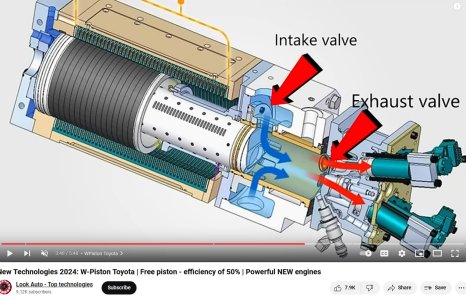
If the designer / inventor would make a version that has 2 two opposing combustion chambers...
Then the resulting forces combustion forces would oppose each other of course in a sequence one after the other, driving the magnet from left to right. And right to left.
Creating a more homogenous magnetic field change over time through the electrical wiring of the coil.
What do you guys and galls think about this engine design ?
And what do you guys and galls think about a design version with two opposing combustion chambers ?
Could this be more efficient than for example a rotational opposed piston combustion engine with an optimized alternator ?
Normally there is a flywheel in engine designs but a Spanish designer company called INNengine claims that an engine without flywheel is also possible as long as the piston follow each other sequentially in a fast pace.
Video, i took the screenshot from :
For more information about opposed piston engines like from INNengine and Achates power.
See this post on another section of the forum.
What i miss here, are two opposing combustion chambers instead of the single combustion chamber in the video.
If the designer / inventor would make a version that has 2 two opposing combustion chambers...
Then the resulting forces combustion forces would oppose each other of course in a sequence one after the other, driving the magnet from left to right. And right to left.
Creating a more homogenous magnetic field change over time through the electrical wiring of the coil.
What do you guys and galls think about this engine design ?
And what do you guys and galls think about a design version with two opposing combustion chambers ?
Could this be more efficient than for example a rotational opposed piston combustion engine with an optimized alternator ?
Normally there is a flywheel in engine designs but a Spanish designer company called INNengine claims that an engine without flywheel is also possible as long as the piston follow each other sequentially in a fast pace.
Video, i took the screenshot from :
For more information about opposed piston engines like from INNengine and Achates power.
See this post on another section of the forum.
Ways to clean up pollution and live in a good climate.
Hi all, I though it would be a good idea to place some good information here. Over the years i learned al ot about how life works form microscopic to macroscopic... The planet , the climate. How the weather changes because of all kind of events that come up in daily life all over the planet and...
forums.anandtech.com


