
-
We’re currently investigating an issue related to the forum theme and styling that is impacting page layout and visual formatting. The problem has been identified, and we are actively working on a resolution. There is no impact to user data or functionality, this is strictly a front-end display issue. We’ll post an update once the fix has been deployed. Thanks for your patience while we get this sorted.
You are using an out of date browser. It may not display this or other websites correctly.
You should upgrade or use an alternative browser.
You should upgrade or use an alternative browser.
Info 64MB V-Cache on 5XXX Zen3 Average +15% in Games
Page 15 - Seeking answers? Join the AnandTech community: where nearly half-a-million members share solutions and discuss the latest tech.

moinmoin
Diamond Member
I think the argument is rather that subsidies are wasted on Intel. After all as you said Intel didn't show to have the right people in the right places and for a long time preferred to spend its own money on buybacks instead on solving its long term issues (like getting/retaining the right people). Intel's issue never has been money, so why should it receive subsidies from tax payers?I think the argument that Intel wasted all their money on buybacks is specious. Yes, they bought back a ton of stock. But they also invested plenty in building fabs and developing new processes. Lack of investment is not the reason they fell behind, they spent more than enough to keep up. They just didn't have the right people in the right places
HurleyBird
Platinum Member
Going for an epeen win, price be darned is a strategy I really don't think AMD is going to play into.
If your halo product is going to look embarrassing compared to the competition that's one thing, but if your halo product can win, you should always release it... and you should always aim to win. Jensen Huang's pathological need to win has made Nvidia what it is today. On the other side of the coin, AMD's old "sweet spot" strategy single-handedly lost them a generation when they had a nearly 2x perf/mm2 advantage.


Asterox
Golden Member
Honestly, I do not think Zen3d will be their halo product for long, if at all. Zen4 should be faster. In fact, I expect that Zen4 (and/or a refresh of Zen4) would be faster than Raptor Lake.
It is expected, but it should be noted that 3D V-Cache is a very simple/elegant way(if we turn a blind eye to cost and production implementation) to considerably increase CPU performance.The jump in gaming performance is pretty big.

Most of the estimates are for October launch for Alder Lake.
With addition of DDR5 and motherboards and Windows 11, all having to be available, I don't think Alder Lake will be a huge seller in Q4. Just too many prerequisites all having to come true all at once.
But I think it is as much a battle for mind share as it is for market share.
Yeah, some info will start trickling out...
For Intel, launch and availability are two different things. If it launches in October, you are looking at December-January for availability.
I think the argument is rather that subsidies are wasted on Intel. After all as you said Intel didn't show to have the right people in the right places and for a long time preferred to spend its own money on buybacks instead on solving its long term issues (like getting/retaining the right people). Intel's issue never has been money, so why should it receive subsidies from tax payers?
If the US is trying to attract others to build fabs in the US, like TSMC, it can't very well exclude Intel from the same subsidies. After all, Intel has fabs in other countries and if they get subsidies from them they would simply build fabs overseas instead of in the US. Multinationals like Intel don't care about the strategic needs of the US, they care only about what is most profitable.
I agree that subsidies targeted at Intel or that would only be available to Intel may not be wise. But if you want TSMC and Samsung to invest in US based fabs, it is pretty hard to write laws that would exclude Intel from those same subsidies.
The Hyperscalers are the customers AMD is having the most success with, as far as market penetration, and other segments are much slower to move. The other segments don't have discounts as deep as hyperscalers.
This was true of Zen 1 and Zen 2 up to a point, but that is changing. AMD is having much more success now with Zen 2 and Zen 3 in getting Enterprise and HPC sales.
AMD kept throwing silicon at the EPYC chips as long as performance kept scaling well and until the power limit was hit. AMD didn't decide to randomly stop half way.
No they didn't. If they wanted to throw more silicon at Epyc they easily could have. Each chiplet is only ~80 mm2 and there is room left on the interposer, they easily could have made each CCD bigger but they chose not to.
BTW, the cost of that SRAM silicon is most likely lower than cost of the IO die silicon, per mm2.
Do you have any calculations for this?
I don't think yields will be an issue at all.
TSMC is getting excellent yields on N7, even better on N6. SRAM will get as close to 100% as you can get. Only good die are entering assembly, and there will most likely be way to isolate and disable bad layers.
I'm not talking about the yield of the dice themselves but the yield of the stacking. We don't know what the yield is like through this process, but whatever it is, it is going to be significantly worse the more stacks that are added relative to 1 stack.
Having problem yielding good dies means you don't have a lot f silicon to throw at the problem.
No, it just means your costs go up to get working silicon which is the whole point. Companies could keep adding silicon to increase performance but they have to take into account not only the cost of the added silicon, but the hit in yields as the dice grow bigger. That's the whole reason AMD went chiplets in the first place. Stacking happens because continuing to grow horizontally on the substrate is no longer practical at some point both in power and cost, so stacking becomes the superior option, but it will still be lower yielding than not stacking and stacking 4 hi will be lower yielding than 1 hi, etc.
It has been only a year since AMD became very profitable. A lot of the decisions about product line up and risk profile of products were made when AMD was much poorer, and the market share in more lucrative segments was very low. So AMD did not have a lot of options as far as buying up risk production at TSMC.
AMD has technically been profitable since the beginning of 2018 but that notwithstanding, they still could have bought into risk production and just paid their debts will all of their income from chip sales. What you're saying, however, is that buying into risk production would have cut into their profits despite it giving them a superior product. Doesn't sound like a very good business decision, does it?
AMD is still quite conservative and risk averse about future products.
What most people can't seem to get is that V-Cache is a very low risk, high reward move. AMD can get N5 or even N3 level performance product out of TSMC N7 node.
At this point in time it's probably lower risk, but that doesn't mean going 4 hi on a consumer product is worth the cost. I'm not claiming to know that AMD won't go 4 hi, but given all the factors and constraints in the consumer market, I very much doubt they will.
Nvidia is charging - and successfully selling a gaming graphics card for $1,500. Nvidia is going to ridiculous lengths to get this type of product.
The trick is to have a product.
Nvidia also has sold a $3000 Titan graphics card and it was an absolute failure in terms of consumer success. Even Nvidia has limits as to what they can charge. We also have no idea how the 3090 would have sold if it weren't for the current market conditions and miners who are much less price sensitive than the regular consumers. You can't compare what graphics cards sell for now to pretty much any other computer part in history (except other GPUs during mining runs) as it is a unique situation and these cards are being driven up in price by people who aren't buying them as members of the target consumer market but are being bought as money making machines.
The Halo ADL product with DDR5, released in 2021 is going to destroy Zen 3.
And Zen 4 is more than a year away from today.
I doubt it will destroy Zen 3 but I guess that depends on your definition of destroy. I also said more than a year away from when ADL launches (actual launch, not announced).
Or to keep ASPs from crushing.
Luckily, AMD has a tool in its tool chest with which performance can be increased gradually, with $6 increments, up to the level needed to beat the ADL
Again, I'd like to see your math behind this number.
Based upon your posts in this forum, I just don't think we will see eye to eye on how AMD will/should operate their business. We'll just have to wait and see how far AMD is willing to go and how much they are willing to spend to keep their 'mind share' as the gaming leader despite having only won this mind share less than a year ago and doing just fine without it.
Last edited:
If your halo product is going to look embarrassing compared to the competition that's one thing, but if your halo product can win, you should always release it... and you should always aim to win. Jensen Huang's pathological need to win has made Nvidia what it is today. On the other side of the coin, AMD's old "sweet spot" strategy single-handedly lost them a generation when they had a nearly 2x perf/mm2 advantage.
Nvidia has excellent margins, higher than Intel's despite being a fabless company. AMD has like 20 pp lower GM than Nvidia right now. It is not the same situation. If AMD can convince gamers to pay $1500 for a CPU that is significantly faster at low res/settings and 0% faster at 4K, then sure, go ahead and release it and reap the rewards. I somehow doubt very many people will be willing to make that purchase though.
Another way to look at it, what value does producing the fastest halo product have? Would it be worth it if AMD lost money on each one sold? How much is that 'mind share' worth? At what cost does it stop making sense to make a halo product just to say you have a product that is the best at gaming?
Honestly, I do not think Zen3d will be their halo product for long, if at all. Zen4 should be faster. In fact, I expect that Zen4 (and/or a refresh of Zen4) would be faster than Raptor Lake.
My expectation is the opposite, that Zen 3D will be a Halo product and Zen 4 for desktop will be later then most people expect. And Genoa will probably be released before Ryzen Zen 4
Honestly, I do not think Zen3d will be their halo product for long, if at all. Zen4 should be faster. In fact, I expect that Zen4 (and/or a refresh of Zen4) would be faster than Raptor Lake.
Not sure that they ll ever release a Zen 3 with this cache, probably that it s only a test vehicle since they still had no Zen 4 at hand, in all likelyhood it will be commercialy inaugurated with the latter.
Not sure that they ll ever release a Zen 3 with this cache, probably that it s only a test vehicle since they still had no Zen 4 at hand, in all likelyhood it will be commercialy inaugurated with the latter.
Zen 3D was announced for "High End Ryzen processor"
darkswordsman17
Lifer
Not sure that they ll ever release a Zen 3 with this cache, probably that it s only a test vehicle since they still had no Zen 4 at hand, in all likelyhood it will be commercialy inaugurated with the latter.
I think Lisa straight up said products with it will be out Q4 this year. Unless Zen 4 is WAY ahead of schedule, its gonna be Zen 3.
AnandTech Forums: Technology, Hardware, Software, and Deals
Seeking answers? Join the AnandTech community: where nearly half-a-million members share solutions and discuss the latest tech.
www.anandtech.com
Update: June 1st:
In a call with AMD, we have confirmed the following:
- This technology will be productized with 7nm Zen 3-based Ryzen processors
I think Lisa straight up said products with it will be out Q4 this year. Unless Zen 4 is WAY ahead of schedule, its gonna be Zen 3.
She said production would start, not be out.
I think Lisa straight up said products with it will be out Q4 this year. Unless Zen 4 is WAY ahead of schedule, its gonna be Zen 3.
See the bottom:AnandTech Forums: Technology, Hardware, Software, and Deals
Seeking answers? Join the AnandTech community: where nearly half-a-million members share solutions and discuss the latest tech.www.anandtech.com
Productized mean produced.?.
Curious since there is only one year or so left before Zen 4 is to be released, that would make a 6 months production window.
I think Lisa straight up said products with it will be out Q4 this year. Unless Zen 4 is WAY ahead of schedule, its gonna be Zen 3.
See the bottom:AnandTech Forums: Technology, Hardware, Software, and Deals
Seeking answers? Join the AnandTech community: where nearly half-a-million members share solutions and discuss the latest tech.www.anandtech.com
According to TSMC roadmap, N5 stacking will be available about 1 year after N7, so Zen 4 could be either without 3D stacking or is 1+ year away.
I think there is a high likelihood that Zen 4 will have 3D stacking and will wait until TSMC has it available.
For Intel, launch and availability are two different things. If it launches in October, you are looking at December-January for availability.
Well, Intel can launch 14nm parts. Rocket Lake had decent availability from the outset.
10nm Ice Lake - not so great. Poor availability and a lag after announcement.
On 10nm Alder Lake, I have a feeling that the scaled down number of SKUs launching in 2021 will have ok availability - just a guess.
HurleyBird
Platinum Member
Another way to look at it, what value does producing the fastest halo product have? Would it be worth it if AMD lost money on each one sold? How much is that 'mind share' worth? At what cost does it stop making sense to make a halo product just to say you have a product that is the best at gaming?
It just might be worth it, but it's obviously not the situation where AMD would come close to losing money.
During the RV770/G200 generation, Nvidia's top die was 2.25x larger than AMD's, and beat it by ~10%. Prior to that generation, commanding a 2X perf/mm2 advantage guaranteed market domination. R300 single handedly made ATI the market leader. Ditto G80 for Nvidia. And neither of those examples had anything like a ~2x perf/mm2 advantage. Nvidia won that gen because they made the fastest product they could. AMD lost that gen because of people who thought the same way you are thinking now.
If you don't see that mindshare matters a hell of a lot, you haven't been paying attention.
If the US is trying to attract others to build fabs in the US, like TSMC, it can't very well exclude Intel from the same subsidies. After all, Intel has fabs in other countries and if they get subsidies from them they would simply build fabs overseas instead of in the US. Multinationals like Intel don't care about the strategic needs of the US, they care only about what is most profitable.
I agree that subsidies targeted at Intel or that would only be available to Intel may not be wise. But if you want TSMC and Samsung to invest in US based fabs, it is pretty hard to write laws that would exclude Intel from those same subsidies.
It should be very easy: On US soil = qualifies.
Which means Intel, Global Foundries, Samsung, TSMC would all qualify. Advanced assembly plants should also get credit.
If national security is to be a consideration, shipping a die to China for assembly is not going to be helping a lot in that regard.
It just might be worth it, but it's obviously not the situation where AMD would come close to losing money.
During the RV770/G200 generation, Nvidia's top die was 2.25x larger than AMD's, and beat it by ~10%. Prior to that generation, commanding a 2X perf/mm2 advantage guaranteed market domination. R300 single handedly made ATI the market leader. Ditto G80 for Nvidia. And neither of those examples had anything like a ~2x perf/mm2 advantage. Nvidia won that gen because they made the fastest product they could. AMD lost that gen because of people who thought the same way you are thinking now.
If you don't see that mindshare matters a hell of a lot, you haven't been paying attention.
You didn't answer my question. What is the value of this mind share and how much cost should AMD sink into getting / maintaining it? I agree mind share is worth something, I just don't think its worth going for the top part, no matter the cost.
R300 may have made ATI the market leader in performance, but not in sales, not even close. The legendary 9000 series wasn't even able to do that. When the Radeon HD7000 launched, it was the bigger die and the OC models (later official GHz models released by AMD) beat Nvidia's 680 at the time, all for. . . not much in the end in terms of market share. The time ATI had the lead in market share, they had a smaller die than Nvidia and Nvidia even put out a 6800 Ultra Extreme Edition just to make sure it had a product at the top of the heap but it didn't get them back on top in sales.
To say that Nvidia's market leadership was due to them having a 10% lead with a bigger die I think is naive. There's far more to it than that, especially with GPUs. IMO, Nvidia's dominance has more to do with ATI/AMD's failures in the past than making sure they have that last little 10% lead at the top.
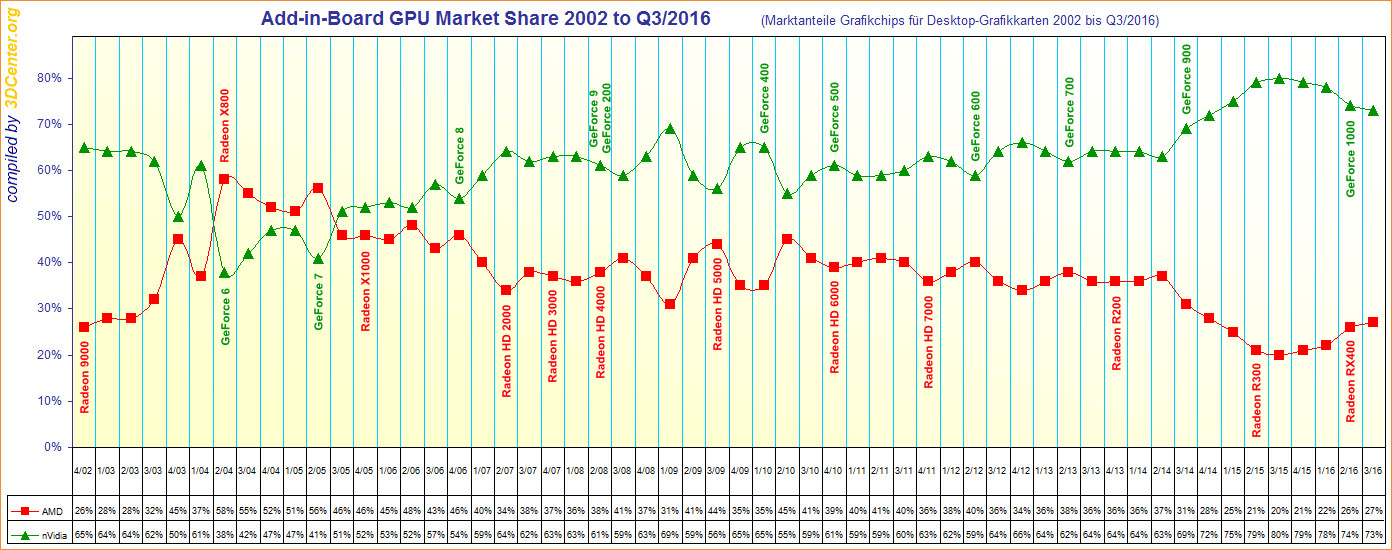
AMD and NVIDIA Add-in-Board GPU Market Share from 2002 to Q3/2016
The folks over at 3dcenter.org have compiled comprehensive historical GPU AIB market share data for our digestion. While we recently reported on Q3'16 and its comparison to the quarter before and the same period last year, this information spans a near 14 year quarter-on-quarter time frame. The...
All of this, though, is really a tangent as the GPU and CPU markets, even for gaming, are different beasts.
HurleyBird
Platinum Member
You didn't answer my question. What is the value of this mind share and how much cost should AMD sink into getting / maintaining it? I agree mind share is worth something, I just don't think its worth going for the top part, no matter the cost.
If it weren't for the real world example of Nvidia, which always goes for the top spot no matter the cost, and is now a 500B dollar company, I might agree.
R300 may have made ATI the market leader in performance, but not in sales, not even close. The legendary 9000 series wasn't even able to do that.
Yes it did. You're misreading the chart. When the X800 series launched, ATI had close nearly 60% market share. After the launch, ATI slowly lost market share share since Geforce 6 was more impressive, but remained the leader via momentum.
Keep in mind when reading the chart that only the start of each generation is labelled, and a lot of movements correlate with mid-generation refreshes.
Admittedly, it wasn't R300 or R400 that made ATI the market leader at the time, it was Half Life 2. Without that, ATI might have ended the R300 generation around 50% share (maybe a bit lower), and then immediately lost their co-leadership position after the R400/Geforce6 launch.
When the Radeon HD7000 launched, it was the bigger die and the OC models (later official GHz models released by AMD) beat Nvidia's 680 at the time, all for. . . not much in the end in terms of market share.
The GHz model didn't beat the 680. It jockeyed for position while consuming much more power with (crucially) a much worse fan profile. If the 7970 (GHz or otherwise) had convincingly beat (or even convincingly tied) the 680, Nvidia had GK100 waiting in the wings.
To say that Nvidia's market leadership was due to them having a 10% lead with a bigger die I think is naive. There's far more to it than that, especially with GPUs. IMO, Nvidia's dominance has more to do with ATI/AMD's failures in the past than making sure they have that last little 10% lead at the top.
At that point in time, the one and only failure was R600 relative to G80. And GT200 would have been a greater failure relative to a hypothetical big-RV770 than that was.
All of this, though, is really a tangent as the GPU and CPU markets, even for gaming, are different beasts.
If anything, the psychological aspect is more important in the current CPU market than it was in the historical GPU market. You don't topple a behemoth by allowing it to retake mindshare when you're able to blunt it from doing so.
If it weren't for the real world example of Nvidia, which always goes for the top spot no matter the cost, and is now a 500B dollar company, I might agree.
You still haven't answered the question or given any kind of value or opportunity cost for achieving this top halo spot.
Yes it did. You're misreading the chart. When the X800 series launched, ATI had close nearly 60% market share. After the launch, ATI slowly lost market share share since Geforce 6 was more impressive, but remained the leader via momentum.
I think you're misreading the chart. This is quarterly sales figures, not accumulated sales or total user base which is what Steam Hardware Survey tries to show.
Keep in mind when reading the chart that only the start of each generation is labelled, and a lot of movements correlate with mid-generation refreshes.
Sure, doesn't change the end result though.
Admittedly, it wasn't R300 or R400 that made ATI the market leader at the time, it was Half Life 2. Without that, ATI might have ended the R300 generation around 50% share (maybe a bit lower), and then immediately lost their co-leadership position after the R400/Geforce6 launch.
I'm not sure what you're saying here as ATI never broke 50% market share until R400 (x800) launched. Saying that HL2 is why ATI had so much success is fine, but it flies in the face of having the top halo product at all costs mentality.
The GHz model didn't beat the 680. It jockeyed for position while consuming much more power with (crucially) a much worse fan profile. If the 7970 (GHz or otherwise) had convincingly beat (or even convincingly tied) the 680, Nvidia had GK100 waiting in the wings.
You're right, I was remembering the OC models as the 7970 had a ton of OC potential. Even still, when the 7970 launched, it was going against the 580 which it was significantly faster than and came out with the GHz edition to more or less match the 680 after it released. Still, nothing to show for it market share wise.
At that point in time, the one and only failure was R600 relative to G80. And GT200 would have been a greater failure relative to a hypothetical big-RV770 than that was.
ATI had major failures. Not always in the hardware, but in the drivers/software and they carried those failures with them (including through reputation) for years. The original R500 launch was not good but the revised R520 was. The HD6000 series was not great. The HD300 refresh was weak. Even the HD7000 series had a bad driver reputation. Fury and Vega were problematic. If ATI/RTG hadn't faltered so many times in hardware or software through the years, Nvidia wouldn't have dominated nearly as much as they did, but credit to them for executing so well through those same years.
If anything, the psychological aspect is more important in the current CPU market than it was in the historical GPU market. You don't topple a behemoth by allowing it to retake mindshare when you're able to blunt it from doing so.
Intel's missteps were AMD's fortunes. Not to discredit what AMD has done with the Zen generations, not at all, but had Intel executed during those generations, AMD wouldn't be where they are now either. If you think AMD should go all out and disregard costs to retain the top gaming SKU, that's fine, we will just fundamentally disagree how important that is for AMD and how much they should sacrifice to do it, especially when you look at Zen 2 and what AMD was able to do while still being behind Intel in gaming performance.
Nvidia won that gen because they made the fastest product they could. AMD lost that gen because of people who thought the same way you are thinking now.
If you don't see that mindshare matters a hell of a lot, you haven't been paying attention.
This perfectly explains why the Wii was such a commercial failure. If you don't have the biggest and best product you'll be quickly relegated to the pages of history.
You don't topple a behemoth by allowing it to retake mindshare when you're able to blunt it from doing so.
If you think that's what AMD has to do in order to be successful you're sorely misguided in your thinking.
Up until Zen 3 AMD was behind Intel when it came to gaming or absolute top performance in single or low-threaded workloads. Yet despite this they were still seeing growing success.
No they didn't. If they wanted to throw more silicon at Epyc they easily could have. Each chiplet is only ~80 mm2 and there is room left on the interposer, they easily could have made each CCD bigger but they chose not to.
Current generation of interconnect has been a challenge to route through the substrate with 8 chiplets. I don't know if it can be extended in the current form any further, since Genoa will not only require extra 4 to 8 chiplets, the bandwidth should ideally double again.
AMD will have to switch to completely new technology to go forward.
Do you have any calculations for this?
Cutress has a video titled cost of 7nm wafer, and in the middle there is a table showing cost of different technologies. 12/14nm was within 20% of cost of 7nm.
Going from logic die to N6/N7 SRAM die, the cost should be drastically lower than N7 logic die. due to fewer layers of metal and likely use of EUV resulting in fewer processing steps.
I'm not talking about the yield of the dice themselves but the yield of the stacking. We don't know what the yield is like through this process, but whatever it is, it is going to be significantly worse the more stacks that are added relative to 1 stack.
The question is: can one bad bond kill the entire chip or just 1 layer?
Most likely, it is only a single layer, so the yield is not going to be a big consideration.
BTW, it is funny that people keep mentioning 1 stack. 1 stack is a proof of concept, but AMD and TSMC are clearly not doing this for one stack.
No, it just means your costs go up to get working silicon which is the whole point. Companies could keep adding silicon to increase performance but they have to take into account not only the cost of the added silicon, but the hit in yields as the dice grow bigger. That's the whole reason AMD went chiplets in the first place. Stacking happens because continuing to grow horizontally on the substrate is no longer practical at some point both in power and cost, so stacking becomes the superior option,
That was my point. Intel had a poorly yielding process and only monolithic architecture making thing worse for larger dies. So throwing more silicon results in movement in wrong direction exponentially
AMD starts with very high yielding process and expands with even higher yielding dies.
but it will still be lower yielding than not stacking and stacking 4 hi will be lower yielding than 1 hi, etc.
At this point, a competent manager would ask you: Is it a material difference?
Most people in the know consider it to be a breakthrough technology, people NOT in the know are talking about yield difference between 1 and 2 stacks.
The reason SRAM is known for extremely high yields is the ease of implementation of redundancies.
AMD has technically been profitable since the beginning of 2018 but that notwithstanding, they still could have bought into risk production and just paid their debts will all of their income from chip sales. What you're saying, however, is that buying into risk production would have cut into their profits despite it giving them a superior product. Doesn't sound like a very good business decision, does it?
I think there is another limiting factor - manpower. There were layoffs, and AMD has been staffing back up,
It would be opportunistic to have, say a shrink of Zen 3 to N5, but AMD, with limited staff, has to be more methodical where to put their eggs, into which baskets.
BTW, AMD is doing risk production of SoIC with TSMC. So this one looked like a good bet to AMD leadership.
Nvidia also has sold a $3000 Titan graphics card and it was an absolute failure in terms of consumer success.
A/B testing. Through which NVidia found out it can charge $1,500 for a market leading consumer card.
Even Nvidia has limits as to what they can charge. We also have no idea how the 3090 would have sold if it weren't for the current market conditions and miners who are much less price sensitive than the regular consumers. You can't compare what graphics cards sell for now to pretty much any other computer part in history (except other GPUs during mining runs) as it is a unique situation and these cards are being driven up in price by people who aren't buying them as members of the target consumer market but are being bought as money making machines.
Intel used to charge $1000. And 5950x. is not that far from $1000.
I don't know where the limit is, but Zen 3D seems to be the ideal product to test the waters. Since it can go as far as 8 stacks high.
I doubt it will destroy Zen 3 but I guess that depends on your definition of destroy. I also said more than a year away from when ADL launches (actual launch, not announced).
There may be caveats, but after all the caveats, Alder Lake will be the best performing desktop CPU when you take a cross section of benchmark. And Intel will take the claim of best performing CPU from AMD.
(in absence of Zen 3D)
Again, I'd like to see your math behind this number.
About the AMD being able to add performance in $6 increments until it beats ADL?
The $6 is an extremely conservative estimate for the cost of 36mm2 SRAM die. I think Cutress floated it this one as well. It is more likely half that, and $6 including assembly.
Based upon your posts in this forum, I just don't think we will see eye to eye on how AMD will/should operate their business. We'll just have to wait and see how far AMD is willing to go and how much they are willing to spend to keep their 'mind share' as the gaming leader despite having only won this mind share less than a year ago and doing just fine without it.
It would be quite unimportant if you had a disagreement with a random poster on Internet. But you are not seeing eye to eye with AMD CEO about how to run their business:
You didn't answer my question. What is the value of this mind share and how much cost should AMD sink into getting / maintaining it? I agree mind share is worth something, I just don't think its worth going for the top part, no matter the cost.
Funny that you are speaking about cost of scaling performance at the very point of breakthrough, where the exponential curve was broken into linear.
HurleyBird
Platinum Member
This perfectly explains why the Wii was such a commercial failure. If you don't have the biggest and best product you'll be quickly relegated to the pages of history.
You can't play Wii games on the 360.
If you think that's what AMD has to do in order to be successful you're sorely misguided in your thinking.
You don't need to be perfect to be successful. But if AMD wants to become the market leader for x86 processors they need to cement the perception that they are the market leader. Letting the competition up for air when you don't need to weakens the narrative.
TRENDING THREADS
-
 Discussion Zen 5 Speculation (EPYC Turin and Strix Point/Granite Ridge - Ryzen 9000)
- Started by DisEnchantment
- Replies: 25K
-
Discussion Intel Meteor, Arrow, Lunar & Panther Lakes + WCL Discussion Threads
- Started by Tigerick
- Replies: 25K
-
 Discussion Intel current and future Lakes & Rapids thread
- Started by TheF34RChannel
- Replies: 24K
-

-
