
-
We’re currently investigating an issue related to the forum theme and styling that is impacting page layout and visual formatting. The problem has been identified, and we are actively working on a resolution. There is no impact to user data or functionality, this is strictly a front-end display issue. We’ll post an update once the fix has been deployed. Thanks for your patience while we get this sorted.
You are using an out of date browser. It may not display this or other websites correctly.
You should upgrade or use an alternative browser.
You should upgrade or use an alternative browser.
Info 64MB V-Cache on 5XXX Zen3 Average +15% in Games
Page 106 - Seeking answers? Join the AnandTech community: where nearly half-a-million members share solutions and discuss the latest tech.
carrotmania
Member
Why are people linking GPU-bound results in an argument about CPU gaming performance?
I linked you one of each, 720p is probably not GPU bound, and another to show a different GPU vendor being used, with similar results.

tamz_msc
Diamond Member
i2Hard tests with RT enabled. Unless you enable RT, CP2077 is mostly GPU-bound.I linked you one of each, 720p is probably not GPU bound, and another to show a different GPU vendor being used, with similar results.
nicalandia
Diamond Member
Don't mind him, he is Grasping at Straws because Alder Lake is no longer the Gaming King. We all Knew that, AMD Knew that.. We just need to know just how faster it was.TPU says something you don't like is more accurate.
i2Hard tests with RT enabled. Unless you enable RT, CP2077 is mostly GPU-bound.
So they are the outlier then since nowhere else does use RT for CPU tests. Would be good if other places did to corroborate the tests but without that an outlier result is an outlier result.
tamz_msc
Diamond Member
OK if you don't like CP2077, look at Troy: A Total War Saga. Most people in the benchmarking business have no idea what settings and scenes are CPU or GPU bound because they do not play the games, they're just making content.So they are the outlier then since nowhere else does use RT for CPU tests. Would be good if other places did to corroborate the tests but without that an outlier result is an outlier result.
OK if you don't like CP2077, look at Troy: A Total War Saga. Most people in the benchmarking business have no idea what settings and scenes are CPU or GPU bound because they do not play the games, they're just making content.
Unfortunately I cannot find any Troy memory scaling benchmarks. I see from that YouTuber it seems to like fast ram but these kinds of games don't get tested all that much and that is something that really should change.
EDIT: Of course if it likes fast ram it will probably like L3 Cache since that is 2TB/s so ya know plenty of room for improvement over the standard 5800X.
I suspect we will see at least one product with 170W, more thoughts on this below.I suspect part of it will be used by the new parts out of the gate. Intel pushing their chips beyond 200W let them benchmark a bit better. AMD doesn't need to go nearly that far, but an extra 50W will let them stretch the bars a bit more.
It also gives some extra room for all core boost on the two chiplet parts. Those were constrained a fair bit because when 16 cores all want to use that TDP and there's an IO die to consider as well, 125W doesn't go quite as far as one would think.
There's also the rumors that all of the Zen 4 CPUs will have a small amount of integrated graphics on the IO die this time around. That will add to the power draw if it's being used and they probably want extra room for it.
Eventually they will release Zen 4D parts and the v-cache is going to need to be powered. With the 5800X3D they lowered the boost clocks in part because the TDP needed to stay the same.
So I don't think there's just one reason for the 170W TDP, but a lot of little reasons. We may not even see the initial Zen 4 CPUs use all of that 170W either, but it will be there in case they need it later and it will ensure that boards will support future parts that actually will draw that full amount of power.
I find 170W regrettable but if your competitor is doing it you have to play that game. Really, AMD shouldn't follow but they will because halo parts work with irrational consumer behavior.
But it'll be really neat to see if the 5800X3D is as competitive as AMD claims while not using more power. On a 4 year old process. On an old platform. With old memory.
Intel will do whatever is required to get to number one DIY/OEM, 400W ? 500W ? 12900ks already uses 500w+.
The 5800X3D is showing some decent gains in gaming and a few other areas. Reviews should drop in two days, so we'll see how overall performance is. It will be interesting to see how widespread the lead is over the 12900K/KF.
Regarding AMD and the higher power limits, I suspect AMD doesn't NEED to go to a higher limit, but if Intel is leading the way, adding more breathing room for mult-chiplet products will only help strengthen their lead. I suspect they hope to push Intel up even higher.
Zen 3 was power limited in a number of scenarios, so raising that power limit will help.
nicalandia
Diamond Member
Tunned DDR5 Worth it's salt are very expensive, MB are Very Expensive and 12900KS are very expensive. Can someone do a MB + DDR5 + 12900KS + 3090 Ti build against a Decent AM4 + DDR4 + 5800X3D + 3080 Ti and see what is the actual gaming/price difference?If those results are true, 5800X3D is a killer Gaming CPU at half the price of 12900K. If DDR5 is used the perf/$ is getting even worse for the AlderLake.

Saylick
Diamond Member
That's easily a $500 difference, even if you ignored the GPU.Tunned DDR5 Worth it's salt are very expensive, MB are Very Expensive and 12900KS are very expensive. Can someone do a MB + DDR5 + 12900KS + 3090 Ti build against a Decent AM4 + DDR4 + 5800X3D + 3080 Ti and see what is the actual gaming/price difference?
nicalandia
Diamond Member
Please let's not Ignore the GPU.That's easily a $500 difference, even if you ignored the GPU.
If buying a 5800X3D would allow you to buy a 3080 Ti or 6900XT over a 3090 Ti, that is a game-changer right there.


Det0x
Golden Member
Maxed tweaked regular Zen3i2Hard tests with RT enabled. Unless you enable RT, CP2077 is mostly GPU-bound.
Cyberpunk 2077: 1080p low = ~252 average fps

Maxed tweaked Alder Lake @ ~5.4ghz and DDR5 @ 7100MT/s CL30 getting 304 average at same settings

And for those interested, Troy at same ddr5 7100MT/s CL30

Alder Lake benchmarks done by "Mumriken" from a Norwegian forum.
Last edited:

AtenRa
Lifer
Please let's not Ignore the GPU.
If buying a 5800X3D would allow you to buy a 3080 Ti or 6900XT over a 3090 Ti, that is a game-changer right there.
I believe you have those backwards, 5800XD + DDR4 will allow you to buy a faster GPU for the same price vs 12900KS+DDR5

Makaveli
Diamond Member
I urge you to take a look at the video. TPU looks amateurish compared to them.
i've been on TPU for almost 20 years I trust them before a random youtuber. But we shall see as reviews are coming this thursday.
nicalandia
Diamond Member
Why not both? I mean If buying a 5800X3D would allow you to game the same with a 6900XT than if you would with a 3090 Ti paired with a 12900K then why not?I believe you have those backwards, 5800XD + DDR4 will allow you to buy a faster GPU for the same price vs 12900KS+DDR5
AtenRa
Lifer
Why not both? I mean If buying a 5800X3D would allow you to game the same with a 6900XT than if you would with a 3090 Ti paired with a 12900K then why not?
Ahhh ok now I get it, yes you could say this as well.
If those results are true, 5800X3D is a killer Gaming CPU at half the price of 12900K. If DDR5 is used the perf/$ is getting even worse for the AlderLake.
I'm not sure the price matters to anyone who just wants to buy top performance. If 12900K and DDR5 is on top, it won't matter to people who have to spend an extra $800 or more. They probably already spent at least that much on getting a slightly better GPU than the next best option.
The most compelling case is the other one that has been brought up where if you have a specific budget, going with Zen 3D/DDR4 let's you shift a lot more of that budget to the GPU.
But at the end of the day it will be a halo product to get AMD more mindshare with the general public. Most gamers are going to end up choosing between a 5600 and a 12400, but maybe these top end parts helps sway average consumers a little bit. Unless you're buying a high-end GPU like a 3080 or a 6800XT, you're not going to be held back by a mid-range CPU. The same goes if you're gaming at 4K or even 1440p in most games. The KS and 3D are both wasted there.
Frankly it just makes me even more excited to see what a Zen 4D is capable of doing or if AMD could create an insane APU with v-cache that's accessible by the GPU.
tamz_msc
Diamond Member
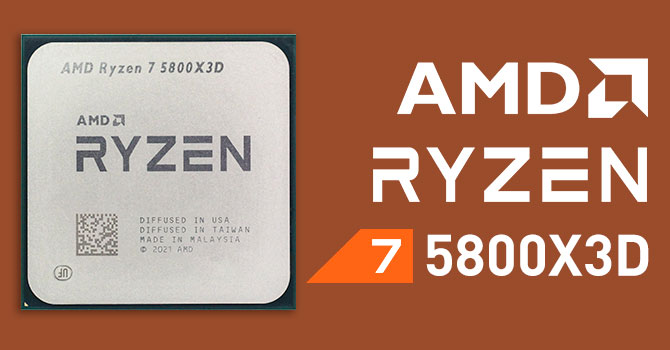
AMD Ryzen 7 5800X3D Review - The Magic of 3D V-Cache
The AMD Ryzen 7 5800X3D is the company's new flagship gaming processor. It introduces 3D V-Cache, a dedicated piece of silicon with additional L3 capacity. In our review, we're testing how much the larger cache can help intensive gaming workloads and applications and compare it to the Intel Core...
It's basically a tie with the 12900K. The biggest gain is in Borderlands 3, and there is a regression in CS:GO (as expected).
Well it's a good CPU, but not something that can claim to be the best gaming CPU.
nicalandia
Diamond Member
Are you Grasping at Straws again? The 5800X3D will be hailed as The New Gaming King...! Until the next new CPU is released. It's going to be a short reign.It's basically a tie with the 12900K. The biggest gain is in Borderlands 3, and there is a regression in CS:GO (as expected).
Well it's a good CPU, but not something that can claim to be the best gaming CPU.
It's basically a tie with the 12900K. The biggest gain is in Borderlands 3, and there is a regression in CS:GO (as expected).
Well it's a good CPU, but not something that can claim to be the best gaming CPU.
Might need a faster GPU than a 3080 😉
Far Cry 5 is also a big improvement. There just might not be enough games where the cache makes a difference. Especially when it must be pretty conservative on clocks.
igor_kavinski
Lifer
The lower clocks are really hurting it. In future iterations, maybe they can put smaller V-cache dies together with dark silicon in between to reduce the thermal impact and keep frequency high.Especially when it must be pretty conservative on clocks.
Saylick
Diamond Member
I got a feeling that the next iteration of V-cache will allow overclocking so the issue of lower clocks is just teething pains associated with implementing V-cache for the first time. Once they get more data/experience with V-cache, I think this will eventually sort itself out. Smaller V-caches won't be necessary.The lower clocks are really hurting it. In future iterations, maybe they can put smaller V-cache dies together with dark silicon in between to reduce the thermal impact and keep frequency high.
nicalandia
Diamond Member
Is there something weird going on with TPU gaming numbers where on 1440 and 4K the older 1090k AND 12400K are often at the top of the chart? GPU Bottle Neck?

igor_kavinski
Lifer
Possibly lower inter-core latency. The E-cores slow down the inter-core communication for the 12900K/KS.Is there something weird going on with TPU gaming numbers where on 1440 and 4K the older 1090k AND 12400K are often at the top of the chart? GPU Bottle Neck?
tamz_msc
Diamond Member
You're looking at a 4K chart and asking the if it isn't a bottleneck?Is there something weird going on with TPU gaming numbers where on 1440 and 4K the older 1090k AND 12400K are often at the top of the chart? GPU Bottle Neck?
View attachment 59908
TRENDING THREADS
-
 Discussion Zen 5 Speculation (EPYC Turin and Strix Point/Granite Ridge - Ryzen 9000)
- Started by DisEnchantment
- Replies: 25K
-
Discussion Intel Meteor, Arrow, Lunar & Panther Lakes + WCL Discussion Threads
- Started by Tigerick
- Replies: 25K
-
 Discussion Intel current and future Lakes & Rapids thread
- Started by TheF34RChannel
- Replies: 24K
-

-
