


- Jun 30, 2003
- 33,603
- 13,299
- 136
So let me preface this with the fact that besides being a budding firearms enthusiast, I'm a materials engineer/metallurgist by training - so I study the science of metals and how the processing, structure, and properties of metals are all related. My specialty is steels, but there's a lot of knowledge that's applicable to all metals, including brass.
Structure, you say? Why yes indeed. Metals actually have a structure to them on the microscopic scale. They're not just one nice big blob of continuous material, even though 99.99% of us consider them that way (even all you structural folks!).
Metals, with few exceptions, are crystalline. The atoms arrange themselves into certain crystal shapes. Most common are body-centered-cubic (BCC) and face-centered-cubic (FCC), but there are others. When you see a giant hunk of metal, it's not one continuous crystal (...unless you happen to be looking at a silicon wafer or a turbine blade). Most metal products we deal with on a day to day basis are composed of millions/billions/trillions of crystals, called grains. Each grain is a crystal with a certain orientation in space. When grains with differing orientations meet, they form a grain boundary.
Now, how do we observe all this? Basically, sand paper, diamonds, a few select chemicals (usually particular acids), and a really nice microscope. You take a piece of metal, polish it to a near-perfect, near-deformation-free surface finish. The polish of your chrome rims? That's got nothing on a proper metallographic sample.
Metallographic samples are generally cut and then ground with progressively finer grits of sand paper (320grit --> 800 or 1200 grit). While 800 and 1200 grit give a nice finish, the sample surface still has a lot of deformation in it. To relieve that, metallographers use very fine diamond and silica (sand) suspensions - I used 6um diamond and 1um diamond. I would have used 0.02um silica, but I needed to clean out the solution, which I didn't feel like doing
For reference, 320 grit is about a ~50um particle size. So 6um diamond is ~10x finer, 1um diamond is ~50x finer, and 0.02um silica is 250x finer. Silica gives an incredible polish, but for my purposes it wasn't necessary. Also, if the silica crystallizes, it forms sand particles, which then scratch the crap out of your otherwise nicely polished sample and you have to start all over.
Shame on me for not taking a picture of my nicely polished sample because it literally has a mirror shine to it. I'll post an update tomorrow.
With an as-polished sample, the one thing that generally can be observed in metal pieces are inclusions - things we don't want in our metal but are there anyway due to things we can't get rid of during processing (or things we don't feel like paying to get rid of).
But if we really want to see the structure, we have to attack our nicely polished sample with acid (or in the case of brass, an ammonia-based solution).
After that is where hella-expensive microscopes come in (as in..people can drop up to $100k on a light-microscope).
Ok, so finally to spring some pictures upon ATOT
I focused down on the base/firing pin area of my 308 cartridge since that's where I spent most of my polishing effort. It looks the nicest, and shows the most interesting stuff.
So here you can see an overview of the cartridge, as-etched
http://pics.bbzzdd.com/users/fenixgoon/00-01-25x.jpg
http://pics.bbzzdd.com/users/fenixgoon/00-02-25x.jpg
http://pics.bbzzdd.com/users/fenixgoon/00-03-25x.jpg
http://pics.bbzzdd.com/users/fenixgoon/00-04-25x.jpg
What you can kind of make out in these pictures are the flow lines in the firing pin area. So when the cartridge is formed, some grains are stretched out or curved. We don't see the actual grains themselves, but all the inclusions (junk) get stretched along too, so that's what the etchant brings out mostly.
Now if we go to the top of the firing pin area, we can really start to see how the brass flowed during the forming process:
http://pics.bbzzdd.com/users/fenixgoon/01-50x.jpg
http://pics.bbzzdd.com/users/fenixgoon/01-100x.jpg
http://pics.bbzzdd.com/users/fenixgoon/01-200x.jpg
http://pics.bbzzdd.com/users/fenixgoon/01-500x-BF.jpg
Sadly, there didn't appear to be much at 500x. Until I used dark field (turns dark things bright and bright things dark).
http://pics.bbzzdd.com/users/fenixgoon/01-500x-DF.jpg
My guess here is that there's so much deformation that the grains are severely stretched out, with a very high aspect ratio (long/thin). Or it could just be my polishing/etching job - I haven't worked with brasses extensively, so I don't know what the best etchants are. I used a general one that's good for a variety of things. Plus I just find this all fun and interesting
I used other imaging modes in this area, but offhand I can't make anything additional out of them. But hey, they still look pretty:
http://pics.bbzzdd.com/users/fenixgoon/01-500x-DIC.jpg
http://pics.bbzzdd.com/users/fenixgoon/01-500x-polarized.jpg
Now, if we move down towards the base area:
http://pics.bbzzdd.com/users/fenixgoon/02-50x.jpg
At the bottom of the cartridge, we can actually start to make out grains since there's not much deformation in this area.
http://pics.bbzzdd.com/users/fenixgoon/03-100x.jpg
http://pics.bbzzdd.com/users/fenixgoon/03-200x.jpg
http://pics.bbzzdd.com/users/fenixgoon/03-500x-BF.jpg
http://pics.bbzzdd.com/users/fenixgoon/03-500x-DF.jpg
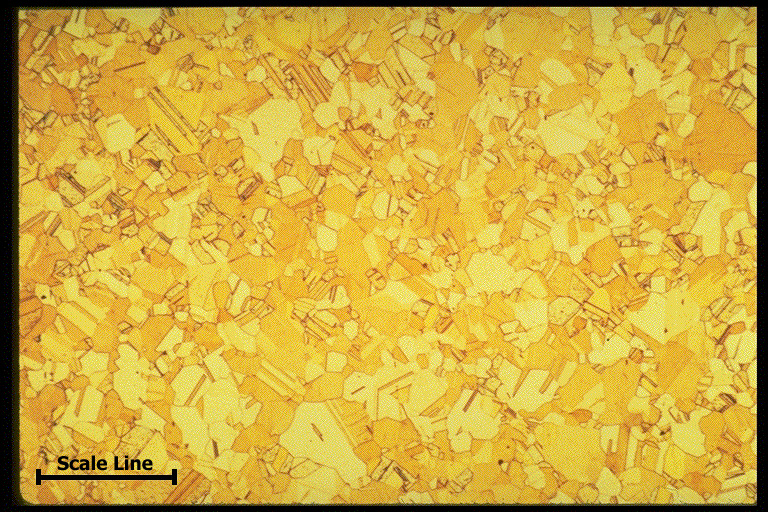
It looks like the grains are about 50um and equiaxed - which means they're roughly the same size in all dimensions (unlike in the firing pin area, where there would be a lot of stretching out of the grains). There also appear to be twins (which we'll ignore for the moment). The other thing we can see in this area is that some areas are lighter than others. This could mean that we have two phases - crystals with two different structures (FCC vs. BCC) and/or composition (say, one that is ~35% zinc vs another that is ~45% zinc).
Not knowing the composition of my cartridge brass offhand, its exact processing history (heat treatment and forming), or having much experience with brasses, I'm hesitant to say what phases we do or don't have. I could find out the composition roughly if I really wanted to, or pay ~$25 to get it exactly since I don't have access to the necessary equipment.
What I can say is that the forming of the cartridge appears to be done after any kind of heat treatment, since some grains are heavily deformed (in the firing pin area) while others at the base are equiaxed.
So, now let's move on to the firing pin area where we can really see the brass flow:
http://pics.bbzzdd.com/users/fenixgoon/00-02-25x.jpg
http://pics.bbzzdd.com/users/fenixgoon/04-50x.jpg
http://pics.bbzzdd.com/users/fenixgoon/04-100x.jpg
http://pics.bbzzdd.com/users/fenixgoon/04-200x.jpg
Aaaaaand that's all I got for now. If you happen to blow up a barrel or something, send it my way and I'll throw it under a microscope for ya when I have spare time
Structure, you say? Why yes indeed. Metals actually have a structure to them on the microscopic scale. They're not just one nice big blob of continuous material, even though 99.99% of us consider them that way (even all you structural folks!).
Metals, with few exceptions, are crystalline. The atoms arrange themselves into certain crystal shapes. Most common are body-centered-cubic (BCC) and face-centered-cubic (FCC), but there are others. When you see a giant hunk of metal, it's not one continuous crystal (...unless you happen to be looking at a silicon wafer or a turbine blade). Most metal products we deal with on a day to day basis are composed of millions/billions/trillions of crystals, called grains. Each grain is a crystal with a certain orientation in space. When grains with differing orientations meet, they form a grain boundary.
Now, how do we observe all this? Basically, sand paper, diamonds, a few select chemicals (usually particular acids), and a really nice microscope. You take a piece of metal, polish it to a near-perfect, near-deformation-free surface finish. The polish of your chrome rims? That's got nothing on a proper metallographic sample.
Metallographic samples are generally cut and then ground with progressively finer grits of sand paper (320grit --> 800 or 1200 grit). While 800 and 1200 grit give a nice finish, the sample surface still has a lot of deformation in it. To relieve that, metallographers use very fine diamond and silica (sand) suspensions - I used 6um diamond and 1um diamond. I would have used 0.02um silica, but I needed to clean out the solution, which I didn't feel like doing
For reference, 320 grit is about a ~50um particle size. So 6um diamond is ~10x finer, 1um diamond is ~50x finer, and 0.02um silica is 250x finer. Silica gives an incredible polish, but for my purposes it wasn't necessary. Also, if the silica crystallizes, it forms sand particles, which then scratch the crap out of your otherwise nicely polished sample and you have to start all over.
Shame on me for not taking a picture of my nicely polished sample because it literally has a mirror shine to it. I'll post an update tomorrow.
With an as-polished sample, the one thing that generally can be observed in metal pieces are inclusions - things we don't want in our metal but are there anyway due to things we can't get rid of during processing (or things we don't feel like paying to get rid of).
But if we really want to see the structure, we have to attack our nicely polished sample with acid (or in the case of brass, an ammonia-based solution).
After that is where hella-expensive microscopes come in (as in..people can drop up to $100k on a light-microscope).
Ok, so finally to spring some pictures upon ATOT
I focused down on the base/firing pin area of my 308 cartridge since that's where I spent most of my polishing effort. It looks the nicest, and shows the most interesting stuff.
So here you can see an overview of the cartridge, as-etched
http://pics.bbzzdd.com/users/fenixgoon/00-01-25x.jpg
http://pics.bbzzdd.com/users/fenixgoon/00-02-25x.jpg
http://pics.bbzzdd.com/users/fenixgoon/00-03-25x.jpg
http://pics.bbzzdd.com/users/fenixgoon/00-04-25x.jpg
What you can kind of make out in these pictures are the flow lines in the firing pin area. So when the cartridge is formed, some grains are stretched out or curved. We don't see the actual grains themselves, but all the inclusions (junk) get stretched along too, so that's what the etchant brings out mostly.
Now if we go to the top of the firing pin area, we can really start to see how the brass flowed during the forming process:
http://pics.bbzzdd.com/users/fenixgoon/01-50x.jpg
http://pics.bbzzdd.com/users/fenixgoon/01-100x.jpg
http://pics.bbzzdd.com/users/fenixgoon/01-200x.jpg
http://pics.bbzzdd.com/users/fenixgoon/01-500x-BF.jpg
Sadly, there didn't appear to be much at 500x. Until I used dark field (turns dark things bright and bright things dark).
http://pics.bbzzdd.com/users/fenixgoon/01-500x-DF.jpg
My guess here is that there's so much deformation that the grains are severely stretched out, with a very high aspect ratio (long/thin). Or it could just be my polishing/etching job - I haven't worked with brasses extensively, so I don't know what the best etchants are. I used a general one that's good for a variety of things. Plus I just find this all fun and interesting
I used other imaging modes in this area, but offhand I can't make anything additional out of them. But hey, they still look pretty:
http://pics.bbzzdd.com/users/fenixgoon/01-500x-DIC.jpg
http://pics.bbzzdd.com/users/fenixgoon/01-500x-polarized.jpg
Now, if we move down towards the base area:
http://pics.bbzzdd.com/users/fenixgoon/02-50x.jpg
At the bottom of the cartridge, we can actually start to make out grains since there's not much deformation in this area.
http://pics.bbzzdd.com/users/fenixgoon/03-100x.jpg
http://pics.bbzzdd.com/users/fenixgoon/03-200x.jpg
http://pics.bbzzdd.com/users/fenixgoon/03-500x-BF.jpg
http://pics.bbzzdd.com/users/fenixgoon/03-500x-DF.jpg
It looks like the grains are about 50um and equiaxed - which means they're roughly the same size in all dimensions (unlike in the firing pin area, where there would be a lot of stretching out of the grains). There also appear to be twins (which we'll ignore for the moment). The other thing we can see in this area is that some areas are lighter than others. This could mean that we have two phases - crystals with two different structures (FCC vs. BCC) and/or composition (say, one that is ~35% zinc vs another that is ~45% zinc).
Not knowing the composition of my cartridge brass offhand, its exact processing history (heat treatment and forming), or having much experience with brasses, I'm hesitant to say what phases we do or don't have. I could find out the composition roughly if I really wanted to, or pay ~$25 to get it exactly since I don't have access to the necessary equipment.
What I can say is that the forming of the cartridge appears to be done after any kind of heat treatment, since some grains are heavily deformed (in the firing pin area) while others at the base are equiaxed.
So, now let's move on to the firing pin area where we can really see the brass flow:
http://pics.bbzzdd.com/users/fenixgoon/00-02-25x.jpg
http://pics.bbzzdd.com/users/fenixgoon/04-50x.jpg
http://pics.bbzzdd.com/users/fenixgoon/04-100x.jpg
http://pics.bbzzdd.com/users/fenixgoon/04-200x.jpg
Aaaaaand that's all I got for now. If you happen to blow up a barrel or something, send it my way and I'll throw it under a microscope for ya when I have spare time
Last edited:





 Facebook
 Twitter