• We’re currently investigating an issue related to the forum theme and styling that is impacting page layout and visual formatting. The problem has been identified, and we are actively working on a resolution. There is no impact to user data or functionality, this is strictly a front-end display issue. We’ll post an update once the fix has been deployed. Thanks for your patience while we get this sorted.

Will AMD design ARM chips?

Will AMD design ARM chips?

  • Yes

  • No


Results are only viewable after voting.

cbn

Lifer
With the announcements of Nvidia Kal-el (Tegra 3), OMAP 5, Qualcomm APQ8064 I thought I would launch this poll.

In my last poll I mistakenly used the word "build" instead of "design" (with respect to AMD and ARM). This poll is an effort to correct that misuse of language in order to gain a better indicator of public sentiment.

Please make your private vote.

EDIT: Maybe AMD can start off at the bottom with Cortex A5 or the upcoming ARM kingfisher (An entry level Cortex A processor a Dell executive claims could be a "game changer") and build a good relationship with all entry level smartphone handset makers?

This would basically undercut all the other major ARM licensees and let AMD work from the bottom up on a mass scale.
 
Last edited:
Why in the hell would they do that? What gain would there by to having to license the ARM instruction set?

Hmmm, let me think, AMD pays ARM to license an instruction set just so they can make a low power CPU? No, absolutely not. Not gonna happen. GlobalFoundries at some point in its life will manufacture ARM chips, but AMD will never license ARM ISAs. I dont think AMD is interested in the smartphone space, dont think the margins are particularly good there and competition is pretty stiff already.
 
Why in the hell would they do that? What gain would there by to having to license the ARM instruction set?

Hmmm, let me think, AMD pays ARM to license an instruction set just so they can make a low power CPU? No, absolutely not. Not gonna happen. GlobalFoundries at some point in its life will manufacture ARM chips, but AMD will never license ARM ISAs.

The hardware may not be that profitable, but it is a place for them to start where the competition may be sparse. (Only one company "CSR" has so far licensed Cortex A5 and they are planning to use the core in GPS rather as an application processor. This makes me wonder if the soon to be announced Cortex A "Kingfisher" may represent opportunity since the rest of the ARM partners probably probably have vested interested in the old ARM11 for low end application processors.)

I dont think AMD is interested in the smartphone space, dont think the margins are particularly good there and competition is pretty stiff already.

That has been the traditional stance of the company, but I wonder if times are changing for them?

Maybe they can make up the lack of profits from hardware (you mentioned in the first part of your response) with software apps, app stores targeted at special version of Kingfisher SOC/APU?
 
Anything AMD would use ARM for will be done by bobcat and its successors.

Bobcat is a big cpu and the higher end ARM ecosystem is already well entrenched with Cortex A8/A9. Furthermore, even Intel doesn't seem to be making much headway in the smartphone department (Nokia recently dropped x86 Meego for ARM WP7).

In contrast, the 40nm Cortex A5 (.27mm2) core I mentioned is ~1/17 the size of the 40nm Bobcat (4.6mm2) core.

With that being said I am still more interested to see what ARM Kingfisher (rather than Cortex A5) will bring? Like I said, I suspect none of the major ARM players will abandon the ARM11 Application processors already in their line-up (due to the costs of a mostly lateral move). But AMD with no existing ARM11 application processor would have nothing to lose.

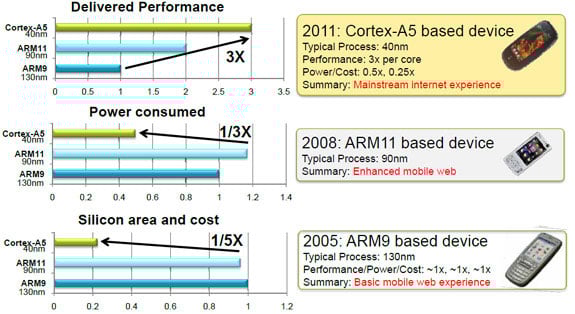
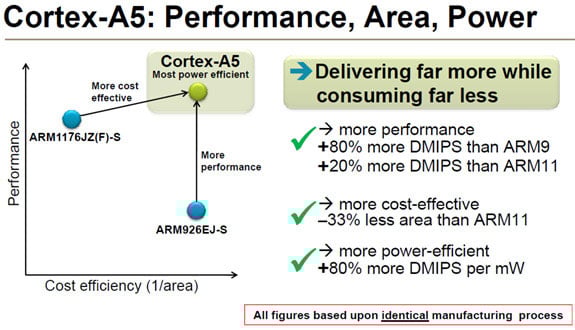
More information on Cortex A5 vs ARM11: (Information on ARM "Kingfisher" should be available soon)

ARMSlide1.jpg


ARMSlide2.jpg
 
Last edited:
http://www.pcmag.com/article2/0,2817,2380443,00.asp

A Recent article about Cortex A5.

ARM: $99 Super-Phones Coming Soon

February 16, 2011 12.34pm EST

Cortex-A5 chips will power much cheaper phones with the capabilities of today's top smartphones, potentially arriving in stores by the holidays.

BARCELONA—ARM is riding high. And why not? Their chip designs are found in almost every device here at Mobile World Congress. But even though Qualcomm, Nvidia, Samsung and TI have all been touting their ARM-based super-chips, ARM's mobile marketing head James Bruce wants us to know about a secret weapon the chipmakers aren't talking about: the new Cortex-A5.

"They're keeping very quiet about it," Bruce said.

Cortex-A5 is ARM's new low-cost chip design that provides the speeds of current Cortex-A8 phones such as the Samsung Galaxy S, Motorola Droid X and T-Mobile MyTouch 4G, but at a "sub-$100 price point."

Several vendors are already sampling Cortex-A5 processors, Bruce said, with an aim to put out A5 phones in either late 2011 or early 2012.

The new processors would turn up in next year's versions of entry-level smartphones like the LG Optimus S/T/M/U line, giving them the speeds of today's top phones.
MWC (Mobile World Congress)

A5's advantage isn't just about speed. All of ARM's Cortex designs share certain instructions that weren't present in slower processors like the ARM11s seen in today's entry-level smartphones. Bringing A5 to cheaper phones will let manufacturers and OS developers leverage the work they're doing for software on high-end phones, as the A5 has the same instruction set.

(An aside: ARM's Cortex-A5 has nothing to do with the rumored next Apple processor, which people on the Internet call the "A5." The Apple A5 may actually be a Cortex-A9.)

Bruce was very cheerful about the intense competition between his company's licensees.

"Our partners are constantly trying to out-innovate each other," he said.

But he did want to clear up one thing: TI's upcoming OMAP5 will probably be faster than Nvidia's new "Kal-El" chip. That's because Kal-El uses a quad-A9 design, while TI uses a dual-A15, and "A15 is much more efficient than A9."

Of course, by the time OMAP5 comes out Nvidia may be on to "Wayne," which is Kal-El's replacement and very well might be an A15.

Bruce also said ARM is excited about appearing in desktop and laptop PCs, thanks to efforts like Nvidia's "Project Denver" and Microsoft's move to port Windows for ARM chips. The low power usage of ARM chips could enable "green" desktops that run cool, use relatively little electricity and fit into small boxes, he said. "Anyone would be excited that Windows would be coming to your architecture," he said.
 
Why would a company move from something were they a) are established and b) have exactly one competitor to an area with about 0 Knowledge and with tons of competitors of which several will not survive?
They are too late to the game. NV was much smarter or entered the market soon enough. They would be years ahead plus are expanding not changing direction.
Not to mentioned AMD has no money for such a project. Did they ever actually make money?
 
I dont think AMD is interested in the smartphone space, dont think the margins are particularly good there and competition is pretty stiff already.

Exactly. What possible benefit is there for them to repackage someone elses design?

The only reason nvidia is pursuing any of this is because they can't build x86 cpus, they can't build chipsets for Intel and they can't compete with AMD chipsets.

AMD might be able to contribute something on the mobile graphics front with ARM, but I don't think they think that it is worth it.

AMD's future is fusion. That means shrinking bobcat and building an ecosystem of games and apps around their components. I think at that point they can start to offer something compelling for tablets. Full opengl support, full opencl support. That should give them something to put up against ARM.

Does anyone know when they plan on doing 28nm APUs?
 
Here is a interesting chart originally posted by Idontcare.

1.jpg


I'm not exactly sure how DMIPs would translate into real world performance, but Cortex A5 does pretty well in that benchmark.

In contrast, An ARM11 only gets 1.2 DMIPs/Mhz.

For those interested:

  • LG Optimus V (considered to be the best Android prepaid phone at the moment) has a 600 Mhz ARM11 for a total of 720 DMIPs.
  • A Cortex A5 core at 1 Ghz would have 1600 DMIPs.
  • iPhone 4's A4 processor has a Cortex A8 @ 850Mhz for 1700 DMIPs.
 
Exactly. What possible benefit is there for them to repackage someone elses design?

Maybe ARM will give AMD a really good deal on this chip? In one article http://www.programmica.info/2009/10/arm-outflanks-intel-with-cortex-a5.html ARM is quoted as saying Cortex A5 was made as a “flanking manoeuvre” on Intel. (It sounds like ARM thinks the chip is very important in their future strategy.)

But as of December 6, 2010, the company was disappointed that Cortex A5 wasn't licensed yet: http://armnews.wordpress.com/2010/12/06/cortex-a5-may-have-to-wait-for-its-big-day/

ARM News
Cortex-A5 may have to wait for its big day

With smartphone demand showing no sign of slowing, there seems little reason for manufacturers to introduce less expensive and less powerful handsets. This is great news for ARM as the royalty rate per core is far higher for Cortex-A8 processors than its predecessor, the ARM11. Unfortunately for many consumers the end price is too high and simply not affordable.

The Cortex-A8 and soon-to-launch Cortex-A9 are powerful smartphone Application Processors, but we are still waiting for the first smartphone with a Cortex-A5 to debut. The Cortex-A5 is the baby brother of the highly successful Cortex-A family, and has been designed so it scales from single-core to quad-core if necessary. It was announced on 21 October 2009 and no manufacturer has announced a product that will utilise it.

The Cortex-A5 is fully software compatible with the Cortex-A8 and Cortex-A9 so there is no technical reason why smartphones powered by the processor cannot be launched within the next 12 months. Although we love to see ARM technology continuing to march into Intel territory with more powerful processors, we also want to see less expensive smartphones on the market during 2011.

Is there a market for the Cortex-A5 in the smartphone space? Western consumers expect a certain level of performance when accessing the internet . The Cortex-A8 delivers what we believe to be the minimum performance that many would deem acceptable. Although the Cortex-A5 royalty rate is significantly less than the Cortex-A8, does it have a place in a low-end smartphone?

We want to see cheaper smartphones become available, but we don’t want less powerful handsets. And we don’t think we’re alone. Will the Cortex-A5 usher in a time of smartphones at stupid prices, or has the mobile internet revolution (using the Cortex-A8) killed the Cortex-A5? What are your views?
 
The reason nobody wants Cortex A5 is because it is obsolete technology. The margins on the phones it is going to be on is massively smaller than the margins on the latest superphones. It's the last place AMD would want to be in the mobile market.

Whats the difference in manufacturing costs between an A5 and an A9? $10 tops, right? But then you sell one phone for $0.99 and the other for $199. That's why nobody is in too much of a hurry to spend R&D money developing phones around it. The people that get the free phones can't tell the difference between an ARM11 and a Pentium 4 anyway.

Phones are about so much more than SOCs. People want good hinges, good keyboards, good displays, etc. The cheap phones make sacrifices in all these areas. The expensive phones don't, and once a manufacturer has gone through the trouble of designing a good phone, they aren't going to skimp on the processor. If using an SOC with half hte die area would cut hte purchase price of hte phone in half, then sure, great, it could be succesful. But it doesn't. An iPhone 4 with a Cortex A5 would cost $10 less than the A8 version and hte same as the A9 version. Why cut the performance in half just to cut costs by 5 or 10%?
 
Last edited:
seeing as they're dumping all these execs, yes, but of course like usual it's going to be too little too late. And in the case of these mobile chips, the "too little" is not the kind of little we want from AMD.
 
Do you guys really think that ARM is going to supplant x86? Because if it does, then AMD either has to licence the technology or stop making CPUs entirely.
 
Do you guys really think that ARM is going to supplant x86? Because if it does, then AMD either has to licence the technology or stop making CPUs entirely.

The future of hardware is written (pun intended) at the hands of the software programmers.

Software programmers follow the user base.

When the user base went from big-iron RISC to cheap clustered servers comprising x86 cpu's so to went the app developers and that market was decimated.

ARM will take off if programmers are there making apps on ARM that the user base wants.

And just as even today there is still a market for big-iron like Power7 and Itanium, there will most assuredly always be an x86 market of some kind.

But will it always be the growth market? Not likely, not unless it is somehow different than every other business cycle that has occurred in technology since the Industrial Revolution began hundreds of years ago.

I look to the likes of Apple's app development environment that they created for the iPhone/iPad as a sign of the times. The freelance app developers are happy to sell their product for a buck or two per license, have extremely low overhead, and access to a large user base...all on ARM.

It is sort of like the long-tail model only it seems to actually happen when you give nerdy software programmers access to a market from their basements and underground cheeto lairs.

They are what x86 has to fear for it is they who will enable a transition to an ARM compute environment for the user-base.

It is the programming stalwarts, your Microsofts and Adobes, that stand at risk of becoming the next AOL's in the history books. Hence their mad dash to support anything the breaths these days, they are running scared that they will miss out on the next big thing (and rightly so).
 
The future of hardware is written (pun intended) at the hands of the software programmers.

Software programmers follow the user base.

When the user base went from big-iron RISC to cheap clustered servers comprising x86 cpu's so to went the app developers and that market was decimated.

ARM will take off if programmers are there making apps on ARM that the user base wants.

And just as even today there is still a market for big-iron like Power7 and Itanium, there will most assuredly always be an x86 market of some kind.

But will it always be the growth market? Not likely, not unless it is somehow different than every other business cycle that has occurred in technology since the Industrial Revolution began hundreds of years ago.

I look to the likes of Apple's app development environment that they created for the iPhone/iPad as a sign of the times. The freelance app developers are happy to sell their product for a buck or two per license, have extremely low overhead, and access to a large user base...all on ARM.

It is sort of like the long-tail model only it seems to actually happen when you give nerdy software programmers access to a market from their basements and underground cheeto lairs.

They are what x86 has to fear for it is they who will enable a transition to an ARM compute environment for the user-base.

It is the programming stalwarts, your Microsofts and Adobes, that stand at risk of becoming the next AOL's in the history books. Hence their mad dash to support anything the breaths these days, they are running scared that they will miss out on the next big thing (and rightly so).

Interesting.

When did you become an elite elite member?

Microsoft looks as though they'll be fine; they're supporting ARM with Windows 8. I'm sure it won't be too hard for Adobe to port their apps over as well.

I personally don't see the big draw to ARM or to the other RISC options for that matter. x86 has been competitive performance wise. Until I see some hard data that shows and ARM Cortex obliterating an Atom or C2D ULV in terms of performance per watt, I'm not going to buy into this whole notion that x86 is dead.

It's actually looking as though there will be two standards for quite some time. ARM will be used in mobile devices, and x86 will remain in most desktop computers and servers.
 
Here's how I see it. Even though licenses of ARM is probably cheaper than what AMD pays Intel for the x86 license (I really have no clue except that I heard developing for ARM is amazingly cheap), it's in AMD's best interest for x86 to succeed and ARM to lose. Why?

In terms of competition if ARM succeeds, then AMD will need to compete against every schmuck in the world. However if x86 succeeds, then AMD is in better hands mainly because the barrier of entry is far harder (no one else can get in on the action except Intel because they can't get the license). So even if they can't dominate the market right now, it's still far better for them than to open up their entire industry to world competition.
 
I voted yes, but i hope its no.

😡Die cell phones Die!!!

More power to the future players with big clunky computers running 6 and 8 gpus:awe:
 
This is pointless, all AMD has to do is shrink their APUs down a bit more and they'll be perfect for cell phones. They'll already work great in tablets that have a little more room to work with.
 
Let me just say, there is no such thing as a tablet "with a little more room to work with". The iPad is the benchmark, and the iPad is already way too heavy and bulky. Anything bigger will fail instantly.
 
if pc's with windows are going to use arm then why would amd not want to cover that base? and if they get into the arm pc business why would they not then bother to do tablets/cell phones as well. they cant afford not to
 
Here's how I see it. Even though licenses of ARM is probably cheaper than what AMD pays Intel for the x86 license (I really have no clue except that I heard developing for ARM is amazingly cheap), it's in AMD's best interest for x86 to succeed and ARM to lose. Why?

In terms of competition if ARM succeeds, then AMD will need to compete against every schmuck in the world. However if x86 succeeds, then AMD is in better hands mainly because the barrier of entry is far harder (no one else can get in on the action except Intel because they can't get the license). So even if they can't dominate the market right now, it's still far better for them than to open up their entire industry to world competition.

It is true that the ARM space is quite crowded as basically every other tech company out there that is fabless has nothing else to differentiate their products than time-to-market (mad dash race all the time) and price.

A few such as TI and Qualcomm have deep enough pockets and lengthy enough experience with ARM that they've built up a formidable IP portfolio for adding doo-dads to their SoCs that the feature-set is actually genuinely differentiating but that is the exception and not the rule.

if pc's with windows are going to use arm then why would amd not want to cover that base? and if they get into the arm pc business why would they not then bother to do tablets/cell phones as well. they cant afford not to

In a perfect world where AMD had no debt and a sizable net positive cashflow they could undertake a serious side-effort like that without putting the rest of their business in peril.

But is AMD really in a position to go all out in ARM?

I think they seriously investigated this question already, 4+ yrs ago, and concluded bobcat was the way to go.
 
Interesting.

When did you become an elite elite member?

Microsoft looks as though they'll be fine; they're supporting ARM with Windows 8. I'm sure it won't be too hard for Adobe to port their apps over as well.

I personally don't see the big draw to ARM or to the other RISC options for that matter. x86 has been competitive performance wise. Until I see some hard data that shows and ARM Cortex obliterating an Atom or C2D ULV in terms of performance per watt, I'm not going to buy into this whole notion that x86 is dead.

It's actually looking as though there will be two standards for quite some time. ARM will be used in mobile devices, and x86 will remain in most desktop computers and servers.

yes, but what he said was that x86 wouldn't continue to be a growth niche, not that it would die out completely overnight. the scenario that you just described is one in which arm is growing in a growth market and x86 remains dominant in a stable market.
 
The future of hardware is written (pun intended) at the hands of the software programmers.

Software programmers follow the user base.

When the user base went from big-iron RISC to cheap clustered servers comprising x86 cpu's so to went the app developers and that market was decimated.

ARM will take off if programmers are there making apps on ARM that the user base wants.

And just as even today there is still a market for big-iron like Power7 and Itanium, there will most assuredly always be an x86 market of some kind.

But will it always be the growth market? Not likely, not unless it is somehow different than every other business cycle that has occurred in technology since the Industrial Revolution began hundreds of years ago.

I look to the likes of Apple's app development environment that they created for the iPhone/iPad as a sign of the times. The freelance app developers are happy to sell their product for a buck or two per license, have extremely low overhead, and access to a large user base...all on ARM.

It is sort of like the long-tail model only it seems to actually happen when you give nerdy software programmers access to a market from their basements and underground cheeto lairs.

They are what x86 has to fear for it is they who will enable a transition to an ARM compute environment for the user-base.

It is the programming stalwarts, your Microsofts and Adobes, that stand at risk of becoming the next AOL's in the history books. Hence their mad dash to support anything the breaths these days, they are running scared that they will miss out on the next big thing (and rightly so).


your forgetting things run both ways, what is the point of haveing a ARM product if there is no software too it?

someone has to be the first, to spend on developing the software for the stuff people want their devices to do.

Microsoft seems to be willing to take the first step with the windows Arm version, its a brand, people want a windows OS when they buy a laptop ect.

This is where the danager to 86x is,... microsoft could change the game.


There are still some things missing from the picture though, ARM isnt gonna replace 86x as it is today. It might someday though.


I think they seriously investigated this question already, 4+ yrs ago, and concluded bobcat was the way to go.
It might be enough to hold ARM at bay... which means out of notebooks,desktops.
on 40nm they can make bobcat cores that are dualcore 1ghz + gpu, that use less than 1watt, it has dx11 and can run all your favorite 86x aps.

at some point... power useage will cease to be a issue, I mean who cares if their cpus use 0.5watts or 1watt?
 
Last edited:
The reason nobody wants Cortex A5 is because it is obsolete technology.

Maybe Cortex A5 will become more popular with SOC chip makers when the price of 40nm fabs drops? But then I wonder what precautions would be taken so it didn't compete with existing Cortex A8 designs on 45nm ( <--- only a half node bigger than 40nm).

This makes me wonder how ARM will position “Kingfisher”? Will it be 28nm making the decision to implement easier than Cortex A5? (Kingfisher on 28nm stripped down SOC for entry level prepaid Smartphones vs. Cortex A15 on 28nm fully loaded SOC for top flight contract phones)

The margins on the phones it is going to be on is massively smaller than the margins on the latest superphones. It's the last place AMD would want to be in the mobile market.

The margins are no doubt smaller, but maybe the volume ends up being higher?

With regards to the high end ARM smartphone SOC market, I've read some posts claiming it is extremely competitive (supply chains already established, etc). Some even claiming Nvidia having to slash prices on Tegra 2, etc. This is why I think it would be interesting if AMD could consider the low end first.


Whats the difference in manufacturing costs between an A5 and an A9? $10 tops, right? But then you sell one phone for $0.99 and the other for $199. That's why nobody is in too much of a hurry to spend R&D money developing phones around it. The people that get the free phones can't tell the difference between an ARM11 and a Pentium 4 anyway.

Good question. I am not sure what the difference in manufacturing price would be? With these smartphone SOCs, it appears the CPU core(s) take up much less silicon area compared to something like Bobcat APU. (due to die space allocated for various types of dedicated hardware- image processor, etc).

Phones are about so much more than SOCs. People want good hinges, good keyboards, good displays, etc. The cheap phones make sacrifices in all these areas. The expensive phones don't, and once a manufacturer has gone through the trouble of designing a good phone, they aren't going to skimp on the processor. If using an SOC with half hte die area would cut hte purchase price of hte phone in half, then sure, great, it could be succesful. But it doesn't. An iPhone 4 with a Cortex A5 would cost $10 less than the A8 version and hte same as the A9 version. Why cut the performance in half just to cut costs by 5 or 10%?

Yep, that is true. On a $600+ contract phone (like iphone4) saving $20 on a CPU only results in a ~3.5% reduction in price.

But what about these $150 smartphones on Virgin Mobile like LG Optimus V? I've consistently read reviews claiming battery life is one of its weak points. Surely there is a market for SOC contributing to better run time? (especially with lower power displays on the horizon)
 
Back
Top