
• We’re currently investigating an issue related to the forum theme and styling that is impacting page layout and visual formatting. The problem has been identified, and we are actively working on a resolution. There is no impact to user data or functionality, this is strictly a front-end display issue. We’ll post an update once the fix has been deployed. Thanks for your patience while we get this sorted.

Why is a year four seasons long?

Dr. Zaus

Lifer
I don't get why the four seasons, by which humans judged what a "year" was for thousands of years, is one "rotation around the sun" long?


Why does it take one rotation around the sun to for the earth wobble from north-hemisphere facing the sun to the south-hemisphere facing the sun and back?
 
are these real questions?

4 seasons, because there are 4 seasons cold and melty, warm, cooler and brown, and cold and freezie.

also it's a year because of this.

main-qimg-6015aa24b592dbcc236abfc97e8c6998


it was easier to track the sun than it was to just guess at it.
 
I don't get why the four seasons, by which humans judged what a "year" was for thousands of years, is one "rotation around the sun" long?


Why does it take one rotation around the sun to for the earth wobble from north-hemisphere facing the sun to the south-hemisphere facing the sun and back?

You are basically asking why the Earth is tilted on its axis. There are theories on that but ultimately they are just theories.

Why don't you ask the creator of the universe this question? 😵
 
You are basically asking why the Earth is tilted on its axis. There are theories on that but ultimately they are just theories.

Why don't you ask the creator of the universe this question? 😵

I'm too busy to answer silly questions from peons.
 
Why does it take one rotation around the sun to for the earth wobble from north-hemisphere facing the sun to the south-hemisphere facing the sun and back?
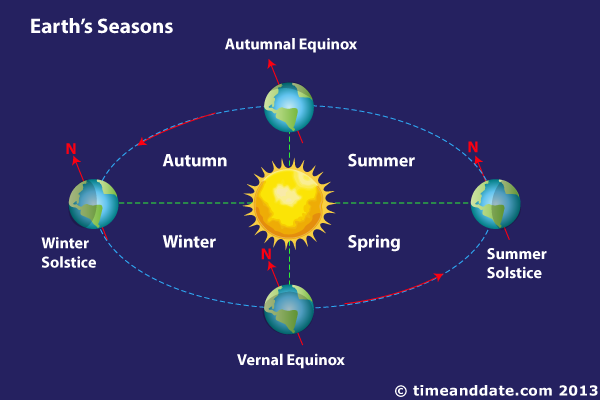
The earth doesn't wobble, the tilt remains (mostly) the same throughout the year. However, the revolution around the sun means that the relative position of the tilt changes with relation to the sun's exposure.
 
Yes okay, the earth wobbles slightly and over enough time the tilt switches entirely, but it is not a significant factor in climate variation throughout a year.
 
You got me. The only ones that matter are fall and winter. Whoever voted for spring and summer should be kicked in the balls.
 
You got me. The only ones that matter are fall and winter. Whoever voted for spring and summer should be kicked in the balls.

Why? Those are the two best seasons of the year. Not too hot, not too cold. (usually) Summer is usually too fucking hot, (and depending on where you are, too fucking humid) winter's ice and snow (if you're unfortunate enough to live in that shit) sucks donkey balls.
 
Why? Those are the two best seasons of the year. Not too hot, not too cold. (usually) Summer is usually too fucking hot, (and depending on where you are, too fucking humid) winter's ice and snow (if you're unfortunate enough to live in that shit) sucks donkey balls.

I love snow and long nights. I wish I was farther north to get more of it. I hope to spend a winter in Lapland some year, but who knows if I ever get to it.
 
earth-seasons.png


Earth doesn't "wobble".
That would explain my question.

However, I am having a very hard time getting an intuition of this...

It only makes sense in my mind if we're not on the same plain as the sun.

Wouldn't the earth being relatively horizontal and the sun being at 23 degrees below us be the same thing?

So it's not that the earth is tilted, it's that we're located at an angle above the sun.
 
That would explain my question.

However, I am having a very hard time getting an intuition of this...

It only makes sense in my mind if we're not on the same plain as the sun.

Wouldn't the earth being relatively horizontal and the sun being at 23 degrees below us be the same thing?

So it's not that the earth is tilted, it's that we're located at an angle above the sun.

If you cut a plane through the center of the earth at the equator, that plane would usually not pass through the center of the sun (although I guess it would twice a year).

Earth_tilt_animation.gif
 
We have six seasons: a bit of winter, perfect, hot but still perfect, monsoon hell, perfect, a bit of rain, then back to winter.
 
That would explain my question.

However, I am having a very hard time getting an intuition of this...

It only makes sense in my mind if we're not on the same plain as the sun.

Wouldn't the earth being relatively horizontal and the sun being at 23 degrees below us be the same thing?

So it's not that the earth is tilted, it's that we're located at an angle above the sun.

When you say "same plane as the sun", same plane compared to what? The plane of our orbit is not the same as the plane formed by the earth's equator, that is true.

Relative to the plane of the equator, yes, the earth is 23.5* above the sun in December, and 23.5* below the sun in June.

However, most explanations are relative to the plane of our orbit around the sun.
 
That would explain my question.

However, I am having a very hard time getting an intuition of this...

It only makes sense in my mind if we're not on the same plain as the sun.

Wouldn't the earth being relatively horizontal and the sun being at 23 degrees below us be the same thing?

So it's not that the earth is tilted, it's that we're located at an angle above the sun.

Well, this is clearly a matter of perspective - or more accurately your choice of a frame of reference.

The frame of reference the other posters are using is the plane that is formed by the orbiting planets, and frankly it's the best one for understanding the answer to your question. The earth's axis of rotation is not perpendicular to the plane of the earth's orbit around the sun. It is essentially a tilted gyroscope that maintains its axis of rotation while also orbiting around the sun. The changing orientation of the earth's surface to the sun causes the four seasons.

What you seem to want to do is use the earth's equator (by definition perpendicular to the rotational axis) as your frame of reference. Describing the motion of the sun in that frame of reference is much more complicated, but its apparent path around the earth would be tilted with respect the the equator (above and below).

FWIW, this is essentially what Copernicus discovered.
 
MN seasons

Cold as eff + snow, warming up but cold + snow, road construction\warm, cooling down\rain. Then back to cold as eff + snow.

But this year has been amazingly warm in the winter. Still growing in my garden in the middle of Dec! That usually ends mid October.
 
Back
Top