When will we start seeing CPU/SOC PCI-E cards?

Apr 20, 2008
10,067
990
126
I've seen it in compute servers where they have loads of atoms on a single cartridge. Will that ever catch on in the desktop market? Maybe add beema/baytrail like cores in laptops in the form of an express card?

Just wondering why it hasn't gained any traction.
 

Soulkeeper

Diamond Member
Nov 23, 2001
6,740
156
106
transmeta and others have done it in the past. I guess it was just too niche
There is nothing stopping such a solution from being exposed as an opencl device if a company wanted.
I suppose it's just cheaper to spend the X dollars on a faster CPU or a GPU than an addon card
 

ShintaiDK

Lifer
Apr 22, 2012
20,378
146
106
Its not really PCIe based tho. And its special for each server.

You would also need memory and such on the card.

Its extra cost and not worth it.
 

Lonyo

Lifer
Aug 10, 2002
21,938
6
81
If they were going to do something like that, you would have socketed CPUs in Atom laptops, rather than soldered in.
As for desktop computers, if you want an additional CPU, but a multi-CPU motherboard.

The market for many Atom cores would be tiny outside business use, hence there's no one making such a thing, because there's no demand.
You can already buy 8 core Atom motherboards, why do you need more cores?
 

NTMBK

Lifer
Nov 14, 2011
10,525
6,050
136
You would need some sort of cache-coherent bus if you wanted to add in extra CPU cores. PCIe wouldn't cut it, unless you wanted to just use it as an independent "compute node" with separate address space. (See: Xeon Phi.)
 
Apr 20, 2008
10,067
990
126
You would need some sort of cache-coherent bus if you wanted to add in extra CPU cores. PCIe wouldn't cut it, unless you wanted to just use it as an independent "compute node" with separate address space. (See: Xeon Phi.)
PICOe-PV-D510-300x300.png

http://www.ieiworld.com/publication/news/content.aspx?id=0A061419404989468924
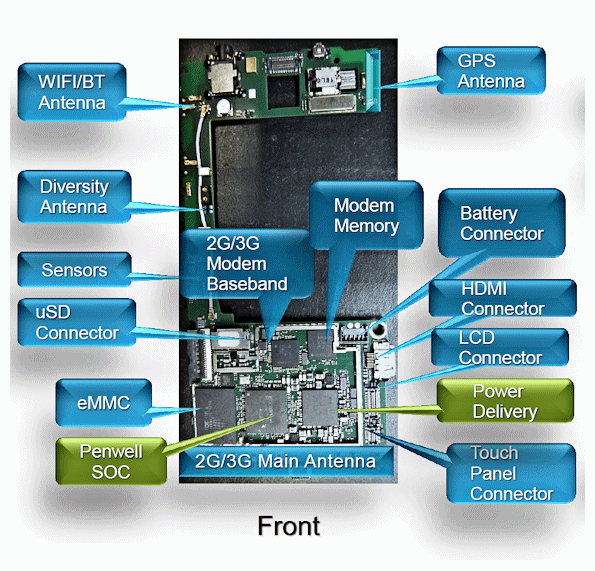
Here's essentially what I'm talking about. I don't see why these cant be x1/x4 add in cards and with a driver stack for windows scheduler, have the main CPU/ram go into sleep state while the daughterboard takes care of idle and ultra low power tasks. We see quad-core Z35xx Atoms in phones now, surely an x1 slot on a motherboard could power that. There's Bay-Trail quad core tablets going on sale for $65 left and right. The price without the screen/emmc/modem would make it even more competitive.

Atom Medfield in a phone.
intel-medfield-cellular-phone-design.gif


Atom+Ram could easily fit on an expresscard without all the unnecessary fluff (GPU/MMC/MODEM) needed for a standalone phone/tablet.

WiiU/PS4/XB1 all use arm cores for standby IIRC. Why not after three minutes of idle without multimedia or compute going, swap all the needed ram into a 2GB/4GB module on the atom and put the main CPU/RAM into sleep mode. A baytrail atom is decent enough as it is, and extremely efficient at idle. During times of extreme compute, have the driver stack allow for the Atom daughterboard provide acceleration for user inputs and windows overlays while the main CPU is busy. This would be extremely helpful if your main CPU was a dual core. System responsiveness would improve greatly.
 

jhu

Lifer
Oct 10, 1999
11,918
9
81
PICOe-PV-D510-300x300.png

http://www.ieiworld.com/publication/news/content.aspx?id=0A061419404989468924
Here's essentially what I'm talking about. I don't see why these cant be x1/x4 add in cards and with a driver stack for windows scheduler, have the main CPU/ram go into sleep state while the daughterboard takes care of idle and ultra low power tasks. We see quad-core Z35xx Atoms in phones now, surely an x1 slot on a motherboard could power that. There's Bay-Trail quad core tablets going on sale for $65 left and right. The price without the screen/emmc/modem would make it even more competitive.

What you linked to is essentially a separate computer that just uses the main computer for electricity.

Atom+Ram could easily fit on an expresscard without all the unnecessary fluff (GPU/MMC/MODEM) needed for a standalone phone/tablet.

WiiU/PS4/XB1 all use arm cores for standby IIRC. Why not after three minutes of idle without multimedia or compute going, swap all the needed ram into a 2GB/4GB module on the atom and put the main CPU/RAM into sleep mode. A baytrail atom is decent enough as it is, and extremely efficient at idle. During times of extreme compute, have the driver stack allow for the Atom daughterboard provide acceleration for user inputs and windows overlays while the main CPU is busy. This would be extremely helpful if your main CPU was a dual core. System responsiveness would improve greatly.

You more or less described ARM's big.little, but with the processors separated. I'm not quite sure how much of a market there is for something like this in the x86 world. I would imagine very small since OEMs don't want to add more complexity and motherboard space (ie cost) to a product with already thin margins and cut throat competition. If anything, it would be up to Intel to fuse an Atom with Core instead.
 

SOFTengCOMPelec

Platinum Member
May 9, 2013
2,417
75
91
Similar (but somewhat) different boards, are already on the market. They are for certain niche customers, who want especially high computing performance from their PCs, and the software is NOT suitable for running on conventional GPU compute cards.

EXAMPLES:

MERRICK3_P2-1024x442.jpg


http://www.enterpoint.co.uk/products/asic-development-high-performance-computing/merrick-3/


NetFPGA10G_web.jpg


http://www.hitechglobal.com/boards/PCIExpress_SFP+.htm


They contain a number of FPGAs, which are devices which can have a number of built in processors, such as Arms, and/or you can "program in", your own (or purchased) cpu cores, up to a certain limit, per chip.
Because they are fully programmable, you can even design your own custom logic system(s), and put it straight into the FPGAs. They are a sort of user re-programmable, high speed digital logic (array) chip.

Hypothetical Example:
A company has written some high performance dynamic fluid simulation software, and wants to sell PCs, which are capable of running their custom software system, at a considerably faster rate than a normal PC. But without the huge expense of racks, and racks of conventional servers.
 
Last edited:
  • Like
Reactions: TurtleCrusher

Lonyo

Lifer
Aug 10, 2002
21,938
6
81
PICOe-PV-D510-300x300.png

http://www.ieiworld.com/publication/news/content.aspx?id=0A061419404989468924
Here's essentially what I'm talking about. I don't see why these cant be x1/x4 add in cards and with a driver stack for windows scheduler, have the main CPU/ram go into sleep state while the daughterboard takes care of idle and ultra low power tasks. We see quad-core Z35xx Atoms in phones now, surely an x1 slot on a motherboard could power that. There's Bay-Trail quad core tablets going on sale for $65 left and right. The price without the screen/emmc/modem would make it even more competitive.

Atom Medfield in a phone.
intel-medfield-cellular-phone-design.gif


Atom+Ram could easily fit on an expresscard without all the unnecessary fluff (GPU/MMC/MODEM) needed for a standalone phone/tablet.

WiiU/PS4/XB1 all use arm cores for standby IIRC. Why not after three minutes of idle without multimedia or compute going, swap all the needed ram into a 2GB/4GB module on the atom and put the main CPU/RAM into sleep mode. A baytrail atom is decent enough as it is, and extremely efficient at idle. During times of extreme compute, have the driver stack allow for the Atom daughterboard provide acceleration for user inputs and windows overlays while the main CPU is busy. This would be extremely helpful if your main CPU was a dual core. System responsiveness would improve greatly.

Because in super power consumption constrained situations, you already have low power CPUs with very low idle power use, and your significant draws are things like the display.
Plus since the PCIe lanes come from the CPU you would still need active areas of the CPU in order to run the add-in card, so your power reductions would not be that significant.
You wouldn't save enough power for the added cost to be worth it in non-power restricted situations such as a desktop computer, or even a SFF PC, where the size would make it unmanageable.

http://www.anandtech.com/show/8941/gigabyte-gbbxi7h5500-broadwell-brix-review/7
7.7w for a NUC using Broadwell. How much power do you think using Atom at idle would save? How much sacrifice in terms of space and cost would you need to make? That's not even the lowest power system, since there are 6w ones as well.

Your suggestion doesn't make sense in the current marketplace because there's nowhere for it to reasonably fit in. What you would need is an Atom core on the main CPU which takes over when the "proper" cores aren't required, like big.Little, and a daughterboard or module isn't effective for that.
Your RAM idea is also silly as you would restrict your main system RAM to whatever the Atom board could hold, or you would have an incredibly slow switching process because you would need to load data from the RAM to disk drive and then back to RAM on sleep/wake of the main system, e.g. if you had 8 or 16GB RAM.

In modern systems basically all inputs go through the CPU, so do the PCIe lanes. That means any interaction between inputs and your Atom input-handling CPU would have massive latency compared to using the main CPU as things would go input -> CPU -> Atom -> CPU rather than input -> CPU.

You haven't presented a sensible or viable use case or problem which your proposition solves or deals with in an effective manner. The most realistic way would be for Intel to replicate big.Little on its own CPUs with an Atom core or two.

Oh hey, here's my thread from 2.5 years ago on the topic:
http://forums.anandtech.com/showthread.php?t=2279950
Where people discuss low power modes on Intel's main CPUs and Intel adding additional power states to reduce the power consumption of their larger CPU cores.