

What will be the largest iGPU size on the laptop AMD Zen APU?
- Thread starter cbn
- Start date
You are using an out of date browser. It may not display this or other websites correctly.
You should upgrade or use an alternative browser.
You should upgrade or use an alternative browser.

- Mar 27, 2009
- 12,968
- 221
- 106
Do we really need another thread?
This is about the large iGPU, not the small one.
Totally different use case scenarios.

frozentundra123456
Lifer
- Aug 11, 2008
- 10,451
- 642
- 126
Yea, we already have 1500 posts in a thread about the mythical zen apu with 16 cores, Greenland APU, and HBM. Maybe we should cool the speculation until like you know 2017 when we might actually see a zen APU.
- Mar 27, 2009
- 12,968
- 221
- 106
Yea, we already have 1500 posts in a thread about the mythical zen apu with 16 cores, Greenland APU, and HBM. Maybe we should cool the speculation until like you know 2017 when we might actually see a zen APU.
That server APU with HBM is a totally different animal from a laptop APU.
- Mar 27, 2009
- 12,968
- 221
- 106
I voted 768sp.
No HBM.
The stream processors will run at low clock speeds and be matched to dual channel DDR4 3200.
For gamers this means 2 x 4GB at a price premium compared to running one 8GB DDR4 3200 stick.
For those using the iGPU to enhance image manipulation and to accelerate 3D effects for video editing a greater amount of RAM (2 x 8GB DDR4 3200, etc.) will be used.
No HBM.
The stream processors will run at low clock speeds and be matched to dual channel DDR4 3200.
For gamers this means 2 x 4GB at a price premium compared to running one 8GB DDR4 3200 stick.
For those using the iGPU to enhance image manipulation and to accelerate 3D effects for video editing a greater amount of RAM (2 x 8GB DDR4 3200, etc.) will be used.

coercitiv
Diamond Member
- Jan 24, 2014
- 7,472
- 17,857
- 136
So we make one thread for general speculation, one thread for small/no iGPU speculation, one for big mobile iGPU speculation, one for desktop iGPU, one for CPU performance, one for mobile Zen power draw, one for a theoretical SKU with 6 cores and even larger iGPU, one for rumors about the HBM Zen APU, one for Zen SMT implementation, one poll for Zen including FIVR and subsequent discussion about power delivery on the new APU, and the list can probably go on.This is about the large iGPU, not the small one.
Totally different use case scenarios.
This reminds me of that joke about the young bull and the old bull on top of a hill .
We can always make a big thread named "AMD Zen Thread" and discuss most SKU scenarios and other specualtion there. If enough more info surfaces in the near future, it might warrant a separate thread about AMD's iGPU, but that thread will likely belong to the VC&G section, unless some compute breakthrough comes along.
- Mar 27, 2009
- 12,968
- 221
- 106
So we make one thread for general speculation, one thread for small/no iGPU speculation, one for big mobile iGPU speculation, one for desktop iGPU, one for CPU performance, one for mobile Zen power draw, one for a theoretical SKU with 6 cores and even larger iGPU, one for rumors about the HBM Zen APU, one for Zen SMT implementation, one poll for Zen including FIVR and subsequent discussion about power delivery on the new APU, and the list can probably go on.
The laptop iGPU is tied to the desktop iGPU (assuming AMD does not make a specific small iGPU version that gets preferentially used instead).
For example, if AMD decides to make a laptop APU with an iGPU even larger than 768sp that would very likely help mobile performance per watt (and dual channel DDR4 3200 would still work well in that performance envelope). So its not a bad idea in that respect.
However, if AMD is not able to sell enough of those very large iGPU dies as mobile SKUs they will come to desktop.
How do we feel about that possible scenario panning out?
Does AMD go medium sized or even larger on the iGPU (even without HBM)? I can see advantages to both approaches, but each carries a different risk.

NTMBK
Lifer
- Nov 14, 2011
- 10,522
- 6,038
- 136
This is about the large iGPU, not the small one.
Totally different use case scenarios.
We don't even know if there will be "small" or "large" iGPUs! Seriously, why do we need another thread?
- Mar 27, 2009
- 12,968
- 221
- 106
We don't even know if there will be "small" or "large" iGPUs! Seriously, why do we need another thread?
I think there will be small and large iGPU Zen APUs because AMD needs to drive up laptop volume.
One recurring complaint I see about AMD APU laptops is that they have a higher than expected price (poor construction is another complaint). Low volume of large iGPU mobile APUs (eg, Kaveri) hurts the ability of OEMs to make large runs of a particular laptop. This, in turn, increases price.
However, one thing I already see AMD doing with Carrizo (Excavator CPU) and Carrizo-L (Puma CPU) is have the two APUs share the same BGA socket (FP4). Having a common socket should help reduce design costs to some degree as the large iGPU APU (Carrizo) can benefit from some of the small iGPU APU's (Carrizo-L) higher volume. Unfortunately though the socket is the same, the BIOS would be different.
Therefore, in order to share both socket and BIOS, I believe AMD will have both a large iGPU Zen APU (the topic of this thread) and a small iGPU Zen APU (which was the topic of this thread).
frozentundra123456
Lifer
- Aug 11, 2008
- 10,451
- 642
- 126
That server APU with HBM is a totally different animal from a laptop APU.
Well the point was that speculation already got totally out of hand in that thread, so do we need another? Not to mention the first Zen cpus will apparently have no igp at all.

Blitzvogel
Platinum Member
- Oct 17, 2010
- 2,012
- 23
- 81
I think there will be small and large iGPU Zen APUs because AMD needs to drive up laptop volume.
One recurring complaint I see about AMD APU laptops is that they have a higher than expected price (poor construction is another complaint). Low volume of large iGPU mobile APUs (eg, Kaveri) hurts the ability of OEMs to make large runs of a particular laptop. This, in turn, increases price.
However, one thing I already see AMD doing with Carrizo (Excavator CPU) and Carrizo-L (Puma CPU) is have the two APUs share the same BGA socket (FP4). Having a common socket should help reduce design costs to some degree as the large iGPU APU (Carrizo) can benefit from some of the small iGPU APU's (Carrizo-L) higher volume. Unfortunately though the socket is the same, the BIOS would be different.
Therefore, in order to share both socket and BIOS, I believe AMD will have both a large iGPU Zen APU (the topic of this thread) and a small iGPU Zen APU (which was the topic of this thread).
I doubt Carrizo-L supports dual channel, though it would be nice if it did. Can single channel CPUs still use two modules on a mobo built for dual channel?
 I also can't think of any single channel CPUs that can run on dual-channel mobos either.........
I figure the issue is based on the CPU memory controllers and socket than mobo traces but socket and mobo flexibility is a plus. What if AMD managed to build a socket with the capacity to power HBM equipped APUs?
Last edited:

sm625
Diamond Member
- May 6, 2011
- 8,172
- 137
- 106
Mobile Tonga is 2048 SP @ 125W. Assuming they optimized a bit, removed the GDDR5 tax, and clocked it down to 700 MHz, it could probably be made to run at 60W, leaving 40W for the CPU cores. That would be a 100W package, which is not at all unprecedented for a gaming notebook. With 8GB of shared HBM it would surely be a total gaming beast. But since the form factor would be so small, they would surely want to target the 35W segment as well. For that, they wouldnt want to go past 1024 cores.
Blitzvogel
Platinum Member
- Oct 17, 2010
- 2,012
- 23
- 81
Mobile Tonga is 2048 SP @ 125W. Assuming they optimized a bit, removed the GDDR5 tax, and clocked it down to 700 MHz, it could probably be made to run at 60W, leaving 40W for the CPU cores. That would be a 100W package, which is not at all unprecedented for a gaming notebook. With 8GB of shared HBM it would surely be a total gaming beast. But since the form factor would be so small, they would surely want to target the 35W segment as well. For that, they wouldnt want to go past 1024 cores.
Well to get there, it might be more feasible in the beginning to use a small amount of HBM because of it's cost. We could use, let us say 2 x 1/2 GB stacks as VRAM and L4 cache, with the rest of the memory being relatively cheap dual channel DDR3. BIOS could be configurable in how the HBM is treated, either as purely video memory or a configurable unified pool with higher capacity stacks.
A 4 core Zen, 1024 SP APU would be quite at home with two stacks for ~256 GB/s total bandwidth and 2 or 4 GB total for a VRAM only configuration. This would be the a console-killer APU without any compromises. Save the HBM only implementations for APUs for when HBM price makes it worth it to ditch external memory traces and modules.
- Mar 27, 2009
- 12,968
- 221
- 106
What if AMD managed to build a socket with the capacity to power HBM equipped APUs?
Right now HBM is using 14.6W for 4GB @ 512 GB/s.
Maybe 2GB at 256 GB/s or 1GB at 128 GB/s is workable for a laptop?
EDIT: With that mentioned, consider in 2017 when these Zen laptop APUs launch 2nd generation HBM should be available.
Last edited:

ninaholic37
Golden Member
- Apr 13, 2012
- 1,883
- 31
- 91
- Mar 27, 2009
- 12,968
- 221
- 106
sp = stream processor
- Mar 27, 2009
- 12,968
- 221
- 106
But since the form factor would be so small, they would surely want to target the 35W segment as well. For that, they wouldnt want to go past 1024 cores.
For 1024sp in a 35W laptop APU, I wonder how slow the stream processors would need to be clocked?
How much bandwidth does that need for gaming? How much bandwidth would be ideal for gaming? (Consider the speed of the CPU cores as well)

- Mar 27, 2009
- 12,968
- 221
- 106
We could use, let us say 2 x 1/2 GB stacks as VRAM and L4 cache, with the rest of the memory being relatively cheap dual channel DDR3. BIOS could be configurable in how the HBM is treated, either as purely video memory or a configurable unified pool with higher capacity stacks.
In 2017 for the first Zen laptop APU, with second generation HBM I am thinking AMD could probably get by with one stack of HBM (which would be either 2GB/4GB/8GB in capacity depending on the size of the dram die and how high the stack is) with 128GB/s bandwidth @ 1Gbps per pin and 256 GB/s @ 2Gbps per pin available for bandwidth.
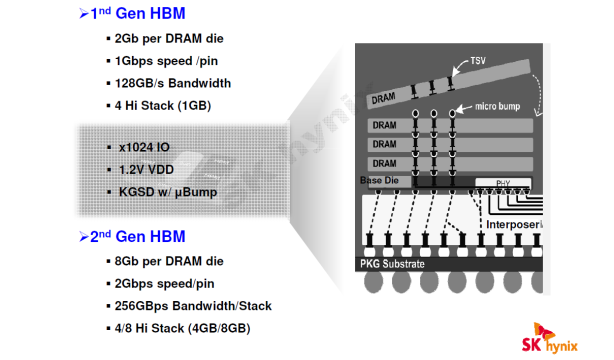
128 GB/s is a lot of bandwidth considering I would expect a 35W laptop chip with 1024sp to be clocked pretty low.
Last edited:

happy medium
Lifer
- Jun 8, 2003
- 14,387
- 480
- 126
We don't even know if there will be "small" or "large" iGPUs! Seriously, why do we need another thread?
buzz/advertising.:thumbsup:
I voted larger than 1280. the bigger the better.


ShintaiDK
Lifer
- Apr 22, 2012
- 20,378
- 146
- 106
Remember 2Hi stacks are half bandwidth. And 2Hi HBM2 is 2GB.
Absolutely. Its just memory like everything else and work exactly the same way. The only barrier is cost and flexibility.
Could HBM/HBM2 work as system memory in this case?
Absolutely. Its just memory like everything else and work exactly the same way. The only barrier is cost and flexibility.
Last edited:
TRENDING THREADS
-
 Discussion Zen 5 Speculation (EPYC Turin and Strix Point/Granite Ridge - Ryzen 9000)
- Started by DisEnchantment
- Replies: 25K
-
Discussion Intel Meteor, Arrow, Lunar & Panther Lakes + WCL Discussion Threads
- Started by Tigerick
- Replies: 24K
-
 Discussion Intel current and future Lakes & Rapids thread
- Started by TheF34RChannel
- Replies: 23K
-

-


AnandTech is part of Future plc, an international media group and leading digital publisher. Visit our corporate site.
© Future Publishing Limited Quay House, The Ambury, Bath BA1 1UA. All rights reserved. England and Wales company registration number 2008885.
 Facebook
 Twitter