Totally overvolted my 3770K it does work but I an gonna replace it for a new one. I am probably gonna go 4770k as I always like to change and experiment with new technology. I am just curious if anyone knows what the situation is with the IHS TIM on Haswell. Are we gonna end up deliding ? or is it as Sandy as far as Soldering. The IHS to TIM .


What tim does haswell have on ihs
- Thread starter Redoitall
- Start date
You are using an out of date browser. It may not display this or other websites correctly.
You should upgrade or use an alternative browser.
You should upgrade or use an alternative browser.

guskline
Diamond Member
- Apr 17, 2006
- 5,338
- 476
- 126
From the "gossip" at various threads it appears haswell continues the same type of TIM as Ivy Bridge. Obviously, you cannot "replace" a 3770k with a 4770k without also buying a new socket 1150 motherboard.Totally overvolted my 3770K it does work but I an gonna replace it for a new one. I am probably gonna go 4770k as I always like to change and experiment with new technology. I am just curious if anyone knows what the situation is with the IHS TIM on Haswell. Are we gonna end up deliding ? or is it as Sandy as far as Soldering. The IHS to TIM .
The TIM likely doesn't matter here, it's the distance from the IHS to the die: http://forums.anandtech.com/showpost.php?p=34053183&postcount=570

blastingcap
Diamond Member
- Sep 16, 2010
- 6,654
- 5
- 76
The TIM likely doesn't matter here, it's the distance from the IHS to the die: http://forums.anandtech.com/showpost.php?p=34053183&postcount=570
This... sort of. The TIM does matter, but the problem is not the TIM which is high-quality. Even if you replaced the TIM with some top of the line stuff like PK-1 or MX-4, it would not change things much because Intel already uses good TIM.
The TIM likely doesn't matter here, it's the distance from the IHS to the die: http://forums.anandtech.com/showpost.php?p=34053183&postcount=570
Well I would say that you are partially right because I used Artic silver when I delided the 3770k and tempreatures were only lower by 8 celcius but when I switched to liquid metal temperatures were down by 20 degrees. I think liquid metal works like Sandy Bridge's fluxless solder. That is why I was curious if Intel was going the Ivy or the Sandy way
Last edited:
Well I would say that you are partially right because I used Artic silver when I delided the 3770k and tempreatures were only lower by 8 celcius but when I switched to liquid metal temperatures were down by 20 degrees. I think liquid metal works like Sandy Bridge's fluxless solder. That is why I was curious if Intel was going the Ivy or the Sandy way
8C is huge for just TIM replacement.
I don't think that would be "just TIM replacement" as the process of delidding-> 're-lidding' reduces the gap distance of the IHS. Only if you delidded and kept the stock TIM after re-mounting everything and tested it, then re-did it with the artic silver and compared would it be an apples to apples TIM comparison. Lots of variables at least but I thought IDC had a pretty solid test setup.

LagunaX
Senior member
- Jan 7, 2010
- 716
- 0
- 76
You will end up delidding.
I would wait to see some retail delidded Haswell overclocks first prior to going all in.
Somehow I think 4.6-4.7ghz will be average and not surpass Ivy as the main design for Haswell is for more power efficiency within the same restrictive 3D lattice (as far as thermals).
You may be better off getting another 3770k instead of springing for a new mobo and premium priced 4770k.
I would wait to see some retail delidded Haswell overclocks first prior to going all in.
Somehow I think 4.6-4.7ghz will be average and not surpass Ivy as the main design for Haswell is for more power efficiency within the same restrictive 3D lattice (as far as thermals).
You may be better off getting another 3770k instead of springing for a new mobo and premium priced 4770k.
Last edited:
From what I read in some forums , they quote as haswell being on the lower side as far as volts for overclocking. But I guess you guys are right better wait for some benchmarks. By the way when I first delidded 3770 k I did put the cpu back w original TIM I just took the glue off and the result was similar to artic. The only big change was liquid metal. So I would conclude that is the distance plus the Soldering effect that liquid metal produces
You can conclude all you like, but the fact of the matter is that IDC approached the problem with a scientific mindset and measured these things objectively. He has real, solid evidence. He controlled for IHS to CPU Die distance to the .0x millimeter. You have not. As much as it is instinctual to go with what seems to be the logical answer based on personal experience, your offhand evidence is not as compelling as IDC's objectively compiled evidence. This is no personal attack, so don't take it that way. It's just tiring to see the same incorrect arguments repeated ad-nauseum online (Bad TIM, Bad TIM!) when there is an alternative theory which is significantly more plausible. The evidence points to the IHS-Die gap being the culprit. Not the TIM.
Also again: many thanks to IDC for his excellent work on this problem. I want to see a guest article by him on the main site, clearing up this issue.
Also again: many thanks to IDC for his excellent work on this problem. I want to see a guest article by him on the main site, clearing up this issue.
Last edited:
There's been test that show liquid metal doing a better job than pastes too.
He said he saw a drop from reducing the space, and an additional drop by going with liquid metal. His conclusions support both IDC's tests as well as tests done with liquid metal, so I'm not sure what you're on about.
He said he saw a drop from reducing the space, and an additional drop by going with liquid metal. His conclusions support both IDC's tests as well as tests done with liquid metal, so I'm not sure what you're on about.
You can conclude all you like, but the fact of the matter is that IDC approached the problem with a scientific mindset and measured these things objectively. He has real, solid evidence. He controlled for IHS to CPU Die distance to the .0x millimeter. You have not. As much as it is instinctual to go with what seems to be the logical answer based on personal experience, your offhand evidence is not as compelling as IDC's objectively compiled evidence. This is no personal attack, so don't take it that way. It's just tiring to see the same incorrect arguments repeated ad-nauseum online (Bad TIM, Bad TIM!) when there is an alternative theory which is significantly more plausible. The evidence points to the IHS-Die gap being the culprit. Not the TIM.
Also again: many thanks to IDC for his excellent work on this problem. I want to see a guest article by him on the main site, clearing up this issue.
Actually you re right. I am not saying IDC is wrong. After reading his conclusions is when I decided to approach delidding my CPU. But I've seen IDC on this forum concluding that Liquid metal does work wonders on IHS to TIM. The distance does play the biggest part but liquid metal really helps transfer the heat to the HSF with impresive numbers . something I could not do with any other paste. Listen I am no expert my chip is about to die from overvolting it , I got greedy and with low temps went to the point of no return , Overclocking is trial and error and your risking destroying your chip , I guess that is what makes it so addictive. I will buy Haswell and delidd if I have to . And if it burns on the process is part of the game. I don't care ... I'll just Redoitall and also I will continue to conclude all I like because if you read several of my posts reporting with conclusive evidence It will support what IDC and several others like me have proven. I really don't understand what your talking about
Last edited:
Regarding Haswell, I was told by an Intel employee (one who ought to know) that Haswell would have the same IHS and CPU TIM situation as Ivy Bridge.
Now this was some 6 or 7 months ago though, and even if that was the POR (plan of record) at the time there is still a chance that the POR has since changed.
However I think the more relevant question is "has Intel improved on the gap height between the CPU and the IHS?" as many of you have noted this is critical in determining the thermal performance of Ivy Bridge.
Also, I want to clear up any confusions my posts in the may have created. It is true the gap is responsible for Ivy Bridge's temperature issues. It is also true that Intel could have further improved on the situation by going with an even better TIM like Liquid Ultra.
What my tests showed was that the CPU TIM Intel does use under the IHS in their Ivy Bridge CPUs is on par with that of the quality of NT-H1 (itself considered to be a high quality TIM by enthusiasts).
But NT-H1 is not "the best" TIM out there, so it stands to reason that enthusiasts can likewise further improve on their delidding results by both reducing the gap height (delidding and removing all the black IHS adhesive material) and replacing the CPU TIM with a liquid-metal type TIM (Liquid Ultra has the best thermal conductivity).
From my thread on comparing 9 different TIMs with bare-die testing we can see that AS5 is quite a step back from NT-H1, which means AS5 is also quite a step back from Intel's stock CPU TIM.
Replacing the stock Intel TIM with AS5 is a step backwards, your thermal performance is going to be worse. The only reason the temperatures did not get worse is that in replacing the TIM with AS5 you also reduced the gap height, so things are less bad and your temperature do become somewhat lower.
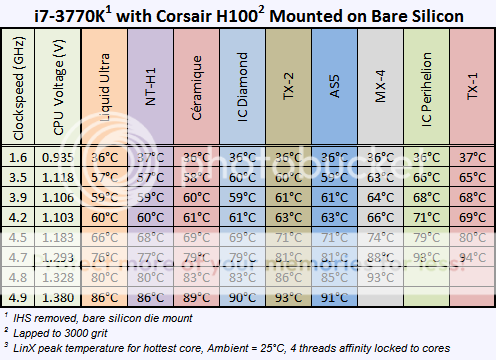
^ ranked from left to right in ascending order of poorer performance, lefthand side are TIMs with the best performance.
If Intel had assembled Ivy Bridge processors with both the existing gap as well as using AS5 instead of the existing stock CPU TIM then the temperatures on Ivy Bridge CPUs would have been all the worse. But if they had used something like Indigo Xtreme then the gap would have not been a concern.
Intel could not have used Liquid Ultra or Liquid Pro with their Ivy Bridge CPUs while having the gap, the liquid TIMs would not have stayed in place so it wasn't even an option.
Bottom line is that on a delidded Ivy Bridge the TIM does matter, don't use AS5 or anything that has poorer thermal conductivity than NT-H1 as you will be taking a step in the wrong direction. Use something on-par with NT-H1 or better, with Liquid Ultra being the best commercially available TIM to use.
Now this was some 6 or 7 months ago though, and even if that was the POR (plan of record) at the time there is still a chance that the POR has since changed.
However I think the more relevant question is "has Intel improved on the gap height between the CPU and the IHS?" as many of you have noted this is critical in determining the thermal performance of Ivy Bridge.
Also, I want to clear up any confusions my posts in the may have created. It is true the gap is responsible for Ivy Bridge's temperature issues. It is also true that Intel could have further improved on the situation by going with an even better TIM like Liquid Ultra.
What my tests showed was that the CPU TIM Intel does use under the IHS in their Ivy Bridge CPUs is on par with that of the quality of NT-H1 (itself considered to be a high quality TIM by enthusiasts).
But NT-H1 is not "the best" TIM out there, so it stands to reason that enthusiasts can likewise further improve on their delidding results by both reducing the gap height (delidding and removing all the black IHS adhesive material) and replacing the CPU TIM with a liquid-metal type TIM (Liquid Ultra has the best thermal conductivity).
From my thread on comparing 9 different TIMs with bare-die testing we can see that AS5 is quite a step back from NT-H1, which means AS5 is also quite a step back from Intel's stock CPU TIM.
Replacing the stock Intel TIM with AS5 is a step backwards, your thermal performance is going to be worse. The only reason the temperatures did not get worse is that in replacing the TIM with AS5 you also reduced the gap height, so things are less bad and your temperature do become somewhat lower.
^ ranked from left to right in ascending order of poorer performance, lefthand side are TIMs with the best performance.
If Intel had assembled Ivy Bridge processors with both the existing gap as well as using AS5 instead of the existing stock CPU TIM then the temperatures on Ivy Bridge CPUs would have been all the worse. But if they had used something like Indigo Xtreme then the gap would have not been a concern.
Intel could not have used Liquid Ultra or Liquid Pro with their Ivy Bridge CPUs while having the gap, the liquid TIMs would not have stayed in place so it wasn't even an option.
Bottom line is that on a delidded Ivy Bridge the TIM does matter, don't use AS5 or anything that has poorer thermal conductivity than NT-H1 as you will be taking a step in the wrong direction. Use something on-par with NT-H1 or better, with Liquid Ultra being the best commercially available TIM to use.
blastingcap
Diamond Member
- Sep 16, 2010
- 6,654
- 5
- 76

Last edited:


Grooveriding
Diamond Member
- Dec 25, 2008
- 9,147
- 1,330
- 126
Nasty. The one upside there is that he is only using 1.24V for 4.5, better than the other shot I've seen of 1.45V for 4.8. Although it is possible to need that sort of additional voltage for that much more of a clock speed bump.
Thing I dislike about CPU reviews is I can never find a site that really does a proper attempt at overclocking. I remember during the SB-E release a lot of sites just cranked voltage, like 1.4-1.5V, gave their attained clocks and called it good....
edit: apparently those above tests are with an Ultra 120 Extreme cooler and here is another anecdote with an H110 for cooling
http://www.overclock.net/t/1396010/its-official-haswell-is-on-fire/30#post_20083781
4.2Ghz@1.18v - 60 C
4.3Ghz@1.25v - 70 C
4.4Ghz@1.30v - 82 C
4.5Ghz@1.35v - 94 C
Last edited:
IDC, will you be getting a Haswell and delidding it this summer?
He's waiting for Broadwell, IIRC. I hope Intel gets their s*** together on making a better TIM or overclocking that 14nm CPU is gonna be a b****.

Yuriman
Diamond Member
- Jun 25, 2004
- 5,530
- 141
- 106
Yup, that's what I thought too.
That's even worse than Ivy unlidded.
Depends on the chip. My 3570K actually looks pretty similar to those numbers.
Depends on the chip. My 3570K actually looks pretty similar to those numbers.
Same here. Before I de-lidded my 3570K, I saw peak core temperatures of 99 degC (!!!) at 4.5 GHz.
TRENDING THREADS
-
 Discussion Zen 5 Speculation (EPYC Turin and Strix Point/Granite Ridge - Ryzen 9000)
- Started by DisEnchantment
- Replies: 25K
-
Discussion Intel Meteor, Arrow, Lunar & Panther Lakes + WCL Discussion Threads
- Started by Tigerick
- Replies: 24K
-
 Discussion Intel current and future Lakes & Rapids thread
- Started by TheF34RChannel
- Replies: 23K
-

-


AnandTech is part of Future plc, an international media group and leading digital publisher. Visit our corporate site.
© Future Publishing Limited Quay House, The Ambury, Bath BA1 1UA. All rights reserved. England and Wales company registration number 2008885.
 Facebook
 Twitter