What are legitimate reasons for citizens owning guns?

What are legitimate reasons for owning guns?


  • Total voters
    92

Atreus21

Lifer
Aug 21, 2007
12,001
571
126
Self defense is probably the most commonly deployed argument, and it applies directly to why I'm about to purchase a gun for the first time. I know that in several of the more gun-restricting countries, self defense is not sufficient justification.

Frankly, as paranoid as it seems, I think the best and ultimate justification is as a check against government tyranny. I assume this was in part the reason for its adoption in the first place. Usually I hear two objections to this:

One, that AR-15s have no chance against Abrams tanks, nuclear weapons and aircraft carriers, but I think the Taliban and Vietcong might disagree. Second, that the US government isn't likely to become tyrannical. But I think that's debatable, particularly in the wake of the 2016 election. Partisanship will lead us to do very stupid things.
 

Sonikku

Lifer
Jun 23, 2005
15,914
4,956
136
I think it was intended for citizens in a well regulated militia to have arms as a check against government as well as a means of defending their homes. Though certainly I can't imagine the founding fathers were thinking of futuristic guns like assault rifles and bump stocks when it came to making the 2nd amendment. They were thinking of one bullet pistols and muskets with very long reload times.

Even by the point of the civil war when technology was so much more advanced than the revolution that officers had revolvers, typical guns still took forever to load.
 
Last edited:

mdram

Golden Member
Jan 2, 2014
1,512
208
106
if this is your first firearm,a s you said, please seek training.
both safety and legal training
its always good to know the laws

i actually recommend the entire family be trained, if age appropriate
 
  • Like
Reactions: FerrelGeek

mdram

Golden Member
Jan 2, 2014
1,512
208
106
I think it was intended for citizens in a well regulated militia to have arms as a check against government as well as a means of defending their homes. Though certainly I can't imagine the founding fathers were thinking of 21st century guns like assault rifles and bump stocks when it came to making the 2nd amendment. They were thinking of one bullet pistols and muskets with very long reload times.

you forgot cannons, and battleships.
as many of them were privately owned at the time of the revolution
 

Atreus21

Lifer
Aug 21, 2007
12,001
571
126
I think it was intended for citizens in a well regulated militia to have arms as a check against government as well as a means of defending their homes. Though certainly I can't imagine the founding fathers were thinking of futuristic guns like assault rifles and bump stocks when it came to making the 2nd amendment. They were thinking of one bullet pistols and muskets with very long reload times.

Even by the point of the civil war when technology was so much more advanced than the revolution that officers had revolvers, typical guns still took forever to load.

Well, an interesting point from that is that the guns of their time put citizens on par with the military of their time. The same can most definitely not be said of our time.
 
  • Like
Reactions: Sonikku

bradly1101

Diamond Member
May 5, 2013
4,689
294
126
www.bradlygsmith.org
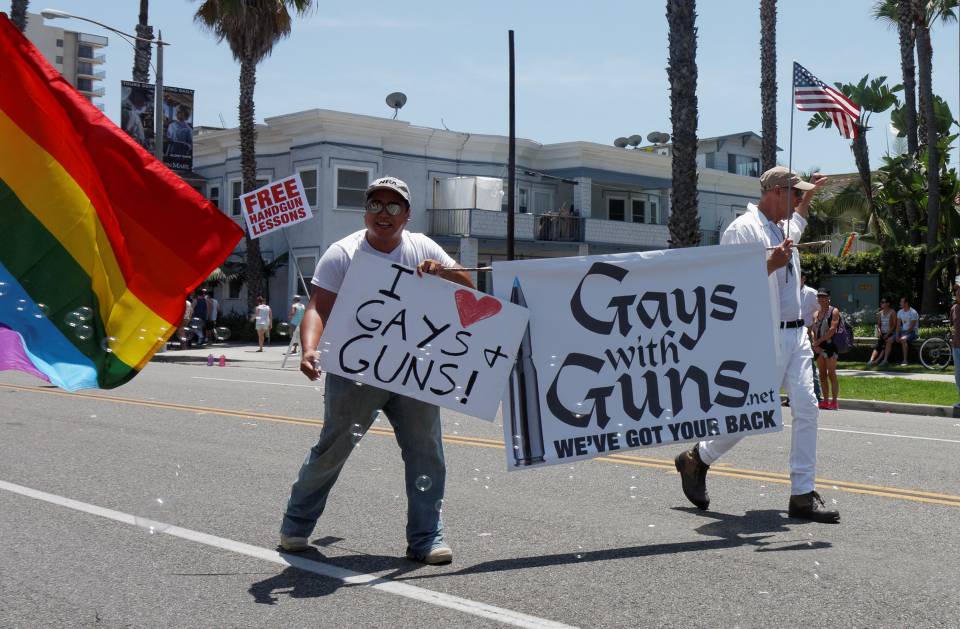
Guns are so gay. Watch out, these boys are fierce! (from my personal collection from a pride parade)
bac63a75f8a469a29a47cc881676c603.jpg
 
  • Like
Reactions: Atreus21

Atreus21

Lifer
Aug 21, 2007
12,001
571
126
if this is your first firearm,a s you said, please seek training.
both safety and legal training
its always good to know the laws

I am. There's a cop who offers a one-on-one all day shotgun course for only $50. The guy who recommended me to him says he essentially considers it a public service, hence the low price.

Not buying any ammo until I take it, except maybe some dummy rounds.

i actually recommend the entire family be trained, if age appropriate

I want my wife to take the class as well, but she's very resistant. My children are all under 7.
 

K1052

Elite Member
Aug 21, 2003
53,699
48,316
136
Frankly, as paranoid as it seems, I think the best and ultimate justification is as a check against government tyranny. I assume this was in part the reason for its adoption in the first place

Sorta kinda. Remember the government also sucessfully put down at least two armed insurrections with military force or the threat of it back in the early days and had little compunction about doing so. I think the world has changed so much that this isn't even necessary since we consistently have decide to give the government whatever it wants in the name of keeping us safe, even things we probably shouldn't.

I think the 2nd establishes and individual right but, as with all other rights, it is not unlimited. What exactly those limits should be is another conversation.
 

yllus

Elite Member & Lifer
Aug 20, 2000
20,577
432
126
It's an interesting question. My mind comes back to two things:

1. If the Jewish population in Germany circa 1930s was well-armed, would that be a check or even a full stop against Nazi aggression against them?

2. A gun is the ultimate force equalizer between a 250-pound man and a 120-pound woman. Are we saying we're willing to take that away from the woman?

I think the answer to #1 is complicated; there was a surprising amount of assent within the Jewish community in Germany to play along with whatever new rules got imposed upon them, thinking that with the latest set of rules those that hated them would finally leave them alone. I could see them trading in the majority of their guns willingly. On the other hand, had the SS come door to door, ain't nobody stopping them.

I guess #2 is complicated too, but even recent events have shown that the aggressor has a huge advantage - they're going to "win" a battle the majority of the time. So what does having a gun really help?
 

ivwshane

Lifer
May 15, 2000
33,727
17,377
136
People who say the 2nd is to fight against a tyrannical government, have obviously never read the constitution.
 

Paratus

Lifer
Jun 4, 2004
17,745
16,062
146
Self defense is probably the most commonly deployed argument, and it applies directly to why I'm about to purchase a gun for the first time. I know that in several of the more gun-restricting countries, self defense is not sufficient justification.

Frankly, as paranoid as it seems, I think the best and ultimate justification is as a check against government tyranny. I assume this was in part the reason for its adoption in the first place. Usually I hear two objections to this:

One, that AR-15s have no chance against Abrams tanks, nuclear weapons and aircraft carriers, but I think the Taliban and Vietcong might disagree. Second, that the US government isn't likely to become tyrannical. But I think that's debatable, particularly in the wake of the 2016 election. Partisanship will lead us to do very stupid things.

A couple of questions.

What about your situation makes you believe a firearm will be more likely to end a dangerous situation safely than the increased risk of owning a weapon to you and your family?

Have you considered any other methods of reducing your risk of becoming involved in a violent situation where you would need a firearm?
 

Atreus21

Lifer
Aug 21, 2007
12,001
571
126
Okay my curiosity has got me...two votes for other, what’s the “other “ reason?

Just a catch-all for anything I can't think of. I suppose people might say, "I'll own a gun for whatever reason I feel like - none of anyone's business."
 

bradly1101

Diamond Member
May 5, 2013
4,689
294
126
www.bradlygsmith.org
We're in P&N. There's a lot to debate, and perhaps the debate will never end. Try replacing the bolded words "sawed-off shotgun" below with "tactical weapon" or "bump stock."

Second Amendment
The Second Amendment of the United States Constitution reads: "A well regulated Militia, being necessary to the security of a free State, the right of the people to keep and bear Arms, shall not be infringed." Such language has created considerable debate regarding the Amendment's intended scope. On the one hand, some believe that the Amendment's phrase "the right of the people to keep and bear Arms" creates an individual constitutional right for citizens of the United States. Under this "individual right theory," the United States Constitution restricts legislative bodies from prohibiting firearm possession, or at the very least, the Amendment renders prohibitory and restrictive regulation presumptively unconstitutional. On the other hand, some scholars point to the prefatory language "a well regulated Militia" to argue that the Framers intended only to restrict Congress from legislating away a state's right to self-defense. Scholars have come to call this theory "the collective rights theory." A collective rights theory of the Second Amendment asserts that citizens do not have an individual right to possess guns and that local, state, and federal legislative bodies therefore possess the authority to regulate firearms without implicating a constitutional right.

In 1939 the U.S. Supreme Court considered the matter in United States v. Miller. 307 U.S. 174. The Court adopted a collective rights approach in this case, determining that Congress could regulate a sawed-off shotgun that had moved in interstate commerce under the National Firearms Act of 1934 because the evidence did not suggest that the shotgun "has some reasonable relationship to the preservation or efficiency of a well regulated milita . . . ." The Court then explained that the Framers included the Second Amendment to ensure the effectiveness of the military.

This precedent stood for nearly 70 years when in 2008 the U.S. Supreme Court revisited the issue in the case of District of Columbia v. Heller (07-290). The plaintiff in Hellerchallenged the constitutionality of the Washington D.C. handgun ban, a statute that had stood for 32 years. Many considered the statute the most stringent in the nation. In a 5-4 decision, the Court, meticulously detailing the history and tradition of the Second Amendment at the time of the Constitutional Convention, proclaimed that the Second Amendment established an individual right for U.S. citizens to possess firearms and struck down the D.C. handgun ban as violative of that right. The majority carved out Miller as an exception to the general rule that Americans may possess firearms, claiming that law-abiding citizens cannot use sawed-off shotguns for any law-abiding purpose. Similarly, the Court in its dicta found regulations of similar weaponry that cannot be used for law-abiding purposes as laws that would not implicate the Second Amendment. Further, the Court suggested that the United States Constitution would not disallow regulations prohibiting criminals and the mentally ill from firearm possession.

Thus, the Supreme Court has revitalized the Second Amendment. The Court continued to strengthen the Second Amendment through the 2010 decision in McDonald v. City of Chicago (08-1521). The plaintiff in McDonald challenged the constitutionally of the Chicago handgun ban, which prohibited handgun possession by almost all private citizens. In a 5-4 decisions, the Court, citing the intentions of the framers and ratifiers of the Fourteenth Amendment, held that the Second Amendment applies to the states through the incorporation doctrine. However, the Court did not have a majority on which clause of the Fourteenth Amendment incorporates the fundamental right to keep and bear arms for the purpose of self-defense. While Justice Alito and his supporters looked to the Due Process Clause, Justice Thomas in his concurrence stated that the Privileges and Immunities Clause should justify incorporation.

However, several questions still remain unanswered, such as whether regulations less stringent than the D.C. statute implicate the Second Amendment, whether lower courts will apply their dicta regarding permissible restrictions, and what level of scrutiny the courts should apply when analyzing a statute that infringes on the Second Amendment. As a general note, when analyzing statutes and ordinances, courts use three levels of scrutiny, depending on the issue at hand:
  1. strict scrutiny
  2. intermediate scrutiny
  3. rational basis
Recent lower-court case law since Heller suggests that courts are willing to uphold
  • regulations which ban weapons on government property. US v Dorosan, 350 Fed. Appx. 874 (5th Cir. 2009) (upholding defendant’s conviction for bringing a handgun onto post office property);
  • regulations which ban the illegal possession of a handgun as a juvenile, convicted felon. US v Rene, 583 F.3d 8 (1st Cir. 2009) (holding that the Juvenile Delinquency Act ban of juvenile possession of handguns did not violate the Second Amendment);
  • regulations which require a permit to carry concealed weapon. Kachalsky v County of Westchester, 701 F.3d 81 (2nd Cir. 2012) (holding that a New York law preventing individuals from obtaining a license to possess a concealed firearm in public for general purposes unless the individual showed proper cause did not violate the Second Amendment.)
More recently, the Supreme Court reinforced its Heller ruling in its Caetano v. Massachusetts (2016) decision. The Court found that the lower "Massachusetts Supreme Judicial Court was wrong in the three reasons it offered for why the state could ban personal possession or use of a “stun gun” without violating the Second Amendment." The Supreme Court, however, remanded the case without further instructions, so this per curiam ruling did not do much to further clarify the Supreme Court's stance on the Second Amendment.

https://www.law.cornell.edu/wex/second_amendment


 

soundforbjt

Lifer
Feb 15, 2002
17,788
6,041
136
Just a catch-all for anything I can't think of. I suppose people might say, "I'll own a gun for whatever reason I feel like - none of anyone's business."
No, I mean the people who voted other, I’m curious as to their reason, not the reason you included it.
 

Humpy

Diamond Member
Mar 3, 2011
4,464
596
126
Id own guns for the same reason I'd buy a Roku or a beer glass, I think they are neat.
 

bradly1101

Diamond Member
May 5, 2013
4,689
294
126
www.bradlygsmith.org
I think the best and ultimate justification is as a check against government tyranny.
Was that for a state to do (with their sponsored, regulated militias at the time) or for the individual? If the latter, why can't anyone just go to Washington with their gun and legally shoot up the tyrants? Did someone see Scalise as a tyrant? How did that go?
 

Atreus21

Lifer
Aug 21, 2007
12,001
571
126
A couple of questions.

What about your situation makes you believe a firearm will be more likely to end a dangerous situation safely than the increased risk of owning a weapon to you and your family?

Have you considered any other methods of reducing your risk of becoming involved in a violent situation where you would need a firearm?

What motivated me to purchase a gun was a spike in crime in my immediate neighborhood - literally my neighbor across the street (carjacked in the middle of the day by two kids who put a gun in her face as she sat on her porch) and a neighbor about 8 houses down who's home was invaded in the middle of the night while she, mercifully, was out of town.

That type of brazenness shakes me. I have four small children, a wife, and a mother-in-law in this house. If someone comes through that door at 2AM, I've presently got a machete and a hatchet to defend myself and my family with. That's not going to cut it (so to speak).

So there are several things I could do: Get an alarm system, get a dog, get a gun, move, or some combination. Financially, alarms and dogs are recurrently costly. As a practical deterrent in a physical fight, alarms won't do any more immediate help than calling the police would; dogs would though, big ones at least. The shotgun I'm getting is under $200. The security cabinet for it is about $300. That's comparatively inexpensive.

One of the reasons I'm getting a shotgun is precisely because they're big and heavy - not easy for children to pick up, load, and fire, unlike handguns.
 

Atreus21

Lifer
Aug 21, 2007
12,001
571
126
Was that for a state to do (with their sponsored, regulated militias at the time) or for the individual? If the latter, why can't anyone just go to Washington with their gun and legally shoot up the tyrants? Did someone see Scalise as a tyrant? How did that go?

I assume because with gun ownership comes a responsibility to distinguish tyranny from political opposition.