


- Oct 9, 1999
- 46,904
- 10,742
- 147
This is a fascinating, eye-rolling story about how our big giant manly National Security apparatus got repeatedly snookered to the tune of $20 million over an unbelievable 8 years by a two-bit, sleazeball con man and his fake terrorist software.
It's worth reading the entire article. The repeated failure to stop relying on this guy is sad and sobering.
Here's the first page of three. The article subsequently details the sleazy confluence of political influence which served to keep the scam alive. Again, it's worth reading the whole thing:
It's worth reading the entire article. The repeated failure to stop relying on this guy is sad and sobering.
Here's the first page of three. The article subsequently details the sleazy confluence of political influence which served to keep the scam alive. Again, it's worth reading the whole thing:
WASHINGTON For eight years, government officials turned to Dennis Montgomery, a California computer programmer, for eye-popping technology that he said could catch terrorists. Now, federal officials want nothing to do with him and are going to extraordinary lengths to ensure that his dealings with Washington stay secret.
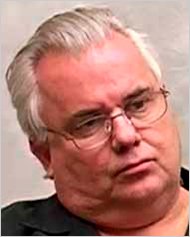
Dennis Montgomery
The Justice Department, which in the last few months has gotten protective orders from two federal judges keeping details of the technology out of court, says it is guarding state secrets that would threaten national security if disclosed. But others involved in the case say that what the government is trying to avoid is public embarrassment over evidence that Mr. Montgomery bamboozled federal officials.
A onetime biomedical technician with a penchant for gambling, Mr. Montgomery is at the center of a tale that features terrorism scares, secret White House briefings, backing from prominent Republicans, backdoor deal-making and fantastic-sounding computer technology.
Interviews with more than two dozen current and former officials and business associates and a review of documents show that Mr. Montgomery and his associates received more than $20 million in government contracts by claiming that software he had developed could help stop Al Qaedas next attack on the United States. But the technology appears to have been a hoax, and a series of government agencies, including the Central Intelligence Agency and the Air Force, repeatedly missed the warning signs, the records and interviews show.
Mr. Montgomerys former lawyer, Michael Flynn who now describes Mr. Montgomery as a con man says he believes that the administration has been shutting off scrutiny of Mr. Montgomerys business for fear of revealing that the government has been duped.
The Justice Department is trying to cover this up, Mr. Flynn said. If this unravels, all of the evidence, all of the phony terror alerts and all the embarrassment comes up publicly, too. The government knew this technology was bogus, but these guys got paid millions for it.
Justice Department officials declined to discuss the governments dealings with Mr. Montgomery, 57, who is in bankruptcy and living outside Palm Springs, Calif. Mr. Montgomery is about to go on trial in Las Vegas on unrelated charges of trying to pass $1.8 million in bad checks at casinos, but he has not been charged with wrongdoing in the federal contracts, nor has the government tried to get back any of the money it paid. He and his current lawyer declined to comment.
The software he patented which he claimed, among other things, could find terrorist plots hidden in broadcasts of the Arab network Al Jazeera; identify terrorists from Predator drone videos; and detect noise from hostile submarines prompted an international false alarm that led President George W. Bush to order airliners to turn around over the Atlantic Ocean in 2003.
The software led to dead ends in connection with a 2006 terrorism plot in Britain. And they were used by counterterrorism officials to respond to a bogus Somali terrorism plot on the day of President Obamas inauguration, according to previously undisclosed documents.
It Wasnt Real
Dennis would always say, My technology is real, and its worth a fortune, recounted Steve Crisman, a filmmaker who oversaw business operations for Mr. Montgomery and a partner until a few years ago. In the end, Im convinced it wasnt real.
Government officials, with billions of dollars in new counterterrorism financing after Sept. 11, eagerly embraced the promise of new tools against militants.
C.I.A. officials, though, came to believe that Mr. Montgomerys technology was fake in 2003, but their conclusions apparently were not relayed to the militarys Special Operations Command, which had contracted with his firm.
In 2006, F.B.I. investigators were told by co-workers of Mr. Montgomery that he had repeatedly doctored test results at presentations for government officials. But Mr. Montgomery still landed more business.
In 2009, the Air Force approved a $3 million deal for his technology, even though a contracting officer acknowledged that other agencies were skeptical about the software, according to e-mails obtained by The New York Times.
Hints of fraud by Mr. Montgomery, previously raised by Bloomberg Markets and Playboy, provide a cautionary tale about the pitfalls of government contracting. A Pentagon study in January found that it had paid $285 billion in three years to more than 120 contractors accused of fraud or wrongdoing.
Weve seen so many folks with a really great idea, who truly believe their technology is a breakthrough, but it turns out not to be, said Gen. Victor E. Renuart Jr. of the Air Force, who retired last year as the commander of the militarys Northern Command. Mr. Montgomery described himself a few years ago in a sworn court statement as a patriotic scientist who gave the government his software to stop terrorist attacks and save American lives. His alliance with the government, at least, would prove a boon to a small company, eTreppidTechnologies, that he helped found in 1998.
He and his partner a Nevada investor, Warren Trepp, who had been a top trader for the junk-bond king Michael Milken hoped to colorize movies by using a technology Mr. Montgomery claimed he had invented that identified patterns and isolated images. Hollywood had little interest, but in 2002, the company found other customers.
With the help of Representative Jim Gibbons, a Republican who would become Nevadas governor and was a longtime friend of Mr. Trepps, the company won the attention of intelligence officials in Washington. It did so with a remarkable claim: Mr. Montgomery had found coded messages hidden in broadcasts by Al Jazeera, and his technology could decipher them to identify specific threats.



 Facebook
 Twitter