• We’re currently investigating an issue related to the forum theme and styling that is impacting page layout and visual formatting. The problem has been identified, and we are actively working on a resolution. There is no impact to user data or functionality, this is strictly a front-end display issue. We’ll post an update once the fix has been deployed. Thanks for your patience while we get this sorted.

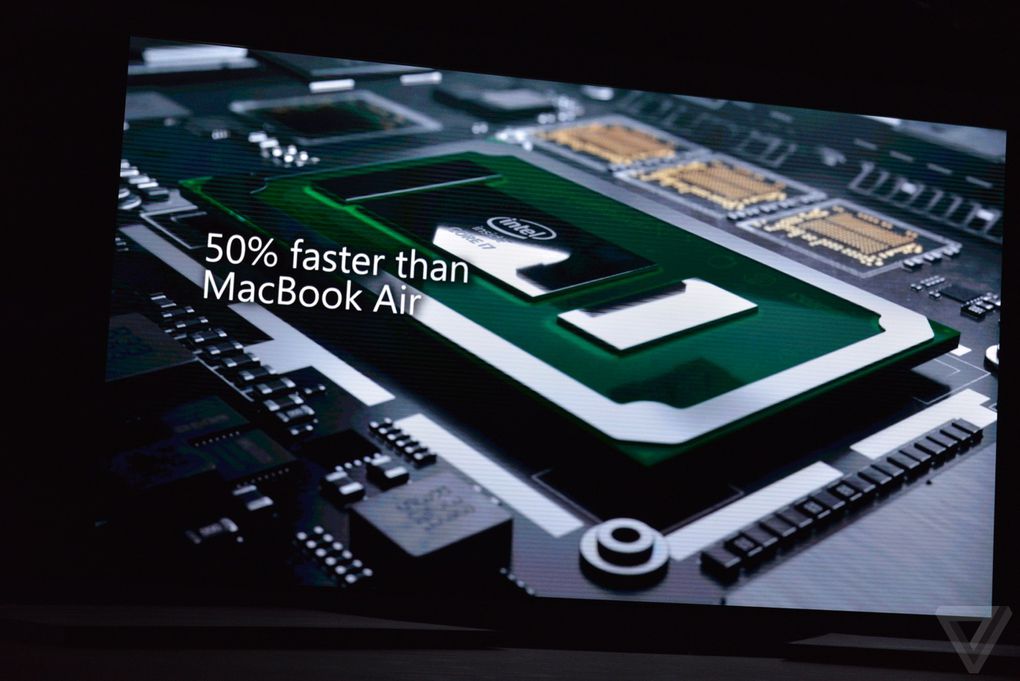
Surface Pro 4 = Skylake with eDRAM?

NTMBK

Lifer
Looks like the SP4 is getting eDRAM:

microsoft-surface-pro-3jpg.0.jpg


3 chips on the package, CPU, chipset and eDRAM?

http://www.theverge.com/2015/10/6/9...o-4-tablet-announced-specs-price-release-date
 
But the rumored 14"'er turned out to be .. the surface-book... Book? Rreally? Didnt take many seconds of success with a brand to begin cannibalizing on it.. surface, surface pro, surface book, surface everywhere...
cant wait to see the throttling profile on the SP4 though..
 
Starting at $1200? They've finally cracked the pipe and swallowed a piece of hot glass.
 
They really should implement something like crystalwell for Core M (Skylake-Y). The 5775C showed that EDRAM has very tangible benefits especially in gaming, something Core M really struggles with. If they can get 64 or 128MB of L4 and base clocks higher than 1.6Ghz they might be able to keep up with or even beat A9X, at least in CPU benchmarks.


I think you are going to see intel being forced to compete and possibly even up core counts very soon. If the new iPad pro ends up selling more than surface pro 4 by a large amount the writing will be on the wall and intel will have to respond or basically be driven out of the consumer SoC space. Obviously this is all hypothetical and would take years or even decades, nonetheless I think it's an important discussion.
 
They really should implement something like crystalwell for Core M (Skylake-Y). The 5775C showed that EDRAM has very tangible benefits especially in gaming, something Core M really struggles with. If they can get 64 or 128MB of L4 and base clocks higher than 1.6Ghz they might be able to keep up with or even beat A9X, at least in CPU benchmarks.

According to Anand, the 128MB eDRAM consumes 3.5W-4.5W at full load, basically the entire TDP of a Core M chip.

I think that this will only become feasible at the 10nm generation. If Intel can integrate the PCH into the main CPU die at 10nm (getting a 2x generational jump there), and build an enhanced eDRAM on 14nm, then a 32MB eDRAM could make a lot of sense on a future Y-series part.
 
That's incorrect. 128MB uses ~960mW. 64MB with ~500mW or so also fits it into 15W down to 7.5W CPUs.

3-4W for 128MB would be utterly insane. That's around what my 16GB of DDR4 uses.
 
Last edited:
That's incorrect. 128MB uses ~960mW. 64MB with ~500mW or so also fits it into 15W down to 7.5W CPUs.

3-4W for 128MB would be utterly insane. That's around what my 16GB of DDR4 uses.

Nonsense. 128MB eDRAM uses 960mW in STANDBY. The 2nd Gen featured in Broadwell reduces it to 1/4th which would make it ~250mW.

http://www.intel.com/content/dam/ww...n-core-mobile-embedded-thermal-mech-guide.pdf

TDP: eDRAM is quoted as 4W. That is: 3W DRAM + 1W OPI

Low standby power is why Intel was able to put it on 15W U chips that feature super low idle power. But you aren't going to see this in Y chips.

1/2 the capacity does not mean half the power either. It would be highly dependent on usage. It's plausible that 64MB in the U chips use less than 4W, but probably not half.
 
Last edited:
Nonsense. 128MB eDRAM uses 960mW in STANDBY. The 2nd Gen featured in Broadwell reduces it to 1/4th which would make it ~250mW.

http://www.intel.com/content/dam/ww...n-core-mobile-embedded-thermal-mech-guide.pdf

TDP: eDRAM is quoted as 4W. That is: 3W DRAM + 1W OPI

Low standby power is why Intel was able to put it on 15W U chips that feature super low idle power. But you aren't going to see this in Y chips.

1/2 the capacity does not mean half the power either. It would be highly dependent on usage. It's plausible that 64MB in the U chips use less than 4W, but probably not half.

thanks for pointing out the facts.
 
Nonsense. 128MB eDRAM uses 960mW in STANDBY. The 2nd Gen featured in Broadwell reduces it to 1/4th which would make it ~250mW.

http://www.intel.com/content/dam/ww...n-core-mobile-embedded-thermal-mech-guide.pdf

TDP: eDRAM is quoted as 4W. That is: 3W DRAM + 1W OPI

Low standby power is why Intel was able to put it on 15W U chips that feature super low idle power. But you aren't going to see this in Y chips.

1/2 the capacity does not mean half the power either. It would be highly dependent on usage. It's plausible that 64MB in the U chips use less than 4W, but probably not half.


Actually in solution like eDRAM what matters the most is standby power. It is not unreasonable to expect that for quite a few workloads it is cheaper in power to go to EDRAM instead of DRAM ( even if power use is higher it allows CPU/GPU to complete race to sleep earlier ).

That was with GEN4/5 stuff, where there was additional sideeffect of burning 2MB of L3 for tags and checking them is not free either. With Skylake it can potentially save even more by virtue of having more L3 and beeing transparent and fully coherent with the rest of the system ( think GPU or some crazy PCIE NVM 1.5GB/s stream beeing consumed and not touching DRAM at all by virtue of having 64MB of buffer.


EDIT: I am not claiming about some magic performance without power use, just pointing out that for device with peak performance X, the only additional tax is standby power.
 
Starts at $899. . .

Yeah, thats for the Core m3, which I assume is the same Intel chip thats in the MacBook 12".

The i7 version starts at $1599, yes nearly double the price. Aren't these the chips that MS is bumming up about....so nowhere near the entry price of $899.
 
Yeah, thats for the Core m3, which I assume is the same Intel chip thats in the MacBook 12".

The i7 version starts at $1599, yes nearly double the price. Aren't these the chips that MS is bumming up about....so nowhere near the entry price of $899.
And yet for $999 one can preorder an i5 version of Surface Pro 4. Quite close to the entry price. With 128GB of storage and 4GB of RAM it matches the $949 iPad Pro.

Also, when looking at more beefier machines (8GB RAM, 256GB SSD)
MacBook Air 13 $1199
MacBook $1299 (Core M)
Surface Pro 4 $1299 (i5)
MacBook Pro 13 $1499 (i5)
Surface Book $1699 (i5)

Microsoft matched their competition price wise, while arguably making the more interesting offer.
 
And yet for $999 one can preorder an i5 version of Surface Pro 4. Quite close to the entry price. With 128GB of storage and 4GB of RAM it matches the $949 iPad Pro.

Matches it in what way? Processor? GPU? Screen? Thickness?

Also, when looking at more beefier machines (8GB RAM, 256GB SSD)
MacBook Air 13 $1199
MacBook $1299 (Core M)
Surface Pro 4 $1299 (i5)
MacBook Pro 13 $1499 (i5)
Surface Book $1699 (i5)

Microsoft matched their competition price wise, while arguably making the more interesting offer.

Microsoft are placing themselves as a premium manufacturer, hence the pricepoint. They have already done this from the Surface v1, which was comparable pricewise with the iPad at the time, but it didn't sell.

The Surface Book looks good, but it's a fortune TBH and is the detachable Surface part as good as a normal Surface Pro 4?
 
Matches it in what way? Processor? GPU? Screen? Thickness?
Price, processing power, memory & storage, weight, screen.

The Surface Book looks good, but it's a fortune TBH
Both Pro and Book devices are marketed towards professionals, their higher tier specs clearly cater towards people who use them as work tools.

and is the detachable Surface part as good as a normal Surface Pro 4?
Why wouldn't it be?
 
And yet for $999 one can preorder an i5 version of Surface Pro 4. Quite close to the entry price. With 128GB of storage and 4GB of RAM it matches the $949 iPad Pro.

Also, when looking at more beefier machines (8GB RAM, 256GB SSD)
MacBook Air 13 $1199
MacBook $1299 (Core M)
Surface Pro 4 $1299 (i5)
MacBook Pro 13 $1499 (i5)
Surface Book $1699 (i5)

Microsoft matched their competition price wise, while arguably making the more interesting offer.

Yet if they all throttle to the same baseline under load, incentive to move up the price-ladder disappears. So far its looking good, but i'll still argue that without a firm review of the throttling profile we have no way of assessing if the pricepoints make sense.
 
Price, processing power, memory & storage, weight, screen.

To me it looks like the iPad Pro is predominantly aimed at the design professional, whereas the Surface Pro is aimed at the general professional, ie microsoft suite of apps.

We've not had any proper specs about the processing power of the iPad Pro, but on paper, it looks like the GPU is geared up to allow for pretty impressive performance which will assist designers. You certainly pay that bit extra for the 128Gb storage compared to the basic 32Gb, but at least there is the option. The keyboards for both iPad Pro and Surface Pro are expensive, so 3rd party versions for both will help with costs. And the iPad Pro had a slightly larger screen and is slightly thinner and quite a bit lighter than the i5 version of the Surface.

It will be interesting to see where this goes though.

 
To me it looks like the iPad Pro is predominantly aimed at the design professional, whereas the Surface Pro is aimed at the general professional, ie microsoft suite of apps.

We've not had any proper specs about the processing power of the iPad Pro, but on paper, it looks like the GPU is geared up to allow for pretty impressive performance which will assist designers. You certainly pay that bit extra for the 128Gb storage compared to the basic 32Gb, but at least there is the option. The keyboards for both iPad Pro and Surface Pro are expensive, so 3rd party versions for both will help with costs. And the iPad Pro had a slightly larger screen and is slightly thinner and quite a bit lighter than the i5 version of the Surface.

It will be interesting to see where this goes though.

The graphics performance on the Surface and Ipad Pro should be pretty close, with the Surface winning in things like 3dmark and the Ipad likely winning in things like GFXBench. And that is taking Apple's claim of 2x GPU performance of Ipad Air 2 literally across all benchmarks.
 
To me it looks like the iPad Pro is predominantly aimed at the design professional, whereas the Surface Pro is aimed at the general professional, ie microsoft suite of apps.

We've not had any proper specs about the processing power of the iPad Pro, but on paper, it looks like the GPU is geared up to allow for pretty impressive performance which will assist designers. You certainly pay that bit extra for the 128Gb storage compared to the basic 32Gb, but at least there is the option. The keyboards for both iPad Pro and Surface Pro are expensive, so 3rd party versions for both will help with costs. And the iPad Pro had a slightly larger screen and is slightly thinner and quite a bit lighter than the i5 version of the Surface.

It will be interesting to see where this goes though.
The SP4 is actively cooled, while the iPad Pro is passively cooled, so the SP4 will certainly have better performance. That's also the reason for the differences in weight and thickness, so it's a choice of what you value more.

Also, it's worth noting that the Pen is included in the SP4 price, while it costs $100 extra for the iPad Pro.
 
Back
Top