
• We’re currently investigating an issue related to the forum theme and styling that is impacting page layout and visual formatting. The problem has been identified, and we are actively working on a resolution. There is no impact to user data or functionality, this is strictly a front-end display issue. We’ll post an update once the fix has been deployed. Thanks for your patience while we get this sorted.

Speculation on Zen's chipset

Page 2 - Seeking answers? Join the AnandTech community: where nearly half-a-million members share solutions and discuss the latest tech.
http://www.kitguru.net/components/c...-chipset-development-outsourcing-deal-report/


Seems like a smart move by AMD. Keep all the high performance stuff on the APU die, and outsource the rest to an external partner.

This way we'll likely get USB 3.1 etc faster, since AsMedia already has that in store. Compare that to Intel, which will not have USB 3.1 even for the Skylake chipsets.

At least Intel's implementation won't be the piece of crap AsMedia makes. Pretty typical of AMD though, their chipsets have pretty much always sucked.
 
At least Intel's implementation won't be the piece of crap AsMedia makes. Pretty typical of AMD though, their chipsets have pretty much always sucked.

Care to clarify and back that up with some solid evidence? And why does major motherboard manufacturers like ASUS often use Asmedia chipsets then!?
 
That became about Intel quickly. And by the AMD fans crapping in an AMD thread.

You're the one who brought Intel into the thread in the first place, and now you complain about derailing? Get a grip.

My prediction is that Zen's chipset will be thoroughly dull, just like the chipset of every other chip in the past five years. Anything interesting is integrated into the CPU.
 
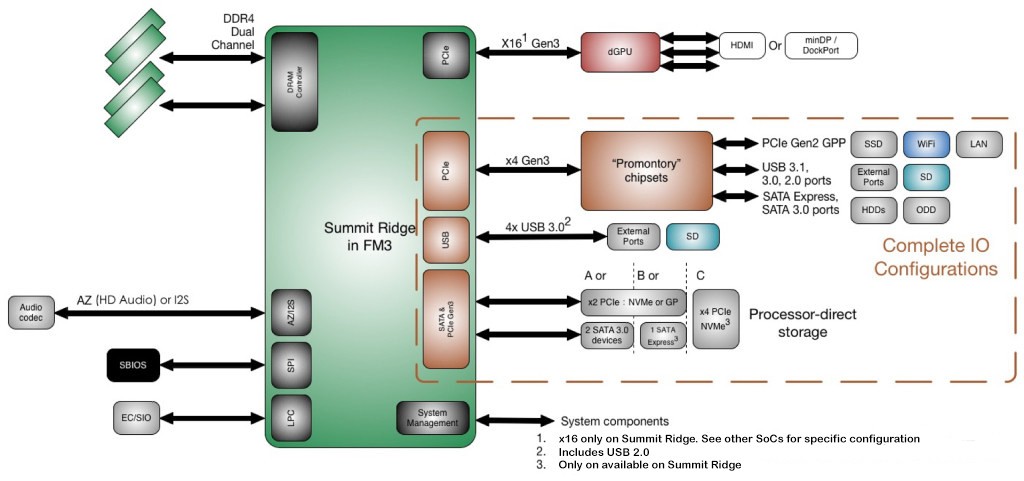
btw, I knew I had seen the name before, but the AM4 chipset (formerly FM3 chipset) does have the FCH on the board. The chip is called Promontory:

http://www.kitguru.net/components/c...r-direct-nvme-storage-promontory-pch-usb-3-1/

Yeah this ain't AM3+ rehashed.


If the following diagram from the above link is true, would it possible to use option A or B for processor direct storage (and use the two General purpose PCIe lanes for LAN, Wifi, etc).

amd_promontory_features_capabilities-1024x481.jpg


Then get rid of the PCH for a SoC based AM4 motherboard? (ie, have two levels of AM4 motherboards, one that is SoC based and one with PCH).
 
If the following diagram from the above link is true, would it possible to use option A or B for processor direct storage (and use the two General purpose PCIe lanes for LAN, Wifi, etc).

Then get rid of the PCH for a SoC based AM4 motherboard? (ie, have two levels of AM4 motherboards, one that is SoC based and one with PCH).

That would be up to the individual board manufacturers to implement such a solution. I'm not sure that your typical integrated sound/network solutions are capable of functioning as standalone PCIe devices. I don't see why not, but that assessment may be meaningless in this situation.
 
If the following diagram from the above link is true, would it possible to use option A or B for processor direct storage (and use the two General purpose PCIe lanes for LAN, Wifi, etc).

amd_promontory_features_capabilities-1024x481.jpg


Then get rid of the PCH for a SoC based AM4 motherboard? (ie, have two levels of AM4 motherboards, one that is SoC based and one with PCH).
Likely both can be used together, since the chipset is seemingly just a hub of I/O which takes a x4 connection. The clock gen, SMBus and BIOS stuff are moved onto the SOC already. It is possible that the x4 connection can be split into four x1 GPP either.
 
Last edited:
Just search the forums here. What's the answer to most SATA issues? Stop using the AsMedia ports.

Yup. It has been the solution to both of the 2 sata problems I've ever had, and the sata problems a handful of my friends have had.

They're garbage.
 
What does HyperTransport have to do with memory?
Nothing per se, since it is a bus, but, I was just saying that HyperTransport 3.1 can handle around 26GB/s, so if they have a 3.1 bus to the southbridge, it will allow faster transfers.
cd00c4909941504fbb116f8ffc343e3021caff0f8a283a4424392f65bc1cd9b3
 
Nothing per se, since it is a bus, but, I was just saying that HyperTransport 3.1 can handle around 26GB/s, so if they have a 3.1 bus to the southbridge, it will allow faster transfers.

That wont happen. Its going to be PCIe based A-Link Express.
 
If the following diagram from the above link is true, would it possible to use option A or B for processor direct storage (and use the two General purpose PCIe lanes for LAN, Wifi, etc).

amd_promontory_features_capabilities-1024x481.jpg


Then get rid of the PCH for a SoC based AM4 motherboard? (ie, have two levels of AM4 motherboards, one that is SoC based and one with PCH).

Likely both can be used together, since the chipset is seemingly just a hub of I/O which takes a x4 connection. The clock gen, SMBus and BIOS stuff are moved onto the SOC already.

So maybe a motherboard with M.2 ultra instead of the Promotory chipset works? Then put the LAN and Wifi on the general purpose lanes labeled under "Processor direct storage"?

If so, that would give the user one M.2 ultra, plus two SATA ports (or one SATA express), two General purpose PCIe lanes, PCIe x16. Then maybe the PCIe x16 lane could be split up into x8, x4 ,x 4.

Then the two x4 lanes could also be used for M.2 ultra. This yielding three M.2 ultra, Two SATA/One SATA express, two General purpose PCIe lanes (for LAN, Wifi, etc), PCIe x8.

P.S. Also wondering if we end up seeing AMD make a laptop SoC out of Summit Ridge? (This with lowered TDP, of course)

It is possible that the x4 connection can be split into four x1 GPP either.

If so, then one of the SATA could be dropped and that would leave three General purpose PCIe x1.
 
At least Intel's implementation won't be the piece of crap AsMedia makes.
I agree with that. ASmedia is probably lower-tier than Via, IMO.

Pretty typical of AMD though, their chipsets have pretty much always sucked.
This I disagree with. Ever since AMD took chipset design in-house, other than their 690 chipset not being able to handle > 4GB DMA, their other chipsets have all been solid.

I won't say that they have "leading performance in the industry", but to me, solid and stable is not "sucks".
 
AMD's 7xx chipsets weren't great (especially 740...). Many documented erata with these chipsets. Not to mention issues with many SSD controllers and lack luster performance compared to Intel's ICH10, 9 and 8.

I have built quite a few systems over the years with motherboards using those chipsets and most of the time things are fine if running a HDD but certain SSDs don't play nice with these southbridges and performance is always worse than Intel's southbridges. Not to mention crap HPET on most boards with them and other miscellaneous issues.

Always preferred nForce chipsets for AMD boards, even with the usually lack lustre first party driver support.
 
Last edited:
Hopefully Promontory is the much vaunted AMD 1090FX chipset - except since it's going to be 2016 before it's released and the PCI-E 4.0 spec has already been ratified it should support PCI-E 4.0 which next generation HBM solutions like Pascal and Fiji 2 should support.
 
Back
Top