• We’re currently investigating an issue related to the forum theme and styling that is impacting page layout and visual formatting. The problem has been identified, and we are actively working on a resolution. There is no impact to user data or functionality, this is strictly a front-end display issue. We’ll post an update once the fix has been deployed. Thanks for your patience while we get this sorted.

Skylake may feature "inverse hyperthreading"?

tipoo

Senior member
http://wccftech.com/intel-inverse-hyper-threading-skylake/

The concept here is sort of like VISC, taking multiple cores and getting them to appear as a single one, the opposite of what hyperthreading does, so that each core can work on the same software thread.
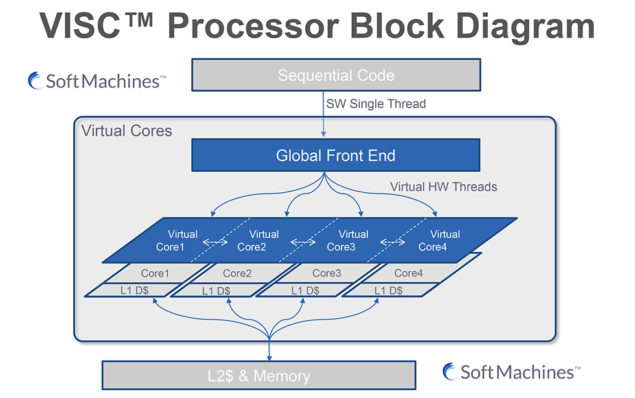
VISC_Title-635x398.jpg


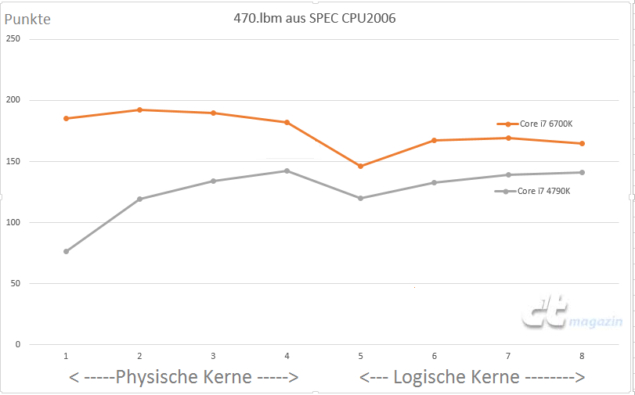
Skylake-Inverse-Hyper-Threading-benchmark-635x395.png


The following benchmark is a result of the SPEC CPU2006 suite courtesy of Heise.de. The first 4 points on the x axis represent physical cores, and the next 4 represent logical cores. As you can see, single threaded performance has taken an absolutely huge jump from the Haswell counterpart to Skylake. Infact, the performance doesn’t increase as more threads are activated. It actually goes down. This is a trend that is the exact opposite of the Haswell counterpart in which performance increases as more threads come online. The reason why this could be happening is because all 4 physical cores are already powering the single thread so as more threads come online, software inefficiency results in a declining trend.


This obviously means that there is going to be an absolutely, absolutely massive boost in performance of single threaded applications in which a Skylake processor is used. This is pretty huge folks. Also (caution: opinion), I suspect, part of Intel’s “Global Shortage” has something to do with the fact that they have yet to reveal the biggest selling point of the Skylake processor to the consumers. Which go a long way in exponentially increasing demand.

Not sure I believe it yet, seems like something Intel would shout from the rooftops at the first reviews, but...I guess we'll see soon enough with IDF starting. I hope they're not just seeing Turbo Boost in that graph or something. Perhaps AVX-512 brings a bigger boost to single cores, but takes too much power for more than two to return a huge benefit.
 
Last edited:
Oh boy, first it was "Skylake might have Morph Core" and now it's "Inverse Hyperthreading" (relabeling of the rumored "reverse hyperthreading" that was rumored for an AMD processor back in the day).
 
Someone figured out a nice clickbait it seems...

It whould be nice if they have that, but i also feel they whould not keep quiet about it and the difference should be bigger, 25% is not very efficient.
 
I was similarly skeptical, I think maybe Skylakes advanced instructions just take too much power on multiple cores so the most advantage is seen on 1-2 and the reviewer just got confused with that. Just wanted to give the idea a fair shake.
 
People are way overhyping this, even if its true:

"For measurements in the c't laboratory showed a particular application of the SPEC CPU2006-Suite"

"But that seems to work only with pure single-threaded operation and in certain load situations."

It's not even in full SpecCPU 2006 suite.
 
Well, the "massive ST performance" is wrong, in any case. It's just an evolutionary improvement.

Secondly, no need for rumors given IDF is later today.

I hope AnandTech is already briefed with deep dive appearing today.
 
memguard-memory-bandwidth-reservation-system-for-efficient-performance-isolation-in-multicore-platforms-6-638.jpg

Hold your horses
There is no inverse hyperthreading

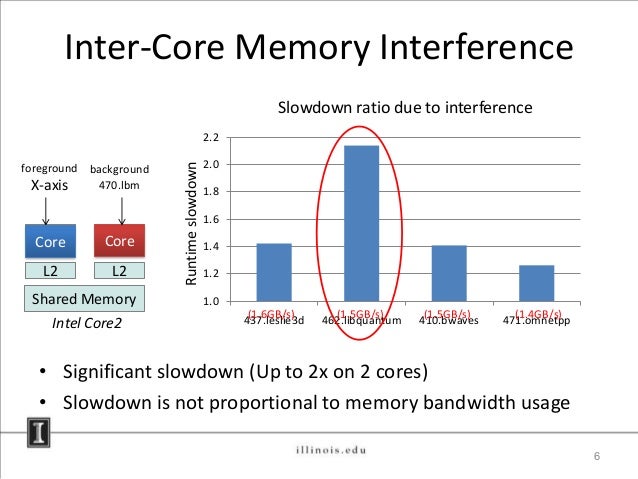
The test in question (470.lbm) is very demanding for memory bandwidth. To the extent that there is only enough bandwidth for 1 thread. And every subsequent thread is slowed by the factor of 2 in memory starvation conditions.

Skylake has more bandwidth and more efficient cache thats why its faster in single thread, but two or more threads still get slowed down.
 
Perhaps AVX-512 brings a bigger boost to single cores, but takes too much power for more than two to return a huge benefit.
Witeken and alecmg gave the likeliest reasons, but to clarify, there's no AVX-512 on the chip Heise.de ran 470.lbm on.
 
memguard-memory-bandwidth-reservation-system-for-efficient-performance-isolation-in-multicore-platforms-6-638.jpg

Hold your horses
There is no inverse hyperthreading

The test in question (470.lbm) is very demanding for memory bandwidth. To the extent that there is only enough bandwidth for 1 thread. And every subsequent thread is slowed by the factor of 2 in memory starvation conditions.

Skylake has more bandwidth and more efficient cache thats why its faster in single thread, but two or more threads still get slowed down.

/thread :thumbsup:
 
Someone figured out a nice clickbait it seems...

It whould be nice if they have that, but i also feel they whould not keep quiet about it and the difference should be bigger, 25% is not very efficient.

Well, the "massive ST performance" is wrong, in any case. It's just an evolutionary improvement.

Secondly, no need for rumors given IDF is later today.

I hope AnandTech is already briefed with deep dive appearing today.

Pheraps you are both missing the fact that in 1 thread load that diagram shows Skylake score 2.5x times more than Haswell, then it just drops or can't scale anymore 😉
 
then it just drops or can't scale anymore
Thats the peculiarity of lbm.470 test. It has been shown before to scale negatively beyond 2 threads. Something to do with concurrent memory writing.
Look at slides
These guys develop software to deal with this kind of anomalous program behaviour.

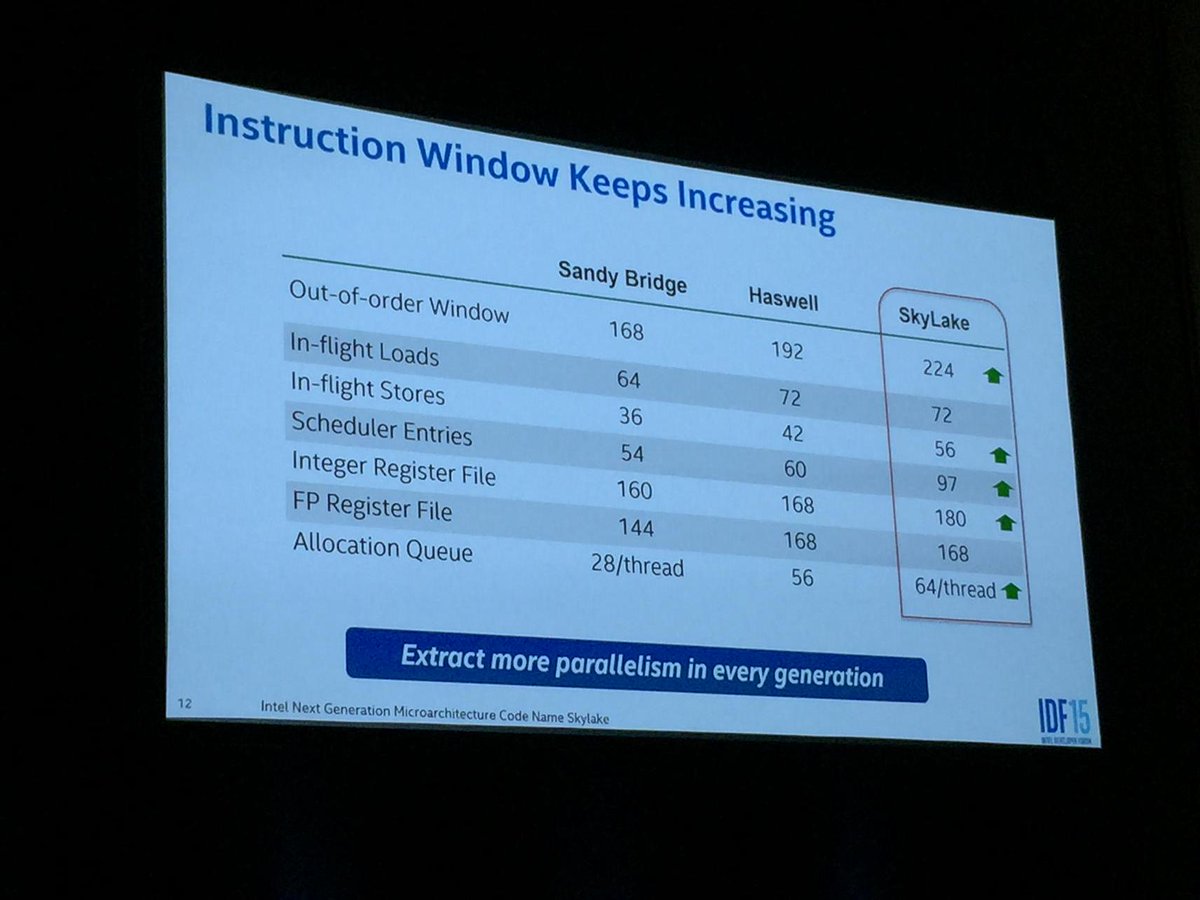
Skylake eliminated some other bottleneck in its memory system that allows 470.lbm to scale over 100%. Either more efficient memory writing or better prefetching did the trick. No need to invent "inverse hyperthreading".
We know 470.lbm is weird test (read badly written), no other single threaded test (even in same SPEC 2006 package) shows this behaviour.
 
Pheraps you are both missing the fact that in 1 thread load that diagram shows Skylake score 2.5x times more than Haswell, then it just drops or can't scale anymore 😉
470.lbm has already been shown not to scale beyond one core on a Q9550 (page 118 & 119).

You can also read about memory bandwidth requirements of 470.lbm in this article. Note this article is from the same authors as the slides linked to by alecmg.
 
Sorry to ask, I am still looking at what you posted... yet in this case why does Haswell scale with 1 to 4 threads and almost doubles the score, let's ignore what happens with virtual threads for the moment, but not Skylake?

If it's just a question of bandwidth limitation then Haswell should show the same regression after 1 thread, or not?

I'm only trying to understand what's happening there, not really expecting inverse-ht or whatever to be a thing to be honest. If it was real we would have heard of it months ago, not weeks after release...
 
Skylake improved cache hierachy substantially and probably has even more advanced prefetching going on. Now the chip can saturate whole available bandwith with 1 thread and there is no improvement with more cores working. Once core caches and TLB's are contested by HT thread, perf breaks down.

Intel built cores for AVX512, that need to load/store a truckload of bytes each cycles ( we will see improvements in hard numbers soon), even with avx512 instructions disabled, these resources are there.
 
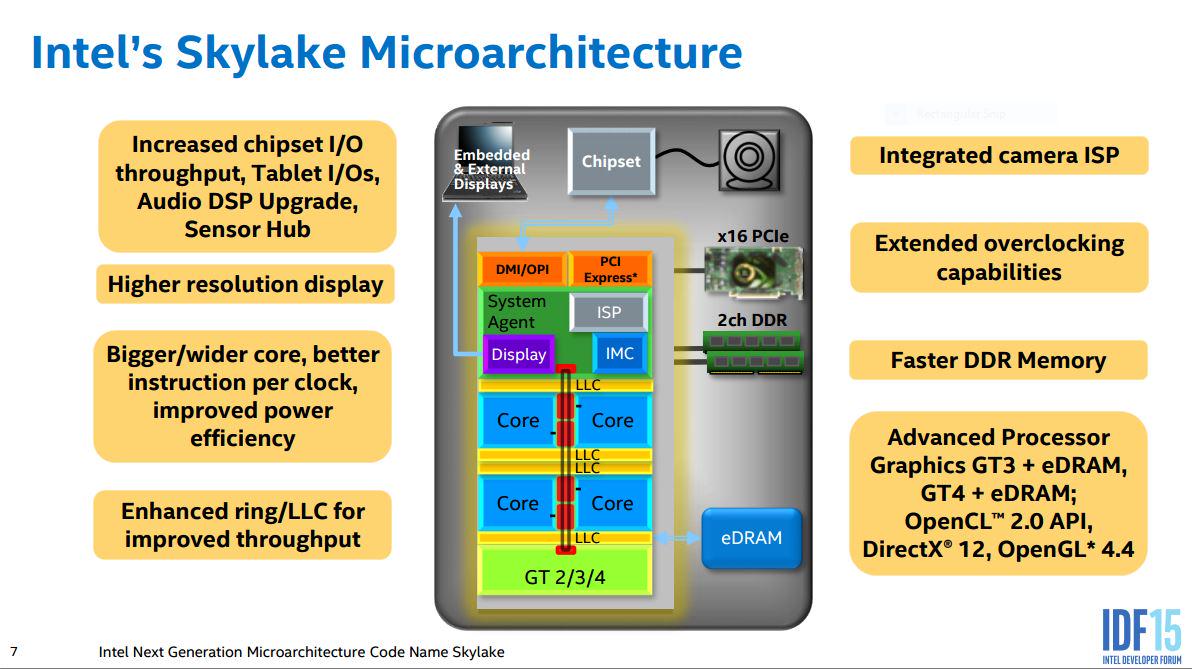
There have also been some suspicious improvements in Photoshop (Tom's Hardware) and at least one other benchmark. These improvements only happen under Windows 10. But I suspect this may relate more to DirectX 12 and better integration with the iGPU than to any kind of "inverse hyperthreading".
 
It might be magic...

Arthur C. Clarke said:
Any sufficiently advanced technology is indistinguishable from magic.

...but I'm going to lean towards this being due to Intel's crafty engineers having come up with a sufficiently advanced technology.
 
As this rHT rumour was created by Andreas Stiller himself, we should also track their news regarding the current state of this rumour.

Original rumour source:
http://www.heise.de/newsticker/meldung/Skylake-mit-inversem-Hyper-Threading-2779793.html

Update based on IDF informations:
Inverses Hyper-Threading, wie hier aufgrund von merkwürdigen Messergebnissen spekuliert wurde, unterstützt der Skylake indes nicht. Für die zuweilen erhebliche Beschleunigung von Single-Thread-Anwendungen sind andere Verbesserungen verantwortlich
Translated:
Inverse Hyper-Threading, as speculated here due to strange measurement results, is not supported by Skylake. Other improvements are responsible for the sometimes considerable acceleration of single-thread applications
http://www.heise.de/newsticker/meld...in-wenig-die-Skylake-Architektur-2784862.html
 
Back
Top