• We’re currently investigating an issue related to the forum theme and styling that is impacting page layout and visual formatting. The problem has been identified, and we are actively working on a resolution. There is no impact to user data or functionality, this is strictly a front-end display issue. We’ll post an update once the fix has been deployed. Thanks for your patience while we get this sorted.

Skience Qwestshun

No, I mean this because I really don't know. Skience was never my interest of any kind and I'm dummer'n a salty squirrel gizmo.. And I don't need a bunch of formulas or graphs or 8 dollar words.


If an object weighs in at 1500 lbs on the surface and is lowered into a 500' deep hole, is it still 1500 lbs, or is it heavier?
 
Technically its lighter because the mass above it is acting in the opposite direction.
Right. If the Earth were the same density all the way through, weight would decrease linearly to the core, and the 1500 lb object would be about half an ounce lighter.

But Earth isn't the same density all the way through. The iron core is a lot more dense than sand on the surface, for instance. So I'm guessing maybe a quarter ounce lighter?
 
Technically its lighter because the mass above it is acting in the opposite direction.
Sure and your feet are lighter because the rest of your body produces an anti gravity field as well.

On the other hand you also have 500' more air about the object pressing down on it.
 
Sure and your feet are lighter because the rest of your body produces an anti gravity field as well.

On the other hand you also have 500' more air about the object pressing down on it.
As i understand it that impacts the air pressure around said object but not its weight.
 
Maybe???

 
As i understand it that impacts the air pressure around said object but not its weight.
Since air is considered a fluid, that pressure from all sides would be, just as the pressure of water, a lifting force.
But also just as a body on the ground of the sea it would press on you and make you heavier as well.
You have to calculate all of the forces that apply on the body, but since all of them are practically zero compared to the weight of the body it wouldn't make much sense to do so.
 
genimage1.jpeg
 
Gravimeters can measure the difference in gravity between sitting on a table and being moved down to the floor next to the table, very sensitive. Differences in gravity among Olympics locations are sufficient to render comparisons in ski jumps between Olympics meaningless.
 
Technically its lighter because the mass above it is acting in the opposite direction.
But isn't there also less angular momentum on the object, given that it'll be moving slower? That should make it heavier (or more specifically, should increase gravity's effect on the mass), yes?

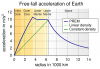
EDIT: Ahah! You are 'heavier' until a bit into the outer core.
1661444806284.png

Bonus science note, if you drill in through the true poles, your weight loss should be consistent with the varied density until the core, then pretty linear until weightlessness at the core. If you drill in from the equator, the above will happen. The closer to the poles you are, the less effect the loss of angular momentum will have.
 
Last edited:
Gravity (education.vic.gov.au)

The weight is the force applied by gravity on the object. Gravity increases as we get closer to the center of the Earth. So the weight will increase but mass remains same.

Another way to think about this is:

If two objects of the same mass are dropped from a height of 1 meter from ground level and one lands at ground level while the other lands in the 500' deep hole (so more than 150 meters), the mass hitting the bottom of the hole will do more damage since gravity pulled on it much more and it accelerated more.
 
Back
Top