

I've been reading Rogoff and Reinhart's "This Time is Different" and on page 76 is an eye-opening figure. It graphs sovereign defaults and inflation. There is a strong correlation. You can find the graph here:
http://www.voxeu.org/index.php?q=node/1067
It's easy to make fun of the people who are buying up gold but the data does not lie. For those who say we should not expect future inflation, is this time really different?
http://www.voxeu.org/index.php?q=node/1067
The inflation-default cycles
Figure 4 on inflation and external default (1900 to 2006) illustrates the striking correlation between the share of countries in default on debt at one point and the number of countries experiencing high inflation (which we define to be inflation over 20 percent per annum). Thus, there is a tight correlation between the expropriation of residents and foreigners.
As noted, investment banks and official bodies, such as the International Monetary Fund, alike have argued that even though total public debt remains quite high today in many emerging markets, the risk of default on external debt has dropped dramatically because the share of external debt has fallen.
Figure 4.
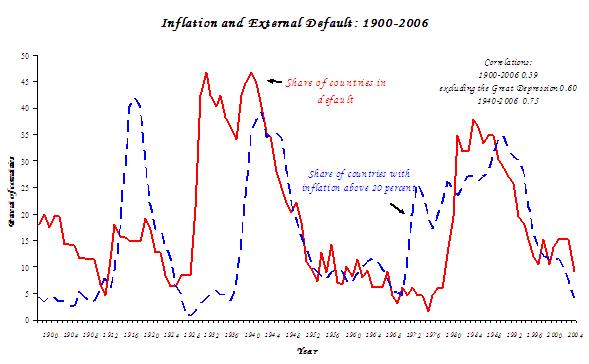
This conclusion seems to be built on the faulty premise that countries will treat domestic debt as junior, bullying domestics into accepting lower repayments or simply defaulting via inflation. The historical record, however, suggests that a high ratio of domestic to external debt in overall public debt is cold comfort to external debt holders. Default probabilities depend much more on the overall level of debt.
It's easy to make fun of the people who are buying up gold but the data does not lie. For those who say we should not expect future inflation, is this time really different?


 ). But it's not meant to be eaten, it's meant to be traded for food when you have nothing else of value to trade, and this is usually the case when your fiat money isn't worth the paper it's printed on. It may not happen here anytime soon, but it's happened elsewhere, and it'll happen again.



 Facebook
 Twitter