Should Intel release unlocked E5 Xeons sometime in the next 3 years?

Should Intel release unlocked E5 Xeons sometime in the next 3 years?

  • Yes

  • No


Results are only viewable after voting.

cbn

Lifer
Mar 27, 2009
12,968
221
106
Please cast your vote in the private poll, and (optional) discuss why you voted the way you did in this thread.

Maybe one factor to consider are the high TDPs on various discrete GPUs (gamer/professional/server) and how Intel high core count E5 CPUs might compete with those? (Supposedly Skylake E5 Xeon with have AVX 512)

P.S. Here is the current list of E5 2600 v3 Xeons: http://ark.intel.com/products/family/78583/Intel-Xeon-Processor-E5-v3-Family#@All , later on this year the Broadwell E5 Xeons should be announced. Hopefully in 2016, we will find out about the Skylake E5 Xeons.
 
Last edited:

SOFTengCOMPelec

Platinum Member
May 9, 2013
2,417
75
91
Please cast your vote in the private poll, and (optional) discuss why you voted the way you did in this thread.

Maybe one factor to consider are the high TDPs on various discrete GPUs (gamer/professional/server) and how Intel high core count E5 CPUs might compete with those? (Supposedly Skylake E5 Xeon with have AVX 512)

P.S. Here is the current list of E5 2600 v3 Xeons: http://ark.intel.com/products/family/78583/Intel-Xeon-Processor-E5-v3-Family#@All , later on this year the Broadwell E5 Xeons should be announced. Hopefully in 2016, we will find out about the Skylake E5 Xeons.

The top part, which seems to be a Xeon E5-2699 v3, seems to cost $4783.95 Source.

Assuming Intel continue to NOT allow overclocking (K) parts, until the very top part (this is NOT always the case, e.g. I5 4690K etc).

Then it would probably cost about $5000, for the unlocked top part.

To get the best out of it, you would need 2, so $10,000 approx.

How many gamers would be happy to pay $10,000+ just for the cpus ?

Games are NOT especially good at exploiting multi-core, let alone so many cores, usefully.

It's already at 145W TDP, before you even start overclocking. I DON'T think things would go well.

Would people be happy to burn out (too much voltage, poor overclocking, bad de-liding etc), to take out $5,000 a pop.

tl;dr
There is no way in a million years, I would think Intel would even contemplate this.

Question for you.

How many gamers, do you know, who ONLY use their (gaming) PC, for gaming. And have chosen an xeon as the gaming cpu ?

tl;dr2
You seem to be trying to convert a TRUCK into a tiny, high performance sports car.

Why not just buy a sports car in the first place (4790K etc) ?

My understanding is that more than 6 cores, is almost a waste of time, for gaming at the moment, as games relatively poorly utilize extra cores.
 

SOFTengCOMPelec

Platinum Member
May 9, 2013
2,417
75
91
Update:
If you are talking about very serious applications (ONLY), then they often require the stability of things such as ECC, high stability server boards etc.
Overclocking, does NOT make sense for such applications.
 

cbn

Lifer
Mar 27, 2009
12,968
221
106
How many gamers would be happy to pay $10,000+ just for the cpus ?

(snip)

Games are NOT especially good at exploiting multi-core, let alone so many cores, usefully.

(snip)

How many gamers, do you know, who ONLY use their (gaming) PC, for gaming. And have chosen an xeon as the gaming cpu ?

Yes, a gamer would never buy an unlocked E5 Xeon. I'm thinking this kind of multi-threading power would more likely be used for video editing or other non gaming tasks.
 

cbn

Lifer
Mar 27, 2009
12,968
221
106
Here is a product from a few years back:

http://www.evga.com/articles/00537/

13-188-067-02.jpg


The EVGA Classified Super Record 2. It could overclock two LGA 1366 hexcore Xeons, but this is the sort of product that would not be purchased primarily for gaming.
 

SOFTengCOMPelec

Platinum Member
May 9, 2013
2,417
75
91
Yes, a gamer would never buy an unlocked E5 Xeon. I'm thinking this kind of multi-threading power would more likely be used for video editing or other non gaming tasks.

Given that you can buy Haswell-E processors at reasonable (but by no means, cheap, prices), such as the 5960X, which DOES allow over-clocking. Intel can probably be satisfied with that.

In order to substantially beat a well over-clocked 5960X, one would have to probably go for a considerably more expensive, dual Xeon E5 computer. The price is so high (depending on the exact configuration), that most potential customers would be put off buying it, "just for", video editing.

At the high/top/profession end of video editing, they may be concerned enough with stability/reliability/dependability to prefer the non-overclocked, ECC version, anyway.

My gut feeling is that the higher end E5's are not really suitable for overlocking anyway. (I think) they are multi-die/chips, with complicated multi-die/chip communications systems (very high speed cache/memory coherence).
So over-clocking them is NOT so straight forward, as the "internal" buses, may NOT like over-clocking, as they are off-die/chip, which limits their bandwidth etc.

tl;dr
I seriously doubt there is enough of a market niche here, to make it worth Intels time/effort.
 

SOFTengCOMPelec

Platinum Member
May 9, 2013
2,417
75
91
Here is a product from a few years back:

http://www.evga.com/articles/00537/

13-188-067-02.jpg


The EVGA Classified Super Record 2. It could overclock two LGA 1366 hexcore Xeons, but this is the sort of product that would not be purchased primarily for gaming.

You're going back in time, to when we had chips like the core 2 duo, Q6600 etc. At that time (era), over-clocking was relatively worthwhile, and somewhat tolerated/allowed by Intel. Without any of this "fully locked down", unless you pay for the top part (of that range), to get the K version (or X in some cases).

Gradually, over-clocking seems to be a dying art, with diminishing returns, on a year by year basis. Especially if your objective, is to save money.

I.e. the days of buying a $55 cpu, and 2 minutes later, turning it into a $500 cpu (think Celeron 300A, if I remember the part number, correctly).
Then we even had, motherboards like the Abit B6 (again, if I remember correctly), which would even take 2 of the $55, (approx) cpus, for up to about double the performance.

tl;dr
Those were the days (my friend).
 

SOFTengCOMPelec

Platinum Member
May 9, 2013
2,417
75
91
I don't think Intel should be releasing, over-clockable Xeons. Xeons are suppose to be for high stability uses.

BUT, Intel could consider releasing consumer chips, with K or X (over-clockable) designations. As part of the Haswell-E (and later releases, Skylake-E etc) 5960X etc, with potentially more cores.

I.e. They are (re-purposed) E5's really, but sold in different market segments. They could be E5's which have failed the stringent Xeon part tests, and/or have one (or too many) faulty cores, to use as E5's.

I think some of the older socket 2011 parts, were rumored to really be failed (faulty core(s), Xeons).
 

cbn

Lifer
Mar 27, 2009
12,968
221
106
My gut feeling is that the higher end E5's are not really suitable for overlocking anyway. (I think) they are multi-die/chips, with complicated multi-die/chip communications systems (very high speed cache/memory coherence).
So over-clocking them is NOT so straight forward, as the "internal" buses, may NOT like over-clocking, as they are off-die/chip, which limits their bandwidth etc.

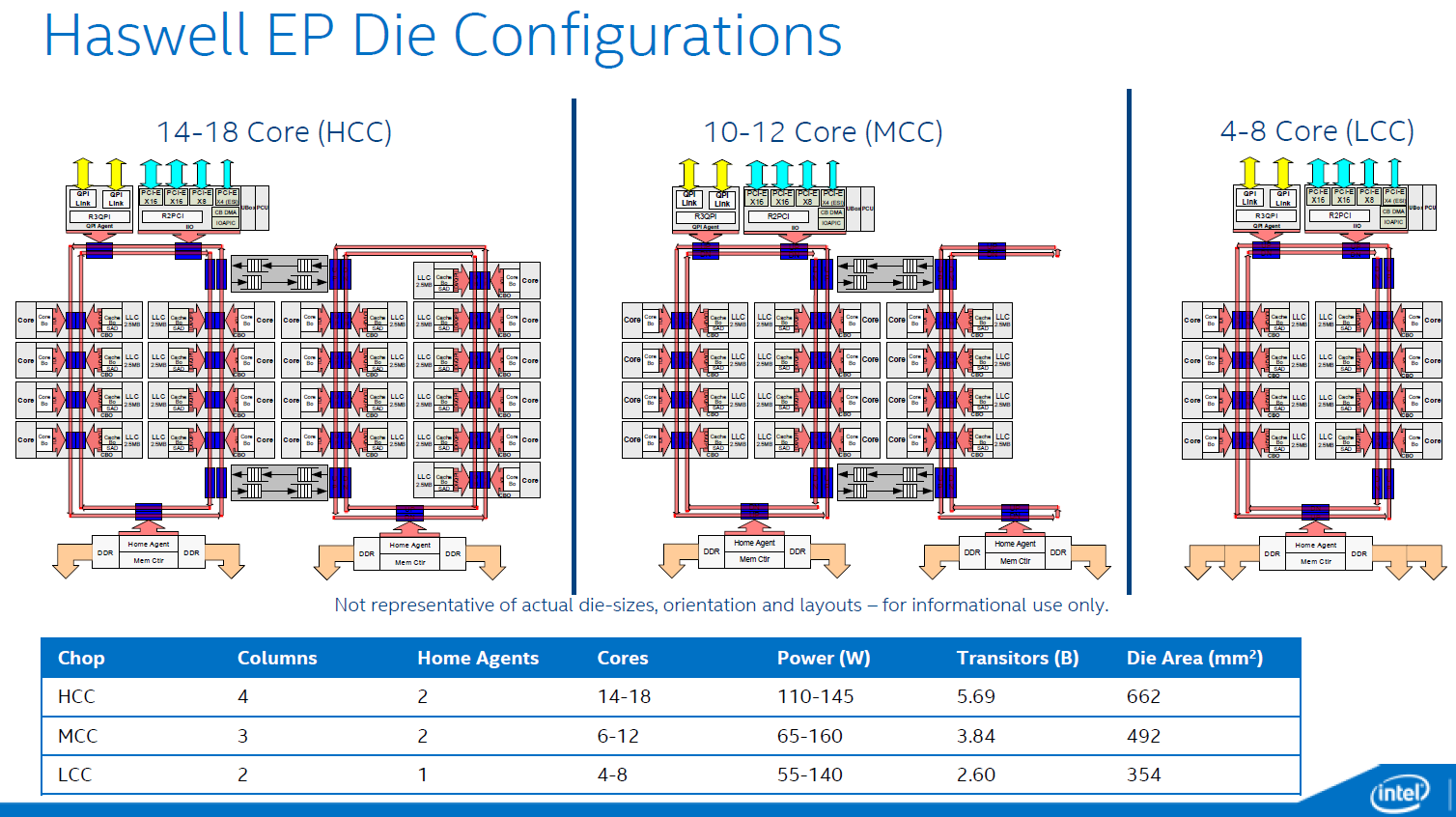
The Haswell E5 Xeons are not multi die chips. What Intel does is take a single design and chop across various parts of it to make various die configurations:

Haswell-EP-640x359.png


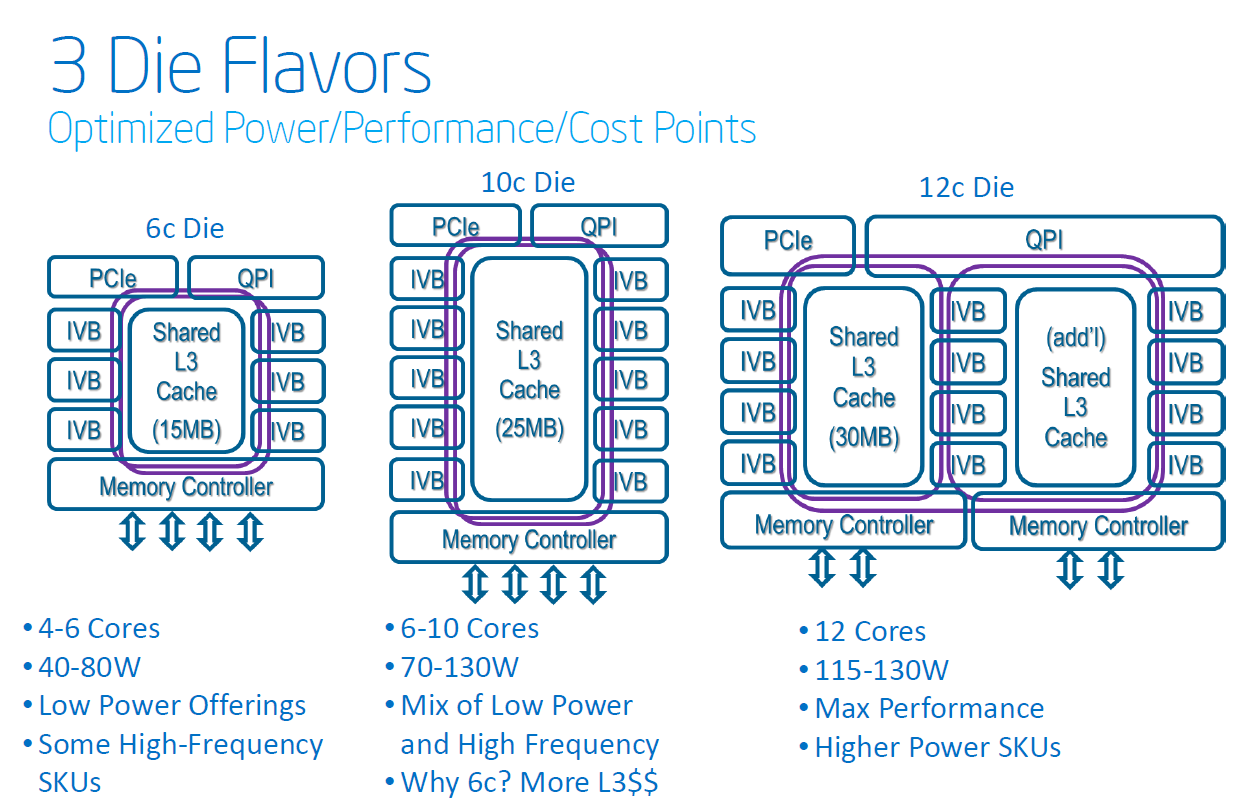
P.S. Here are pictures of the Ivy Bridge die configurations:

OverviewIVB3dies.png
 

cbn

Lifer
Mar 27, 2009
12,968
221
106
At the high/top/profession end of video editing, they may be concerned enough with stability/reliability/dependability to prefer the non-overclocked, ECC version, anyway.

I wouldn't be surprised if there is some level of professional video editing where a 2P E5-2699 v3 ($4115 each) is realistic.

However, I have read about other builds (at the professional level) using overclocked processors.

Another factor to consider is the idea of more video editing software moving to the GPU. Multi-core processor(s) vs. cost of professional or gamer video card(s)? At some point I just wonder where Intel feels the need to intervene (more than we expected) in the value equation.
 
Last edited:

ShintaiDK

Lifer
Apr 22, 2012
20,378
146
106
Unlocked Xeons makes no sense. Reliability is a key factor for Xeons. And overclocking is everything but reliability.

Its pretty much one of the dumbest and useless things you can ever do to a Xeon.
 

cbn

Lifer
Mar 27, 2009
12,968
221
106
Unlocked Xeons makes no sense. Reliability is a key factor for Xeons. And overclocking is everything but reliability.

Its pretty much one of the dumbest and useless things you can ever do to a Xeon.

Lots of folks overclocked Xeons in the past and never complained :thumbsup:

Furthermore, Xeon isn't just about stability, it is about RAM capacity as well.
 

SOFTengCOMPelec

Platinum Member
May 9, 2013
2,417
75
91
I wouldn't be surprised if there is some level of professional video editing where a 2P E5-2699 v3 ($4115 each) is realistic.

However, I have read about other builds (at the professional level) using overclocked processors.

Another factor to consider is the idea of more video editing software moving to the GPU. Multi-core processor(s) vs. cost of professional or gamer video card(s)? At some point I just wonder where Intel feels the need to intervene (more than we expected) in the value equation.

You seem to be creating, rather small marketing niches, to justify a relatively major set of new product(s), to be launched by Intel.

It probably takes lots of time, money, resources and organisation, to create each new SKU. It is probably not in Intels interests, to create far too many, because they tried to make the market place far too segmented.

I think, Intel have far too many processor numbers floating about at the moment. In a very disorganised higgity piggity way.

E.g. Pentiums being full cpus (Haswells) OR mediocre cpus (Atoms), performance wise.
 

SPBHM

Diamond Member
Sep 12, 2012
5,076
440
126
Unlocked Xeons makes no sense. Reliability is a key factor for Xeons. And overclocking is everything but reliability.

Its pretty much one of the dumbest and useless things you can ever do to a Xeon.

tell that to the 6 core x58 Xeon thread guys...

also I've seen overclocked CPUs being used by professionals with great results,


well, I'm going to be unrealistic and say every CPU should be fully unlocked, but I don't see Intel releasing new unlocked Xeons, they are to happy with the current all locked model,
 

ShintaiDK

Lifer
Apr 22, 2012
20,378
146
106
well, I'm going to be unrealistic and say every CPU should be fully unlocked

We had that in the past. Just gave lots of counterfeit.

also I've seen overclocked CPUs being used by professionals with great results

Overclocked and professionals doesnt belong in the same sentence. Unless its professional overclockers or gamers.
 

cbn

Lifer
Mar 27, 2009
12,968
221
106
You seem to be creating, rather small marketing niches, to justify a relatively major set of new product(s), to be launched by Intel.

I have really no idea how big the market is for this type of gear. But I think it is a fair question to ask.

It probably takes lots of time, money, resources and organisation, to create each new SKU. It is probably not in Intels interests, to create far too many, because they tried to make the market place far too segmented.

I don't think having unlocked E5 Xeons necessarily results in an increase in SKUs. It might be Intel simply converts a SKU or two they would have made a locked SKU into a unlocked SKU. This keeps the number of SKUs the same.

P.S. There was a rumor from May 2014 at VR-zone that claims Intel is/was considering unlocked Haswell E5 Xeons. Now granted that is a rumor, but I consider VR-zone is a decent website.

http://vr-zone.com/articles/computex-will-show-desktop-alive-well/77282.html

Add to this the rumoured confirmation that, unlike their predecessors, Haswell-EP Xeons, including likely thae 14-core and 18-core flavours, will have several top bin un-locked and even liquid-cooling optimised variants meant for HPC, workstations and high frequency trading, and you can guess the implications: the Haswell-E and Haswell-EP platforms will again be the overclocker’s heaven.

In general, these are very good news as, with Haswell and Broadwell next-gen high end platforms, we will get the unlocking and speeding-up capabilities we saw in the high end desktops of the past, this time spread across both single socket and dual socket desktops and workstations, not to mention HPC supercomputing platforms.
 

SOFTengCOMPelec

Platinum Member
May 9, 2013
2,417
75
91
I don't think having unlocked E5 Xeons necessarily results in an increase in SKUs. It might be Intel simply converts a SKU or two they would have made a locked SKU into a unlocked SKU. This keeps the number of SKUs the same.

That's a bit like saying, Intel just need to flip a switch, and then Broadwell-E can be released the next day.
Another switch, Skylake release.
Finally, one more switch and Cannonlake can be released the next day.

There is a lot of work and testing which goes on in the background, at Intel. Otherwise we would be complaining, about faulty chips, etc etc.

It is very easy for you to say that Intel just has to flip this tiny switch, and then tomorrow, they can release new ...-K chips. But the reality, is almost certainly, completely different.

P.S. There was a rumor from May 2014 at VR-zone that claims Intel is/was considering unlocked Haswell E5 Xeons. Now granted that is a rumor, but I consider VR-zone is a decent website.

http://vr-zone.com/articles/computex-will-show-desktop-alive-well/77282.html

As long as they release them as ordinary Haswell-E's. (I.e. NOT as Xeons), I don't have a big problem with it.

E.g. 18-core versions of the 5960X. Obviously the part number would have to change. Or even dual processor (enabled) versions.

But I strongly believe that Xeon (branded/named) parts, should be reserved for quality, non-overclock-able, reliable, stable, dependable parts.
 
Last edited:

cbn

Lifer
Mar 27, 2009
12,968
221
106
But I strongly believe that Xeon (branded/named) parts, should be reserved for quality, non-overclock-able, reliable, stable, dependable parts.

That can be achieved simply be installing a unlocked multiplier Xeon on a motherboard that does not allow overclocking.

So for a IT manager who doesn't want workers overclocking their processors it would just be a matter of choosing the right motherboard? What am I missing?
 

SOFTengCOMPelec

Platinum Member
May 9, 2013
2,417
75
91
That can be achieve simply be installing a unlocked multiplier Xeon on a motherboard that does not allow overclocking.

So for a IT manager who doesn't want workers overclocking their processors it would just be a matter of choosing the right motherboard? What am I missing?

As previously stated in this thread...

We had that in the past. Just gave lots of counterfeit.


Server with VERY low end Xeon cpu(s) = $750

Server with high end Xeon cpu(s) = $9,999

Counterfeit server with highly overclocked $cheap Xeon cpu(s) = $9,999 (but is a complete con, and potentially highly unstable, unreliable, problematic etc).

Making all Xeons NOT-overclockable, reduces this (counterfeiting) problem.
 

cbn

Lifer
Mar 27, 2009
12,968
221
106
As previously stated in this thread...

ShintaiDK said:
We had that in the past. Just gave lots of counterfeit.

Server with VERY low end Xeon cpu(s) = $750

Server with high end Xeon cpu(s) = $9,999

Counterfeit server with highly overclocked $cheap Xeon cpu(s) = $9,999 (but is a complete con, and potentially highly unstable, unreliable, problematic etc).

Making all Xeons NOT-overclockable, reduces this (counterfeiting) problem.

I think what ShintaiDK was referring to were days of old when all processors were single core and only the clockspeed differed.

These days trying to pass some kind of $750 Xeon for a $9999 Xeon (if such a Xeon even existed) would be impossible simply because the core count would no doubt be different. (ie, no way to make a low core count perform like a high core count processor no matter how much overclocking were done to it).

With that mentioned, Intel could always adopt some kind of strategy where only the top bin in a specific core count category get the unlocked multiplier. (In fact, we see them doing this already for LGA 1150 and LGA 2011-3 K SKUs, the major exception being the i7-5820K and i7 5930K which both have 6c/12T, but differing PCIe 3.0 lanes)
 

SOFTengCOMPelec

Platinum Member
May 9, 2013
2,417
75
91
I think what ShintaiDK was referring to were days of old when all processors were single core and only the clockspeed differed.

These days trying to pass some kind of $750 Xeon for a $9999 Xeon (if such a Xeon even existed) would be impossible simply because the core count would no doubt be different. (ie, no way to make a low core count perform like a high core count processor no matter how much overclocking were done to it).

With that mentioned, Intel could always adopt some kind of strategy where only the top bin in a specific core count category get the unlocked multiplier. (In fact, we see them doing this already for LGA 1150 and LGA 2011-3 K SKUs, the major exception being the i7-5820K and i7 5930K which both have 6c/12T, but differing PCIe 3.0 lanes)

My understanding, is that a huge number of Xeons, are sold to server manufacturers, such as Dell, HP, IBM, etc.

They want their servers to be reliable, trouble free, quality, stable, accurate etc.

They are NOT going to touch overclocking with a 1 mile long barge pole. (My opinion).

The words, Overclocking and Xeons, should NEVER appear in the same sentence. (Joke, but I hope you can see, that the concept, is true, nevertheless).

Most people who buy brand new Xeon equipment, such as servers/workstations, DON'T want to overclock it. Even if they could.

Overclocking servers (brand new ones), is a very bad idea. They are meant to run 24/7, 365 days a year. Ideally, as trouble free as possible.

Eventually (in say 15 years time), when the server is worth $35. The new owner might want to overclock it, to get more performance out of it. But that is NOT a good reason for enabling overclocking, on ALL Xeons.

Part of the problem is that if you are gaming, and the overclock freezes (crashes), the computer. No great harm has occurred, and the user can immediately re-boot the computer.

But a Server (is often), in a rack system, in some partly out of the way, server room, somewhere. If it suddenly froze (crashed), due to overclocking (which can't happen, because Intel rightly, DON'T allow it, on modern Xeons), 1000 internet users, who are currently using that server, will find their web browsers, saying Error 404.
It might now take a significant period of time, before a technician, can re-boot that frozen server.
The company, may now have lost thousands of customers (angry at always getting Error 404). Which may now cost the company $100,000 in lost customers. All because they tried to save $199, by overclocking the cpu.

tl;dr
Overclocking serious use Xeons, is a very bad idea (in many cases).

 
Last edited:

ShintaiDK

Lifer
Apr 22, 2012
20,378
146
106
I think what ShintaiDK was referring to were days of old when all processors were single core and only the clockspeed differed.

These days trying to pass some kind of $750 Xeon for a $9999 Xeon (if such a Xeon even existed) would be impossible simply because the core count would no doubt be different. (ie, no way to make a low core count perform like a high core count processor no matter how much overclocking were done to it).

With that mentioned, Intel could always adopt some kind of strategy where only the top bin in a specific core count category get the unlocked multiplier. (In fact, we see them doing this already for LGA 1150 and LGA 2011-3 K SKUs, the major exception being the i7-5820K and i7 5930K which both have 6c/12T, but differing PCIe 3.0 lanes)

It really doesnt matter how many cores there is. The issue is the same unless there are no SKUs with the same amount of cores.

But again, its not going to happen. There is no incentive for it. The unlokced products already exist as the LGA2011 desktop series.
 
Last edited:

Essence_of_War

Platinum Member
Feb 21, 2013
2,650
4
81
Should Intel release unlocked E5 Xeons sometime in the next 3 years?
Forget "should they", why WOULD they? :confused: What would be the value to Intel? Who is presently not buying Xeons that would suddenly start buying Xeons if they were multiplier unlocked? Xeons are doing so well in the server space because they offer excellent perf/watt. Instead of overclocking a Xeon and getting worse perf/watt but more absolute performance, why wouldn't you just throw more Xeons at the problem and keep your perf/watt up?
 

cbn

Lifer
Mar 27, 2009
12,968
221
106
My understanding, is that a huge number of Xeons, are sold to server manufacturers, such as Dell, HP, IBM, etc.

They want their servers to be reliable, trouble free, quality, stable, accurate etc.

They are NOT going to touch overclocking with a 1 mile long barge pole. (My opinion).

I share that same opinion, but you are forgetting that not the buyers of Xeon E5 are Dell, HP, IBM, etc


Most people who buy brand new Xeon equipment, such as servers/workstations, DON'T want to overclock it. Even if they could.

Overclocking servers (brand new ones), is a very bad idea. They are meant to run 24/7, 365 days a year. Ideally, as trouble free as possible.

As I mentioned, installing a unlocked Xeon E5 in a non-overclocking motherboard disables that feature.

Part of the problem is that if you are gaming, and the overclock freezes (crashes), the computer. No great harm has occurred, and the user can immediately re-boot the computer.

As mentioned earlier in the thread, overclocked E5 Xeon would not be used for gaming.

But a Server (is often), in a rack system, in some partly out of the way, server room, somewhere. If it suddenly froze (crashed), due to overclocking (which can't happen, because Intel rightly, DON'T allow it, on modern Xeons), 1000 internet users, who are currently using that server, will find their web browsers, saying Error 404.
It might now take a significant period of time, before a technician, can re-boot that frozen server.
The company, may now have lost thousands of customers (angry at always getting Error 404). Which may now cost the company $100,000 in lost customers. All because they tried to save $199, by overclocking the cpu.

This is why some companies like SuperMicro don't allow overclocking of E5 Xeons, while other companies like ASUS do allow overclocking of E5 Xeons (via BCLK) on some of their boards (for people willing to take that risk).

In fact, here is a video at Linus Tech tips with E5 2697 v2 being overclocked via 113 Mhz BCLK:

https://www.youtube.com/watch?v=khDsbxa5_G0

Not every task needs mission critical precision, so why not let Intel make people's lives easier?
 
Last edited: