• We’re currently investigating an issue related to the forum theme and styling that is impacting page layout and visual formatting. The problem has been identified, and we are actively working on a resolution. There is no impact to user data or functionality, this is strictly a front-end display issue. We’ll post an update once the fix has been deployed. Thanks for your patience while we get this sorted.

Ram pricing discussion

Nocturnal

Lifer
I know that periodically ram prices increase and decrease. However many times there are distinct reasons as to why ram prices go up. I recall a few years back the earthquakes in Taiwan caused a spike in ram prices due to facilities that produce ram being destroyed.

I noticed within the last few months that prices of DDR2 and 3 have gone up significantly again, on average probably $40-50 dollars.

Is there any special reason as to why the prices went up all of a sudden?
 
in the past 5 years quite a few instances of price setting by ram manufactures have surfaced so not surprised if a few is doing it again. ddr2 maybe just due to low supply now that no one is making them but not sure about ddr3 prices so high.
 
Well yeah DDR prices too. I wish I could get my hands on a few more sets of 2GB. I have a bunch of Ballistix but they die every few months so they're really no use to me.
 
Remember that DRAM is considered a commodity and prices rise and fall with supply and demand. There are, obviously, other factors, but the basic supply/demand is key.

It's considered "normal" for the price of "obsolescent" memory types to increase after the memory makers stop making them. By now, most memory makers are moving the majority of their production lines to DDR3.

The "normal" pattern is:
1) Initial price of "new" memory type is very high.
2) Price of "new" memory type moves down as production increases. In September, the price of DDR3 and DDR2 became equal.
3) Manufacturers move most of their production to the "new" memory type as demand increases. Old production lines are shut down and new production lines are turned on.
4) The "old" memory type declines in price to record lows, often with large rebates, as distributors attempt to clear out their inventory and any excess order committments. For DDR2, this happened about ten months ago.
5) As less of the "old" memory is available, the price starts rising, soon exceeding the price of the "new" memory type.
6) Prices for "old" memory type starts to fall again, as demand for the "old" memory type lessens. Everybody who is going to upgrade their old PCs has done so and more "used" old memory comes.
7) Rinse and repeat. The next few months is the time to sell your DDR2 if you want to get the best price for it.
 
Last edited:
The DDR3 price increases are pissing me off. 🙁

I was paying about $75 for 3x2GB kits, now they're damn near $130.
 
I know that periodically ram prices increase and decrease. However many times there are distinct reasons as to why ram prices go up. I recall a few years back the earthquakes in Taiwan caused a spike in ram prices due to facilities that produce ram being destroyed.

I noticed within the last few months that prices of DDR2 and 3 have gone up significantly again, on average probably $40-50 dollars.

Is there any special reason as to why the prices went up all of a sudden?

The same market fundamentals that are behind the Nand flash price rise in the same period of time are behind the rise in dram prices.

Checkout the links in the OP of this thread, particularly relevant is this capex graph:

141442-NAND_Flash.jpg


The dram capex versus bit volume graph mirrors this one for flash.

That massive roll-off in the capex from 08 to 09F means this year the companies did not invest in increasing their production capacity as would have been needed to maintain a supply/demand equilibrium at a pricepoint we have grown accustomed for dram in the coming year.

It takes about 6 months minimum from the time a company decides to spend money (capex) to expand production lines and the time before that capacity is released and brought on-line assuming the capacity is being added to pre-existing and un-utilized fabspace. (referred to as a "fab buildout")

If new fabspace is required to support the capacity then the minimum timeline increases another 6 months in the case of a fab-expansion (called a "fab add-on") or another 12-18 months in the case of needing an entirely new fab built.

This is why the analysts behind the articles linked in that other thread's OP are saying the lack of capex that occurred in the beginning of this year will have knock-on effects that will be felt in the supply/demand equilibrium price-point for the next 3-4 yrs.
 
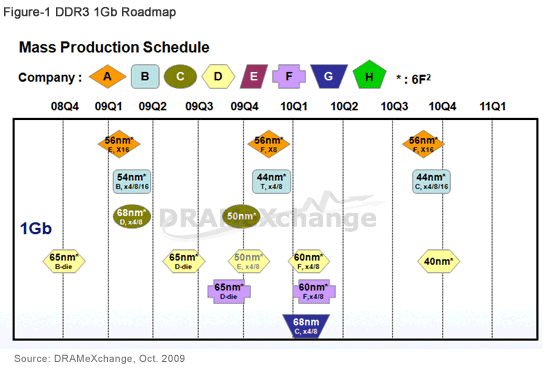
October DDR2 spot price rose 35%. Shortage will likely continue in November while US$3 chip price is the target.

Analysis for DDR3 migration
Given the rocket high DDR2 price, PC-OEMs have accelerated the DDR3 migration in line with the new Calpella platform supported by Intel and new platform from AMD. We expect the PC shipment with DDR3 will surpass those with DDR2 by the mid-2010.

marketview_20091104.gif


http://www.dramexchange.com/WeeklyResearch/Post/2/2193.html

Basically the dramexchange analysis is that because there is a DDR2 shortage the DDR2 prices are rising and this is pushing more suppliers towards buying DDR3 stock instead of DDR2 which is then in turn causing DDR3 prices to rise.
 
Back
Top