• We’re currently investigating an issue related to the forum theme and styling that is impacting page layout and visual formatting. The problem has been identified, and we are actively working on a resolution. There is no impact to user data or functionality, this is strictly a front-end display issue. We’ll post an update once the fix has been deployed. Thanks for your patience while we get this sorted.

Physicists: Recommend a good book on physics

I thought, hey how about a thread on books you recommend people read on physics. There is so much misinformation out there, everyone should read a good book on physics to get up to speed on the latest goings on in physics.

Sometimes you hear jargon thrown about for example, dark matter, dark energy, WIMPS, MACHOS. A good book that explains the latest jargon and what they are would be nice.

I know Quantum Mechanics is right now a separate science from Astro physics, but if you can recommend 1 book that covers both that would be great. If not then 2 separate texts would be fine.

So, anyone out there have any recommendations on what books they found had lots of good up to date info on physics?

I'll start with The Elegant Universe by Brian Greene, which I'm sure many of you heard of due to the whole string theory movement.
 
Well, first I would recommend a basic college level physics book before recommending someone dive into some fringe pop culture physics book.

If a physics book doesn't have math in it, it doesn't really talk about physics. You can't understand physics without understanding the math. So many concepts came as a result of the math, IE Dark matter.

Too many people (9/11 truthers) have no clue when it comes to basic kinematics.
 
Well, first I would recommend a basic college level physics book before recommending someone dive into some fringe pop culture physics book.

If a physics book doesn't have math in it, it doesn't really talk about physics. You can't understand physics without understanding the math. So many concepts came as a result of the math, IE Dark matter.

Too many people (9/11 truthers) have no clue when it comes to basic kinematics.

Quoted for absofrigginlutely true.

I got my first taste of physics with University Physics 8th Edition by Hugh D. Young (1992) but that was a long time ago so I wanted a more up to date book recommendation. I did take calculus too so I can follow the math, although sometimes I admittedly skip it to get to the good parts.
 
I've been impressed by the thought provoking way that Brian Greene presents cutting edge (well, at least cutting edge in the last decade) physics theories such as string theory and "inflation" while also providing background in earlier work on relativity and quantum physics.

I was the beneficiary of several years of physics courses in college, but can honestly say that he opened my eyes to new views on topics I thought I had already understood.

http://www.amazon.com/Fabric-Cosmos-...1313956&sr=8-1

http://www.amazon.com/Elegant-Univer...1313956&sr=8-2
 
The best physics texts are the Feynman Lectures, they might actually keep you reading for a few months. The third book gets into a lot of QM.
 
The best physics texts are the Feynman Lectures, they might actually keep you reading for a few months. The third book gets into a lot of QM.

This is absolutely the best suggestion.

Also, QM and astrophysics are very intricately linked too by the way.
 
For the comprehensive exam for the PhD program at my university, depending on the field there are a number of texts that are must reads.

Caroll&Ostlie "An introduction to modern astrophysics" - a very solid book with a LOT of info in it, I use it all the time.

and whatever 1st/2nd year physics text is popular at the time. In my day it was Serway and Bachner(sp?)

Then read anything written by Griffiths which will cover Quantum, E&M, and some particle physics.

And a stat mech book, I have little to no stat mech so some suggestions here.

I would have to put my vote in for the Feynmen lectures as well.
 
Depends on what you're looking for... If you simply want a list of ideas that are out there and a very rough idea of what happens, then the popular books by Greene, Hawking, Feynman etc. will do you fine.

If you really want to understand these hypotheses and theories and where they come from, it's a bigger undertaking. As mentioned above start with the standard mechanics and E&M. I recommend University Physics by Young and Freedman (the one that I had for freshman physics). Halliday and Resnick is the other standard (my father had that one, oddly enough).

Once mechanics is relatively intuitive to you, special relativity is definitely within grasp. A.P. French is an awesome first text on the subject, and doesn't really require any advanced math. The tricky part is bending your mind in a way that can understand it.

General relativity is much harder, and something I've never learned beyond the hand-wave-y stage. You'll really have to be able to work with calculus in 4 dimensions. Wheeler's Gravitation is the most noted book on the subject.

Quantum is a little more attainable, but does require math through linear algebra to be really comfortable. As said above Giffiths is good, but nearly impenetrable without a professor working you through it. The basic principles are covered in volume three of Young and Freedman and is more accessible, but Griffiths and a class will give you a lot more theoretical depth.

Hope this helps!
 
For the comprehensive exam for the PhD program at my university, depending on the field there are a number of texts that are must reads.

Caroll&Ostlie "An introduction to modern astrophysics" - a very solid book with a LOT of info in it, I use it all the time.

and whatever 1st/2nd year physics text is popular at the time. In my day it was Serway and Bachner(sp?)

Then read anything written by Griffiths which will cover Quantum, E&M, and some particle physics.

And a stat mech book, I have little to no stat mech so some suggestions here.

I would have to put my vote in for the Feynmen lectures as well.

Caroll & Ostlie sucks. It's just a thick annal of boring out of date stuff. There's maybe 50 pages of good info in the entire thing.

Griffiths rocks. Especially the particle physics.

Stat mech - go with Sturge. I loved that book.

CPB Finn has a classic thermo book that all the profs try to get but is out of print.

But these are all textbooks. The OP wants something more accessible. Feynman does that, and once you get out of texts, you're looking at Hawking and/or Greene for the hand-wavy type stuff.
 
Feynman...


cat_sticking_out_its_tongue-1360.jpg


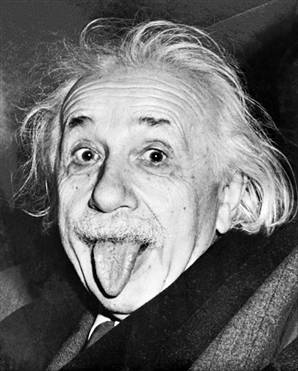
einstein_tongue-widec.jpg


tongue-statue.jpg


att00072.jpg


maori-wooden-carving-with-tongue-sticking-out-rotorua-north-island-new-zealand1.jpg
 
Last edited:
Are you sticking your tongue out at Feynman in opposition or recommending him?

A bit of both to be honest.
I experience mixed feelings when hearing the name worshipped. But when reading about the person R Feynman or his idea's, it can be quite enjoyable when reading from all perspectives.

Oh i almost forgot, the 12 dimensions tale was a yoke 🙂.

EDIT:
I did not stick my tongue out.
The picture of Einstein doing so popped up in my mind. I do like the pictures, though. Amazing expressions.
 
Last edited:
I know this isn't really what you are looking for (I really don't have any recommendations as I've only read the textbooks used in my classes, and haven't really had a chance to compare the relative qualities of each), but if you want an interesting (and non-technical) read on some of the history of modern physics, I enjoyed reading Faust in Copenhagen. It was an easy read and it really made me want to have been a part of the revolution. Lots of interesting really smart people doing some cool stuff 🙂
 
Both of Brian Greene's books explained string theory very well and in relatively laymans terms to someone who is not a physics major. I thoroughly enjoyed both of them.
 
Back
Top