• We’re currently investigating an issue related to the forum theme and styling that is impacting page layout and visual formatting. The problem has been identified, and we are actively working on a resolution. There is no impact to user data or functionality, this is strictly a front-end display issue. We’ll post an update once the fix has been deployed. Thanks for your patience while we get this sorted.

New memory from Micron/Intel

kimmel

Senior member
Interesting...

https://intel-micron-webcast.intel.com/webcast
http://www.intelsalestraining.com/infographics/memory/3DXPointc.pdf
http://newsroom.intel.com/docs/DOC-6713

Maybe?
http://seekingalpha.com/article/3253655-intel-and-micron-the-purple-swan

- 3D XPoint technology has up to 1000x the endurance of NAND
- 3D XPoint technology is up to 1000x faster than NAND
- The companies invented unique material compounds and a cross point architecture for a memory technology that is 10 times denser than conventional memory
 
Last edited:
Interesting, XPoint cost to produce is less than planar NAND flash but the retail will be between DRAM and NAND flash. Sounds like the JV does not have adequate capacity and they are forced to suffer through a period of extraordinary profit margins to ration scarce capacity. If demand is as elastic as some say and costs come down as capacity ramps, it may take the JV some time to work it's way out of the killer margins position. I hope select Broxton desktop SoC's come with 32GB of on package XPoint. On package has to be the cheapest and best way to deliver XPoint. Superior efficiency should make it thermally possible. There has been some question whether Intel receives a benefit from it's leadership investments in Moore's Law. If XPoint lives up to it's billings, Intel's leadership investments make more sense.

A more accurate assessment of the value of Intel's "superior" process technology will come from the IoT market. Every foundry in the world sees IoT coming and wants a piece. The emerging standards have been largely formulated in public forums and there is a common understanding of customer requirements. All want to put their best foot forward with fresh designs explicitly targeting this market. The emerging IoT market is as level a playing field as you are likely to find. If Intel's "superior" process technology has substantive value, they should be able to dominate the emerging IoT market. If they are not able to do so, it calls into question what is the value of "superior" process technology.
 
Interesting, XPoint cost to produce is less than planar NAND flash but the retail will be between DRAM and NAND flash. Sounds like the JV does not have adequate capacity and they are forced to suffer through a period of extraordinary profit margins to ration scarce capacity. If demand is as elastic as some say and costs come down as capacity ramps, it may take the JV some time to work it's way out of the killer margins position. I hope select Broxton desktop SoC's come with 32GB of on package XPoint. On package has to be the cheapest and best way to deliver XPoint. Superior efficiency should make it thermally possible. There has been some question whether Intel receives a benefit from it's leadership investments in Moore's Law. If XPoint lives up to it's billings, Intel's leadership investments make more sense.

A more accurate assessment of the value of Intel's "superior" process technology will come from the IoT market. Every foundry in the world sees IoT coming and wants a piece. The emerging standards have been largely formulated in public forums and there is a common understanding of customer requirements. All want to put their best foot forward with fresh designs explicitly targeting this market. The emerging IoT market is as level a playing field as you are likely to find. If Intel's "superior" process technology has substantive value, they should be able to dominate the emerging IoT market. If they are not able to do so, it calls into question what is the value of "superior" process technology.
Seems like the next dot com bubble waiting to burst 😛

Anyway shouldn't this thread be in mem & storage?
 
So basically it's a RAM that retains it's content even when not powered on, and is much faster than regular RAM?

Missing info:

-What typical sizes can the RAM be provided in? MB, GB, TB, ...?
-How much will it cost per GB/TB?
-When will it be available on the market?
-Power consumption?

If we are to believe the hype, we could replace DDR RAM, SSDs and HBM with just this. As single memory/storage type to rule them all. Too good to be true?
 
So basically it's a RAM that retains it's content even when not powered on, and is much faster than regular RAM?

Missing info:

-What typical sizes can the RAM be provided in? MB, GB, TB, ...?
-How much will it cost per GB/TB?
-When will it be available on the market?
-Power consumption?

If we are to believe the hype, we could replace DDR RAM, SSDs and HBM with just this. As single memory/storage type to rule them all. Too good to be true?
I don't think it's faster than dram. It IS much faster than flash memory so depending on the price, this could be a problem for disk mfr's.

In the Wired article they said that they'd start producing the memory later this year in Utah.
 
Definitely agree that it's more fitting for the memory and storage forum, since it affects CPUs the same way as any other memory and storage architecture change does. Will this end up being a straight replacement for mass storage? Or are we going to see DRAM transition into what's effectively another cache level with 3D XPoint becoming the primary system memory? (The inclusion of a DRAM cache being both for speed and endurance concerns.) I can see a setup like that being particularly appealing in terms of power considerations - effectively instant power off/on. This sort of usage also pretty much eliminates system memory size issues considering that the initial technology is apparently a 16 GB die.
 
So basically it's a RAM that retains it's content even when not powered on, and is much faster than regular RAM?

Missing info:

-What typical sizes can the RAM be provided in? MB, GB, TB, ...?
-How much will it cost per GB/TB?
-When will it be available on the market?
-Power consumption?

If we are to believe the hype, we could replace DDR RAM, SSDs and HBM with just this. As single memory/storage type to rule them all. Too good to be true?

This isn't a product yet. It will be years - if ever - that you can buy this.

I don't know why you are saying this is being 'hyped'. By whom?
 
So basically it's a RAM that retains it's content even when not powered on, and is much faster than regular RAM?

Missing info:

-What typical sizes can the RAM be provided in? MB, GB, TB, ...?
-How much will it cost per GB/TB?
-When will it be available on the market?
-Power consumption?

If we are to believe the hype, we could replace DDR RAM, SSDs and HBM with just this. As single memory/storage type to rule them all. Too good to be true?

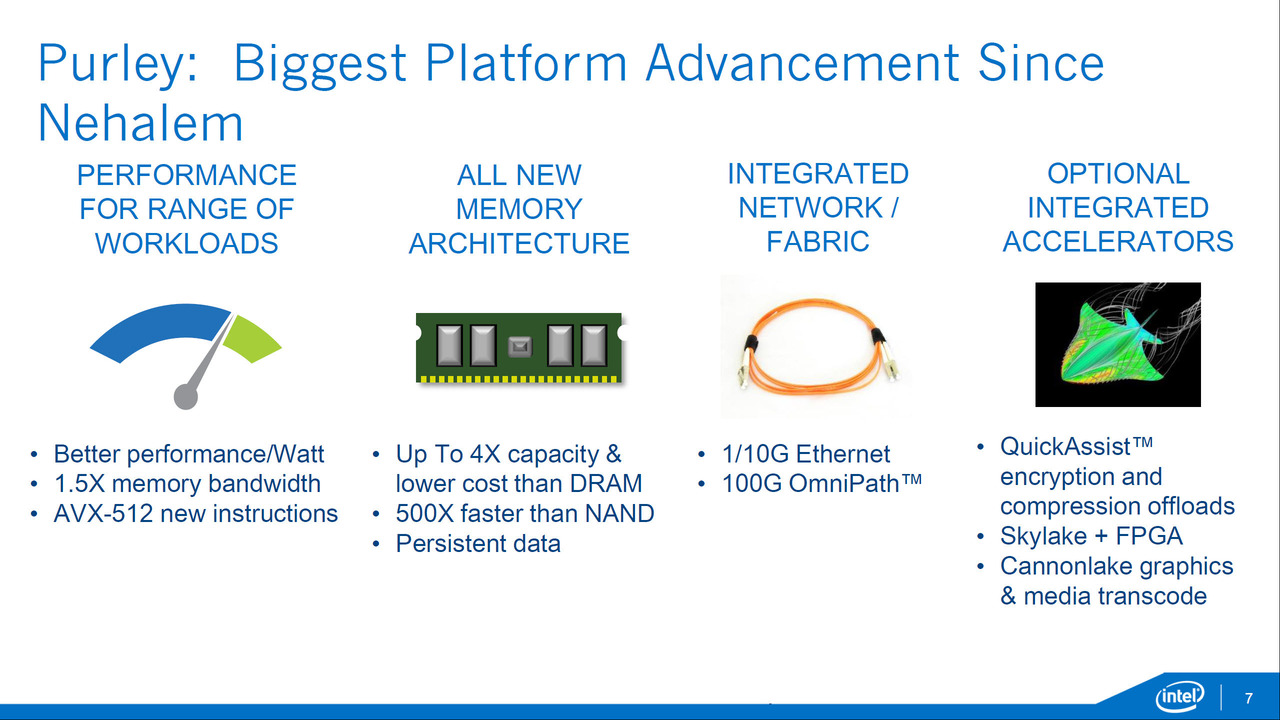
If its Apache Pass, then 2017. Its for servers only to begin with. Lookup Purley platform. It will be used in combination with HMC and DDR4 it seems.

Microsoft also got a filesystem ready for it.
 
Last edited:
News say it's 1000 times faster than NAND (i.e. flash i.e. SSDs). SSD's can do more than 1 GB/s. So if this new RAM is 1000 times faster than that it'll be 1 TB/s. That's much faster than DDR4, and even GDDR5.

The slide says its in relation to latency, not speed. That puts it in the 60-150ns ballpark.
 
Seems like their take on memristor or phase-change memory. Seems like the first product will be a storage device similar to an SSD but with their new phase change technology.
 
The slide says its in relation to latency, not speed. That puts it in the 60-150ns ballpark.

You mean the footnote saying "1 Technology claims are based on comparisons of latency, density and write cycling metrics amongst memory technologies recorded on published specifications of in-market memory products against internal Intel specifications."?

So how do you derive the actual speed from that? Are you saying the bit width is less than regular RAM (i.e. number of bits read per clock), or why wouldn't the lower latency result in proportionally higher speed too?

And where did you get the 60-150 ns number from BTW?
 
Seems it will be DDR4 type DIMMs.

Rnd2MkA.jpg
 
As well, comparing an SSD against a memory technology is definitely an apples to oranges. While a high-performance SSD can sustain 1 GB/s write speeds an actual NAND MLC die is still limited to what, 25 MB/s? Now sure, it'd still be kinda crazy for a single memory package to be capable of 2.5 GB/s, but that's beside the point since, as ShintaiDK already pointed out, the performance relation to NAND is most likely with respect to latency. And there it's quite reasonable considering that you're going from write latency of hundreds of us for NAND to hundreds of ns for 3D XPoint.
 
You mean the footnote saying "1 Technology claims are based on comparisons of latency, density and write cycling metrics amongst memory technologies recorded on published specifications of in-market memory products against internal Intel specifications."?

So how do you derive the actual speed from that? Are you saying the bit width is less than regular RAM (i.e. number of bits read per clock), or why wouldn't the lower latency result in proportionally higher speed too?

And where did you get the 60-150 ns number from BTW?

SSD latency today isnt some kind of secret. Neither is DDR4.

pcm.png


I think the only one getting 1000x bandwidth from that slide is you.
 
[/I]So how do you derive the actual speed from that? Are you saying the bit width is less than regular RAM (i.e. number of bits read per clock), or why wouldn't the lower latency result in proportionally higher speed too?

Because with NAND you're dealing with much larger blocks of data for a given latency. On a read, the high latency is incurred for the first byte, with each successive byte in a given block coming on the next clock. Similarly, with a write you have a set latency for writing an entire block regardless of whether you're writing one byte or everything. This is assuming that I'm remembering everything correctly.
 
Bandwidth we are talking DDR4 speed or slower, most likely 50-75% the speed if I had to guess.

But the SSD essentially became the HD and so on. Tho it will require more time.
 
There first product will be 128 gigs 2d not 3d so yes this XPoint is still in the future.
In the video they claim how games are limited because they have to keep going into the system for more info and how this bottleneck can be replaced with XPoint tech.
Now suppose you added XPoint L4 cache on the package.
 
Last edited:
I think the only one getting 1000x bandwidth from that slide is you.

I said the news articles said it's 1000x faster. Normally that would mean it has 1000 times higher bandwidth unless else is specified.

If that is not the case, I'd like to know what the actual bandwidth is.
 
Back
Top