• We’re currently investigating an issue related to the forum theme and styling that is impacting page layout and visual formatting. The problem has been identified, and we are actively working on a resolution. There is no impact to user data or functionality, this is strictly a front-end display issue. We’ll post an update once the fix has been deployed. Thanks for your patience while we get this sorted.

Need help picking out a soldering iron

Status
Not open for further replies.

ibex333

Diamond Member
So I got an artifacting video card from ebay hoping to repair it by reflowing. During disassembly, I noticed that one of the tiny wires soldered to the fan came loose and needed to be soldered back.

I have cheapo soldering iron but it's tip is too damn thick, and it was a nightmare getting into that cramped space to solder a tiny spot the size of a pin head. Even though I am not someone who does this stuff for a living or even as a permanent hobby, I realized I definitely need a good soldering kit. While browsing amazon, I couldn't see any soldering irons that specifically mention having a tiny tip designed for very small jobs.

Can someone please help me? I am not very good with electronics and n ot sure where/how to properly search for these things.
 
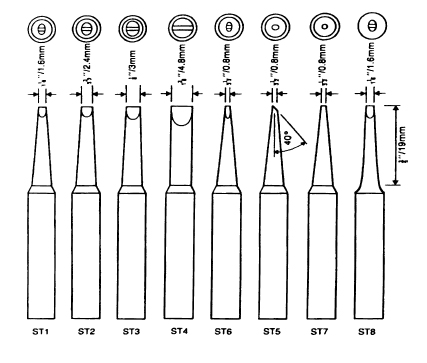
The Weller WLC100 40-Watt Soldering Station is an inexpensive consumer grade soldering station for the hobbyist. It's adjustable from five to 40 watts (good for PCB work) and comes with the 1/8" (ST3) screwdriver tip.

Additional tips are sold separately:
WELLER_B000AS28UC-3-lg.jpg
 
We use Metcal MX-5000's at work. There is a massive assortment of tips available however the station is rather expensive.

Don't forget to re-tin your soldering tips when you're done soldering.
 
Last edited:
we have a hakko fm203. i have done some good motherboard work with it. also, we have a full set of tips.
 
Wow! So many choices! Thanks a lot dudes!

I am not sure whats the difference between the chisel and conical tips when it comes to soldering... Which ones are better for working with motherboards, cards, etc?
 
Last edited:
Wow! So many choices! Thanks a lot dudes!

I am not sure whats the difference between the chisel and conical tips when it comes to soldering... Which ones are better for working with motherboards, cards, etc?

the more material in the tip, the larger the reservoir of heat to work with. i'm doing fine with 40 watts and the st3 (medium chisel/screwdriver) tip, but i'm working on fairly large contacts and 12 awg. the reason i got the wlc100 is for the (lousy) stand and on/off switch. the 5-40W power dial means nothing to me, although it might come in handy working on very sensitive parts.

maybe an expert could correct me, but my assumption is that with a smaller tip you would use a higher-power iron (65W or more) to offset the smaller reservoir of heat stored in the tip.
 
the more material in the tip, the larger the reservoir of heat to work with. i'm doing fine with 40 watts and the st3 (medium chisel/screwdriver) tip, but i'm working on fairly large contacts and 12 awg. the reason i got the wlc100 is for the (lousy) stand and on/off switch. the 5-40W power dial means nothing to me, although it might come in handy working on very sensitive parts.

maybe an expert could correct me, but my assumption is that with a smaller tip you would use a higher-power iron (65W or more) to offset the smaller reservoir of heat stored in the tip.
You could, but then the tip temperature would be extremely high during off-usage. A temperature-controlled station or iron is ideal since it moderates its own temperature constantly.
 
Wow! So many choices! Thanks a lot dudes!

I am not sure whats the difference between the chisel and conical tips when it comes to soldering... Which ones are better for working with motherboards, cards, etc?
Chisels are better general-purpose tips for through-hole soldering. Conical can go finer but is a little slower to transfer heat (sometimes you have no choice though).
 
I agree with Howard. Chisel tips have a wide surface area and can transfer heat easily. Conical tips are useful for surface mount parts especially working on fine pitch parts. I mostly work with an angled conical tip for reworking parts.
 
Status
Not open for further replies.
Back
Top