


- Jun 4, 2004
- 17,728
- 16,030
- 146
https://arstechnica.com/science/201...ket-making-progress-toward-a-100-hour-firing/
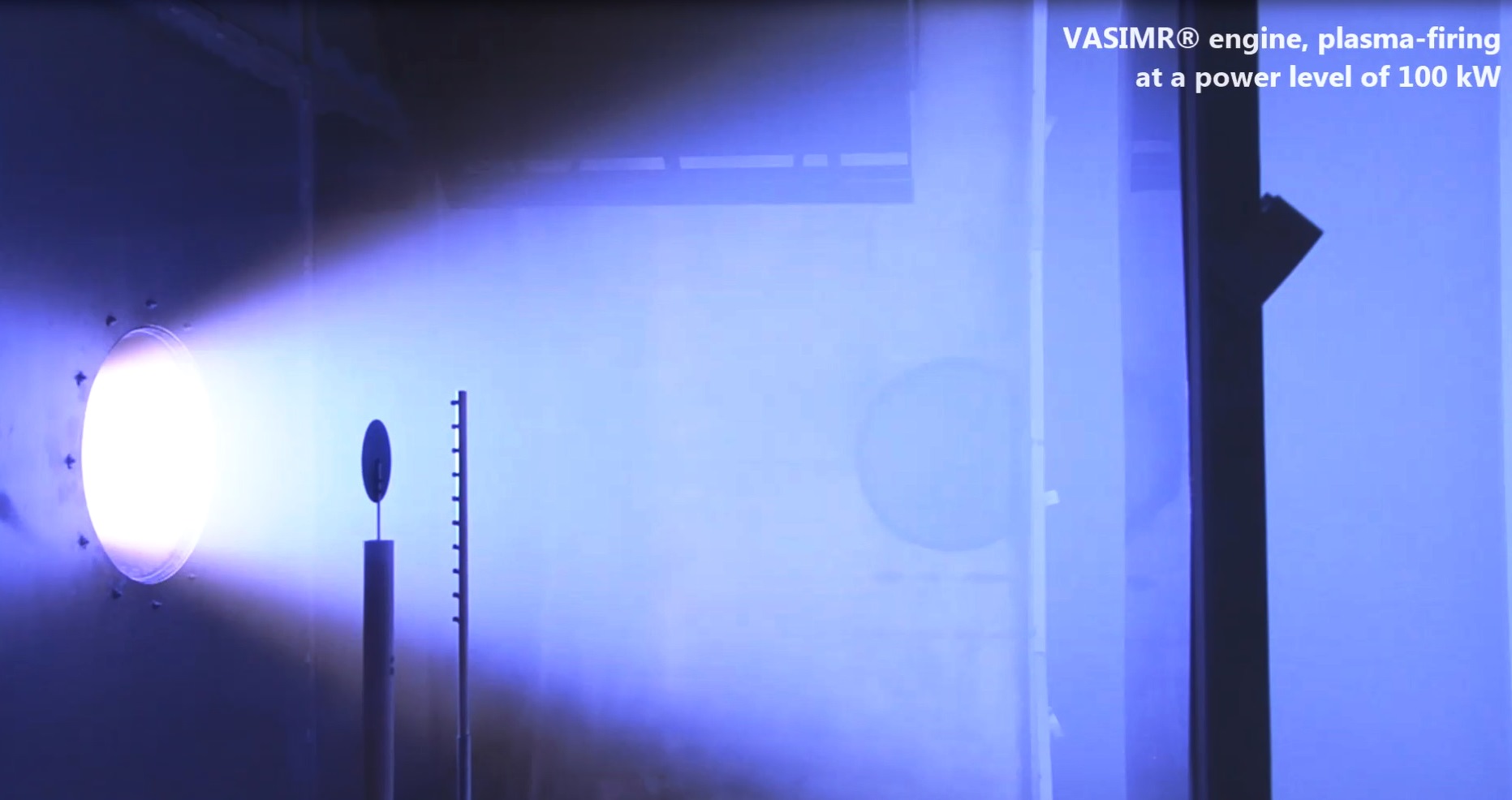
VASIMR stands for Variable Specific Impulse Magnetoplasma Rocket.
It's a pretty cool design. Basically it's a low to medium thrust in space engine that acts like a transmission for a spacecraft.
They take argon gas (or really any gas), pump it into the chamber where the first microwave attenna is tuned to excite the electrons in the gas turning it into a cold plasma. Three circular magnets direct the plasma using electric and magnetic fields towards the next antenna which is tuned to excite the ions in the plasma. This in turn jacks the temperature up to millions of degrees. The hottest fastest ions and electrons are then accelerated out the magnetic nozzle.
By putting more energy into the first antenna you get more thrust at worse "gas mileage", like being in low gear. If more energy is directed to the second antenna you get better mileage but less thrust, like being in high gear. It ends up about 10-100 times more efficient than a chemical rocket.
It was designed by Dr Franklin Chang-Diaz a seven time astronaut, (tied for most launches) and plasma physics guy. Back when he was doing fusion experiments 30 years ago he realized that there problems containing the plasma would actually make a great rocket if they just had the containment problem on one end.
First use might be to move cargo from earth orbit to lunar orbit. With ISS sized arrays they could move the same cargo with 8 tons of fuel that a chemical rocket would take 60 tons to move.
For manned flights, if a nuclear reactor was used, flight times to Mars to could be knocked down from 9 months to less than two months.
At any rate they've moved from firing it for a few seconds at a time up to 5 minutes of continuous thrust. By next year they should be at the contracted 100 hours continuous firing.
After that hopefully an on orbit test.
In 2015, the space agency awarded three different contracts for development of advanced propulsion systems. Of these, perhaps the most intriguing is a plasma-based rocket—which runs on Argon fuel, generates a plasma, excites it, and then pushes it out a (magnetic) nozzle at high speed. This solution has the potential to shorten the travel time between Earth and Mars to weeks, rather than months.
But to realize that potential, Houston-based Ad Astra Rocket Company must first demonstrate that its plasma rocket, VASIMR, can fire continuously for a long period of time. The three-year, $9 million contract from NASA required the company to fire its plasma rocket for 100 hours at a power level of 100 kilowatts by 2018.
VASIMR stands for Variable Specific Impulse Magnetoplasma Rocket.
It's a pretty cool design. Basically it's a low to medium thrust in space engine that acts like a transmission for a spacecraft.
They take argon gas (or really any gas), pump it into the chamber where the first microwave attenna is tuned to excite the electrons in the gas turning it into a cold plasma. Three circular magnets direct the plasma using electric and magnetic fields towards the next antenna which is tuned to excite the ions in the plasma. This in turn jacks the temperature up to millions of degrees. The hottest fastest ions and electrons are then accelerated out the magnetic nozzle.
By putting more energy into the first antenna you get more thrust at worse "gas mileage", like being in low gear. If more energy is directed to the second antenna you get better mileage but less thrust, like being in high gear. It ends up about 10-100 times more efficient than a chemical rocket.
It was designed by Dr Franklin Chang-Diaz a seven time astronaut, (tied for most launches) and plasma physics guy. Back when he was doing fusion experiments 30 years ago he realized that there problems containing the plasma would actually make a great rocket if they just had the containment problem on one end.
First use might be to move cargo from earth orbit to lunar orbit. With ISS sized arrays they could move the same cargo with 8 tons of fuel that a chemical rocket would take 60 tons to move.
For manned flights, if a nuclear reactor was used, flight times to Mars to could be knocked down from 9 months to less than two months.
At any rate they've moved from firing it for a few seconds at a time up to 5 minutes of continuous thrust. By next year they should be at the contracted 100 hours continuous firing.
After that hopefully an on orbit test.



 Facebook
 Twitter