Leaked Intel Slides on Atom 22nm (OoO Quad Core).

Roland00Address

Platinum Member
Dec 17, 2008
2,196
260
126
Looks like they are removing hyperthreading.

http://mobilegeeks.com/leaked-intel-atom-tablet-roadmap-bay-trail-t-valley-view-t-detailed/

timthumb.php


Bay-Trail-T-2.jpg


Bay-Trail-T-3.jpg


Bay-Trail-T-4.jpg
 

NTMBK

Lifer
Nov 14, 2011
10,525
6,050
136
Not really surprised to be honest. The reason it was so necessary on original Atom was because utilisation was so low due to lack of OoE. Probably wouldn't give enough of a performance increase on an OoO core to make the power budget worth it.

Be interesting to see how this stacks up against Jaguar.

EDIT: Still only lists 32 bit Windows 8 as an OS? No 64 bit?!
 

nehalem256

Lifer
Apr 13, 2012
15,669
8
0
Not really surprised to be honest. The reason it was so necessary on original Atom was because utilisation was so low due to lack of OoE. Probably wouldn't give enough of a performance increase on an OoO core to make the power budget worth it.

Be interesting to see how this stacks up against Jaguar.

EDIT: Still only lists 32 bit Windows 8 as an OS? No 64 bit?!

It seems like they are referring to its use in phones/tablets. Does 64 bit make sense in that market given the < 4GB of ram used?
 

Zap

Elite Member
Oct 13, 1999
22,377
7
81
50-60% faster CPU than previous Atom
3x faster GPU than previous Atom
slightly lower power draw (1/2 at "same" performance, but higher performing!)

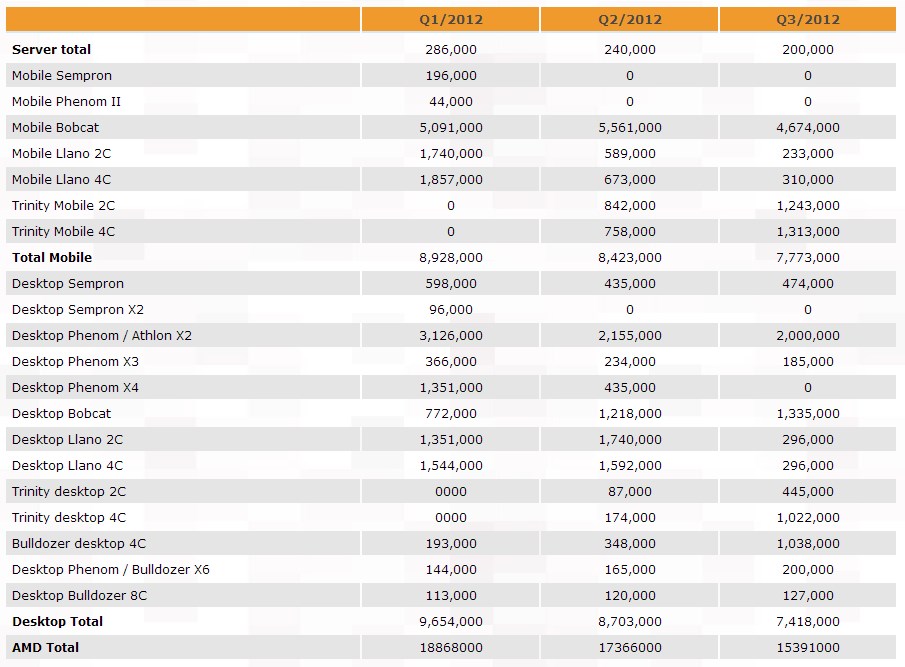
If it is cheap enough then it sounds like a winner. Looks as if Intel is trying to leapfrog AMD's Bobcat/Zacate APUs (C and E series). Bad news for AMD as around 6 million of 15 million CPUs that AMD sold last quarter were Bobcats.

146a.jpg


146b.jpg


Of course all Intel needs to do is price these new chips out of the market for AMD to keep churning out Bobcats. Oh yeah, and no support for 64-bit? Well, recent Atoms supported it. Hmmm...
 

Ferzerp

Diamond Member
Oct 12, 1999
6,438
107
106
It seems like they are referring to its use in phones/tablets. Does 64 bit make sense in that market given the < 4GB of ram used?


Yes, it does: maintaining equivalency across the entire line. Why develop 32-bit architectures when everything else is 64? It would cost more.

Also, never assume X of anything is "enough"
 

NTMBK

Lifer
Nov 14, 2011
10,525
6,050
136
It seems like they are referring to its use in phones/tablets. Does 64 bit make sense in that market given the < 4GB of ram used?

I've already hit the limits of 32 bit on the netbook I just bought- a 4GB SODIMM is £14 right now. Microsoft's limitations on Win7 Starter are the only reason netbooks are still shipping with 1GB RAM .
 

Exophase

Diamond Member
Apr 19, 2012
4,439
9
81
I don't think they're saying 50-60% total performance, but that 4C is 50-60% faster than 2C/4T would have been.. if that makes any sense. Which I suppose it doesn't, since HT benefit wouldn't be the same for this as it is for Saltwell, but I don't see how that statement can make any sense otherwise. With a significantly better uarch, significantly higher clock speed, and twice the physical cores how would you only get 50-60%?

x86-64 should really be used everywhere now. Regardless of how much memory the device has, it's the superior ISA (more registers) and you pay a performance penalty avoiding it. Instead of going with pure 32-bit mode they should have pressured MS or whoever necessary to make software ABIs allowing fully 32-bit pointers in 64-bit mode. Like x32 is finally doing on Linux. Then you get all the benefit and almost none of the cost and you can finally deprecate 32-bit mode in new hardware.

There's some other kind of weird things on the slides. Clover Trail is supposed to be 1.8GHz (and not just a turbo speed, Intel is actually calling it 1.8GHz base), not 1.5GHz. And the GPU is supposed to be 533MHz. 3x GPU performance over 400MHz SGX545, while a good improvement, is still not that amazing.
 

Khato

Golden Member
Jul 15, 2001
1,387
494
136
I don't think they're saying 50-60% total performance, but that 4C is 50-60% faster than 2C/4T would have been.. if that makes any sense. Which I suppose it doesn't, since HT benefit wouldn't be the same for this as it is for Saltwell, but I don't see how that statement can make any sense otherwise. With a significantly better uarch, significantly higher clock speed, and twice the physical cores how would you only get 50-60%?

Yeah, I'm also quite curious as to what metric that 50-60% performance improvement is actually for. Single-threaded performance is a remote possibility, but combined with the frequency increase would be low for the jump from in order to out of order. That's kinda what I expect it'll be though, given that such roughly lines up with the previous bar chart of tablet atom CPU performance.
 

podspi

Golden Member
Jan 11, 2011
1,982
102
106
Interesting. It looks like Intel will finally be competitive in the 'netbook' CPU market.

The dual-core mobile phone SoCs based off of these are going to be awesome.
 

inf64

Diamond Member
Mar 11, 2011
3,884
4,692
136
50-60% faster CPU than previous Atom
3x faster GPU than previous Atom
slightly lower power draw (1/2 at "same" performance, but higher performing!)

If it is cheap enough then it sounds like a winner. Looks as if Intel is trying to leapfrog AMD's Bobcat/Zacate APUs (C and E series). Bad news for AMD as around 6 million of 15 million CPUs that AMD sold last quarter were Bobcats.


Of course all Intel needs to do is price these new chips out of the market for AMD to keep churning out Bobcats. Oh yeah, and no support for 64-bit? Well, recent Atoms supported it. Hmmm...
It would be problem for AMD IF AMD didn't have anything better than Bobcat in 2013. Since they have Jaguar coming along next year,with 2x more cores ,higher clock and better IPC(fp has ~2x more throughput per core Vs Bobcat),AMD should be positioned very nicely against this 4C/4T product from intel.
 

Acanthus

Lifer
Aug 28, 2001
19,915
2
76
ostif.org
So this will be squaring off with the quad core ARM A15?

I have been baffled that Intel has been behind at all in this market segment because of the massive advantage they have with in house fabs and smaller process technology.
 

ShintaiDK

Lifer
Apr 22, 2012
20,378
146
106
So this will be squaring off with the quad core ARM A15?

I have been baffled that Intel has been behind at all in this market segment because of the massive advantage they have with in house fabs and smaller process technology.

Because before smartphones, the same type of CPUs in regular phones payed only a tiny margin. Now in a smartphone, people happily pay huge overprices in a concept that gets obsolete faster than you can unpack it.
 

Fjodor2001

Diamond Member
Feb 6, 2010
4,671
758
126
What "standard" Intel desktop CPU will these Atom CPUs be comparable to performance-wise? P4, C2D, or... ? And at what clock speed?
 
Feb 25, 2011
16,999
1,628
126
What "standard" Intel desktop CPU will these Atom CPUs be comparable to performance-wise? P4, C2D, or... ? And at what clock speed?

Well, the older Atoms (the 1.6GHz chips in all the Netbooks) were comparable to a P4 running at 2.whatever GHz, although they traded off - losing in raw CPU performance for things like video encoding, and beating them resoundingly in things that were I/O limited because of the newer memory support, faster SATA, etc.

These are faster. Maybe into C2D territory?
 

inf64

Diamond Member
Mar 11, 2011
3,884
4,692
136
Yes,probably Merom level of performance with much better power efficiency.
 

Exophase

Diamond Member
Apr 19, 2012
4,439
9
81
Yeah, I'm also quite curious as to what metric that 50-60% performance improvement is actually for. Single-threaded performance is a remote possibility, but combined with the frequency increase would be low for the jump from in order to out of order. That's kinda what I expect it'll be though, given that such roughly lines up with the previous bar chart of tablet atom CPU performance.

Right, single threaded performance improvement would be in line with what Intel reported in their projected slides, which showed a ~62% increase in the bar length after you normalize it for a doubling in core count.

Question is, going from what to what? 1.5GHz Clover Trail or 1.8GHz? Former would be a 40% increase in frequency, latter 16.67%. Former would imply a 7-14% improvement in IPC, latter would imply a 29-37% improvement. Former seems too low, while the latter seems plausible, and a little higher than the numbers Charlie claimed.

Only knowing that you're going from in-order to out-of-order doesn't really give you anything to base expectations on. Cortex-A8 to A9 for instance gave about 25% IPC improvement. The original Pentium, in-order and dual-issue, did decently against competitors that were out-of-order and dual-issue (I'm actually not aware of any in-order integer superscalar processor from a competitor at any point).

I really doubt these will be hitting Merom IPC, am thinking closer to Bobcat IPC.