• We’re currently investigating an issue related to the forum theme and styling that is impacting page layout and visual formatting. The problem has been identified, and we are actively working on a resolution. There is no impact to user data or functionality, this is strictly a front-end display issue. We’ll post an update once the fix has been deployed. Thanks for your patience while we get this sorted.

Idontcare -- your wisdom, please!

Idontcare,

I would have sent this to you as a private message but the topic is of interest to a broad audience, so I humbly ask it publicly:

What the heck happened with TSMC's 16 FinFET? More importantly, how did Samsung beat TSMC to the punch and land those Apple/Qualcomm orders? Do you believe TSMC's claim that Samsung is beating them to 14/16 because TSMC focused on the 20nm opportunity? Or is this a matter of Samsung willing to sell wafers for much cheaper, meaning it can go into production at lower yields sooner? Or did Samsung simply school TSMC in terms of getting an economically viable process ramped sooner?

Anything you can offer on this -- as you seem to be this board's foundry guru -- would be highly appreciated.
 
16 FinFET, which FinFETs? We still have to wait ~6Qs before we can buy those shiny foundry 3D transistors, so it looks rather soon to say that Samsung beat TSMC, or do you have a source?
 
Not really news, Morris Chang already indicated this a year ago:
http://technews.tw/2013/07/19/tsmc-16nm-pre-2015april/

The 15% higher density 16FF+ is similar to Samsung's 14nm but came
too late.

and then: Capacity, Capacity, Capacity

"Volume Production" for Apple/Qualcomm is something entirely different as
your average "volume production" for the average client.
Very high Volume production for 16nmFF is only Fab 14 Phase 7

20nm volume production planned at TSMC:

Fab 12 Phase 6 in Hsinchu: 2013
Fab 14 Phase 5 in Tainan: Feb 2014
Fab 14 Phase 6 in Tainan: May 2014
Fab 14 Phase 7 in Tainan: April 2015 (20nm and 16nm FinFet)

Realistically, Apple/Qualcomm like 16nm volumes were always in H2, 2015

http://www.tsmc.com/tsmcdotcom/PRLis...il&newsid=6641
http://seekingalpha.com/article/1555...nscript?page=5

The combined 20/16nm cleanroom space at Fab14 is enormous:

130,000 square meter (1,400,000 square feet)

http://www.simmtester.com/page/news/shownews.asp?num=14850
http://www.cleanroomtechnology.com/news/article_page/TSMC_begins_further_expansion_of_Fab_14/77345

F14P5.jpg

F14P6.jpg

F14P7.jpg


The D1X fab at Intel's Ronler Acres site in Oregon for 14nm production has
something like 200,000 square feet of clean room.

Intel_14_nm_Fabs_Wide.jpg


http://exploreintel.com/ronleracres

FinFET.png


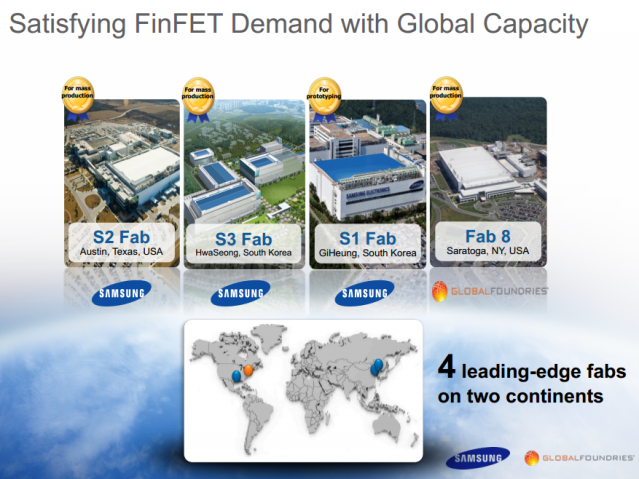
GlobalFoundries fab8 in Albany, Saratoga County, New York has 300,000
square feet of clean room

Line 17 of Samsungs S3 Fab for 20/14nm production in HwaSeong in South Korea
has a similar size (80,000 Wafers per month)

Samsungs S2 Fab in Austin is smaller.


Apple/Qualcomm need this kind of extra capacity for their mobile production.


http://globalfoundries.com/docs/def...dries-14nm-collaboration---final.pdf?sfvrsn=2
 
Last edited:
Idontcare,

I would have sent this to you as a private message but the topic is of interest to a broad audience, so I humbly ask it publicly:

What the heck happened with TSMC's 16 FinFET? More importantly, how did Samsung beat TSMC to the punch and land those Apple/Qualcomm orders? Do you believe TSMC's claim that Samsung is beating them to 14/16 because TSMC focused on the 20nm opportunity? Or is this a matter of Samsung willing to sell wafers for much cheaper, meaning it can go into production at lower yields sooner? Or did Samsung simply school TSMC in terms of getting an economically viable process ramped sooner?

Anything you can offer on this -- as you seem to be this board's foundry guru -- would be highly appreciated.

This, as you can imagine, is a multi-layered onion.

Nothing is set in stone per se at this time, the order sizes themselves are more like free samples in the volumes being mentioned.

Thus far this all appears to be a bit of negotiation jousting between the various businesses as they puff out their chests and attempt to put on a charade for shareholders and business partners alike.

We knew Samsung/GloFo were going to get Apple orders for 14nm as that was the tenet of their 14nm licensing deal, GF needed someone to put some production into their NY fab and Apple convincing Samsung to cross-license was the way to go there.

The Qualcomm deal is also not too surprising given that Samsung finds themselves using Qualcomm's chips over their own internal designs. Naturally there will be a bit of quid-pro-quo in terms of wafer pricing (for Qualcomm) and chip pricing (for Samsung) for those 14nm Qualcomm IC's which are going to end up in Samsung products.

What I have not heard anything substantial about is TSMC's plans for 16FinFET (+ edition or regular). The plan, naturally, was for them to win 99% of the tapeouts for 20nm and then retain 99% of those design wins as customers who want to swap out the planar xtors in their 20nm designs for the lower-power losses or higher performance attributes of the 16 FinFET "half-node".

What TSMC wasn't expecting was that there would be some customers, just a couple, who would be willing to forego the opportunity of leveraging their existing 20nm designs at TSMC with the cheap "shrink" option to go to 16 FinFET, and instead they'd invest 100% of the cost of re-doing those chips for Samsung's 14nm (but not putting them into Samsung's 20nm process).

So for now this all appears to be within the realm of "it makes economic sense because of the nature of the complicated business partnerships of TSMC, Apple, Qualcomm, and Samsung".
 
This, as you can imagine, is a multi-layered onion.

Nothing is set in stone per se at this time, the order sizes themselves are more like free samples in the volumes being mentioned.

Thus far this all appears to be a bit of negotiation jousting between the various businesses as they puff out their chests and attempt to put on a charade for shareholders and business partners alike.

We knew Samsung/GloFo were going to get Apple orders for 14nm as that was the tenet of their 14nm licensing deal, GF needed someone to put some production into their NY fab and Apple convincing Samsung to cross-license was the way to go there.

The Qualcomm deal is also not too surprising given that Samsung finds themselves using Qualcomm's chips over their own internal designs. Naturally there will be a bit of quid-pro-quo in terms of wafer pricing (for Qualcomm) and chip pricing (for Samsung) for those 14nm Qualcomm IC's which are going to end up in Samsung products.

What I have not heard anything substantial about is TSMC's plans for 16FinFET (+ edition or regular). The plan, naturally, was for them to win 99% of the tapeouts for 20nm and then retain 99% of those design wins as customers who want to swap out the planar xtors in their 20nm designs for the lower-power losses or higher performance attributes of the 16 FinFET "half-node".

What TSMC wasn't expecting was that there would be some customers, just a couple, who would be willing to forego the opportunity of leveraging their existing 20nm designs at TSMC with the cheap "shrink" option to go to 16 FinFET, and instead they'd invest 100% of the cost of re-doing those chips for Samsung's 14nm (but not putting them into Samsung's 20nm process).

So for now this all appears to be within the realm of "it makes economic sense because of the nature of the complicated business partnerships of TSMC, Apple, Qualcomm, and Samsung".

Thank you, Idontcare. Always a pleasure to read your insights.
 
Not really news, Morris Chang already indicated this a year ago:
http://technews.tw/2013/07/19/tsmc-16nm-pre-2015april/

The 15% higher density 16FF+ is similar to Samsung's 14nm but came
too late.

and then: Capacity, Capacity, Capacity

"Volume Production" for Apple/Qualcomm is something entirely different as
your average "volume production" for the average client.
Very high Volume production for 16nmFF is only Fab 14 Phase 7

20nm volume production planned at TSMC:

Fab 12 Phase 6 in Hsinchu: 2013
Fab 14 Phase 5 in Tainan: Feb 2014
Fab 14 Phase 6 in Tainan: May 2014
Fab 14 Phase 7 in Tainan: April 2015 (20nm and 16nm FinFet)

Realistically, Apple/Qualcomm like 16nm volumes were always in H2, 2015

http://www.tsmc.com/tsmcdotcom/PRLis...il&newsid=6641
http://seekingalpha.com/article/1555...nscript?page=5

The combined 20/16nm cleanroom space at Fab14 is enormous:

130,000 square meter (1,400,000 square feet)

http://www.simmtester.com/page/news/shownews.asp?num=14850
http://www.cleanroomtechnology.com/news/article_page/TSMC_begins_further_expansion_of_Fab_14/77345

F14P5.jpg

F14P6.jpg

F14P7.jpg


The D1X fab at Intel's Ronler Acres site in Oregon for 14nm production has
something like 200,000 square feet of clean room.

Intel_14_nm_Fabs_Wide.jpg


http://exploreintel.com/ronleracres

FinFET.png


GlobalFoundries fab8 in Albany, Saratoga County, New York has 300,000
square feet of clean room

Line 17 of Samsungs S3 Fab for 20/14nm production in HwaSeong in South Korea
has a similar size (80,000 Wafers per month)

Samsungs S2 Fab in Austin is smaller.


Apple/Qualcomm need this kind of extra capacity for their mobile production.


http://globalfoundries.com/docs/def...dries-14nm-collaboration---final.pdf?sfvrsn=2

Thanks, Hans!
 
Back
Top