

-
We’re currently investigating an issue related to the forum theme and styling that is impacting page layout and visual formatting. The problem has been identified, and we are actively working on a resolution. There is no impact to user data or functionality, this is strictly a front-end display issue. We’ll post an update once the fix has been deployed. Thanks for your patience while we get this sorted.
You are using an out of date browser. It may not display this or other websites correctly.
You should upgrade or use an alternative browser.
You should upgrade or use an alternative browser.
HD 5870 PCI-Express Scaling with pci-e 1x, 4x ,8x ,16x,
- Thread starter happy medium
- Start date

waffleironhead
Diamond Member
those x1 numbers are pretty surprising.(to me at least)
thilanliyan
Lifer
Thanks for the link.
soccerballtux
Lifer
This is great. My board scales back to pci-e 2.0 8x on both of the slots if I plug in 2 graphics cards. Good to know even a 5870 won't be limited by 8x.

soccerballtux
Lifer
more like lol that 1920x1200 gets better frames than 1024x768.
deimos3428
Senior member
TF2 is awesomely easy on video hardware. My IGP (790GX) will even run it pretty well @ 1368x768.
Absolution75
Senior member
Not that surprising. Its just like SATA 3GB, just because you have the bandwidth, doesn't mean you will ever use it on a single hard drive.

TurtleCrusher
Lifer
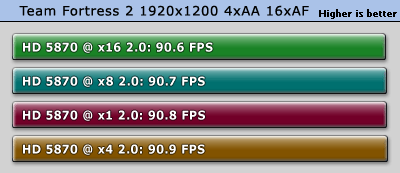
Lolwut?
lavaheadache
Diamond Member
This is great. My board scales back to pci-e 2.0 8x on both of the slots if I plug in 2 graphics cards. Good to know even a 5870 won't be limited by 8x.
excatly my thought regarding my ep45 ud3p. I look forward to a cypress crossfire setup
happy medium
Lifer
excatly my thought regarding my ep45 ud3p. I look forward to a cypress crossfire setup
This is why I posted this review.
I was looking at 1156 boards and they all come with 2 8x pci-e slots when running crossfire or sli.
Before I go out and spend hundereds of dollars on a new i5 750 rig ,I wanna know it will handle two high end cards. 😀
Actually my current board runs 2 pci-e slots @ 8x also. Mabe I'll just see if this cpu can push some new cards in crossfire.


SunnyD
Belgian Waffler
There's one thing they neglected to test. Load times.
I'm betting there was a significant difference in load times between 1x and 16x. All of this makes sense though, given the large amounts of RAM present on these cards. Most of the textures and geometry are preloaded into the video RAM, so the size of the bus generally won't matter in terms of actual game play once the geometry and textures are preloaded. The only time it matters is when something new has to be written into video memory, which explains why (I'm assuming since it wasn't detailed) average frame rates are as high as they are across the board.
I'm betting there was a significant difference in load times between 1x and 16x. All of this makes sense though, given the large amounts of RAM present on these cards. Most of the textures and geometry are preloaded into the video RAM, so the size of the bus generally won't matter in terms of actual game play once the geometry and textures are preloaded. The only time it matters is when something new has to be written into video memory, which explains why (I'm assuming since it wasn't detailed) average frame rates are as high as they are across the board.
heyheybooboo
Diamond Member
Interesting article ... I bet it took a few weeks to bring all that together.
The only caution flag I might raise is that inferences are being made between X-58 <----> P55, and the signaling/switching of the PCH versus the IOH with a QPI at 25 Gb/s+.
I can't recall off-hand the theoretical bandwidth of the PCH but I know it's less than the IOH of the X58. How that impacts the real world, who knows?
The article did reinforce the notion that a 'general' 5% difference may be seen in some titles, but I also suspect that difference may exceed 10% or so in limited instances of heavy texture loading in extended game play ....
--
The only caution flag I might raise is that inferences are being made between X-58 <----> P55, and the signaling/switching of the PCH versus the IOH with a QPI at 25 Gb/s+.
I can't recall off-hand the theoretical bandwidth of the PCH but I know it's less than the IOH of the X58. How that impacts the real world, who knows?
The article did reinforce the notion that a 'general' 5% difference may be seen in some titles, but I also suspect that difference may exceed 10% or so in limited instances of heavy texture loading in extended game play ....
--
soccerballtux
Lifer
There's one thing they neglected to test. Load times.
I'm betting there was a significant difference in load times between 1x and 16x. All of this makes sense though, given the large amounts of RAM present on these cards. Most of the textures and geometry are preloaded into the video RAM, so the size of the bus generally won't matter in terms of actual game play once the geometry and textures are preloaded. The only time it matters is when something new has to be written into video memory, which explains why (I'm assuming since it wasn't detailed) average frame rates are as high as they are across the board.
I don't think there is. PCI-e 1x is 100MB/s. Loading up a 1024MB card at that speed isn't going to take any longer than streaming it from the harddrive. Since we're all running at least 8x, this is obviously not a problem.
SunnyD
Belgian Waffler
I don't think there is. PCI-e 1x is 100MB/s. Loading up a 1024MB card at that speed isn't going to take any longer than streaming it from the harddrive. Since we're all running at least 8x, this is obviously not a problem.
Point taken, initially a lot of the data will come from the HDD. However, all of that data is preloaded into system RAM to be processed by the graphics engine for setup prior to being copied over to the video card. And when I say "significant" time in this case, I'm talking about a couple seconds difference at most, but still be noticeable/measurable.
Last edited:

EarthwormJim
Diamond Member
There's one thing they neglected to test. Load times.
I'm betting there was a significant difference in load times between 1x and 16x. All of this makes sense though, given the large amounts of RAM present on these cards. Most of the textures and geometry are preloaded into the video RAM, so the size of the bus generally won't matter in terms of actual game play once the geometry and textures are preloaded. The only time it matters is when something new has to be written into video memory, which explains why (I'm assuming since it wasn't detailed) average frame rates are as high as they are across the board.
Good point, an excellent game to test this is GTA IV. Simply turning your character around can reveal how much new data the game is loading.

PingSpike
Lifer
Cool article, very interesting.
Performance hit is bad for 1x, but not that awful bad. Looks like I'll be getting a 16x to 1x adapter and saving money not buying SLI boards for my dual video card setup. (I use a second older card to play old games since DX10 and up hardware breaks tons of old games).
Performance hit is bad for 1x, but not that awful bad. Looks like I'll be getting a 16x to 1x adapter and saving money not buying SLI boards for my dual video card setup. (I use a second older card to play old games since DX10 and up hardware breaks tons of old games).
Due to an improper insertion, my 9800gtx+ was running at 1x for a while. No games were playable, even vastly older ones. Crysis was a slide show and would freeze up for minutes at a time.
(however, under ubuntu the pci express slot was still running at 1x, but games running in wine, even some of the same games, ran fine)
I think I've seen past results that indicate ati cards are less effected by pci express bandwidth than nvidia, but most of these games are barely impacted even at 1x speed. (or the driver may have just freaked out in some od way)
(however, under ubuntu the pci express slot was still running at 1x, but games running in wine, even some of the same games, ran fine)
I think I've seen past results that indicate ati cards are less effected by pci express bandwidth than nvidia, but most of these games are barely impacted even at 1x speed. (or the driver may have just freaked out in some od way)
TRENDING THREADS
-
 Discussion Zen 5 Speculation (EPYC Turin and Strix Point/Granite Ridge - Ryzen 9000)
- Started by DisEnchantment
- Replies: 25K
-
Discussion Intel Meteor, Arrow, Lunar & Panther Lakes + WCL Discussion Threads
- Started by Tigerick
- Replies: 25K
-
 Discussion Intel current and future Lakes & Rapids thread
- Started by TheF34RChannel
- Replies: 24K
-

-
