• We’re currently investigating an issue related to the forum theme and styling that is impacting page layout and visual formatting. The problem has been identified, and we are actively working on a resolution. There is no impact to user data or functionality, this is strictly a front-end display issue. We’ll post an update once the fix has been deployed. Thanks for your patience while we get this sorted.

Haswell Viability question

mojothehut

Senior member
Hey all
I'm just kinda wondering from a purely gaming point of view if
my i7 4770k will be fine for another year or so?

Currently I have it running at 4.4ghz.
Rest of system.
EVGA Classified 980ti
Asus Z87
Samsung 850Pro 1tb
Win10 Pro

Should I be looking at upgrading cpu&mobo this summer or just stay aboard the Haswell train 🙂
 
I would think 3 to 5 years as well. With consoles still at the start of their current cycle, I do not expect game developers to push very hard to make the experience better. They will keep to tweaking the performance on console level hardware.

edit: the only exception will be VR, but that is still a bit on the new side to worry about upgrading hardware for (even if a upgrade is needed).
 
Haswell is the new baseline for future lifespan. So dont worry. The 4770K is the new 2600K. Should last you some years.
 
Is your cpu viable for another year? Does a bear poop in the woods? Actually, I think it should be fine for 3 to 5 years.

^ This. At 4.4ghz it should be golden for at least 3 years and honestly it could be perfectly fine for gaming for 6-8 years if DX12 is adopted like it's looking it will be.


Coolbeans thanks for the input
I'll do something crazy and spend money on the girlfriend instead..whaaaaat?


^ I do not recommend this train of thought. 😀 Pay off any debt you have first, save your money, invest it, do something practical and productive. Spending money on a girlfriend is like throwing money down a bottomless pit as a sacrifice to the gods.
 
Last edited:
The only worthy upgrade for a long time will be to a the enthusiast platform unless Intel releases a mainstream hexcore CPU at some point. They probably haven't even considered doing that yet though, and even 10 years from now they'll still stick to quads .
 
Half the cache speed, no AVX2 etc.

Games (which the OP is asking about) to my knowledge aren't using AVX2 (with the exception of one title I believe)

The consoles have Jaguar cores which have AVX, so I would think that one is being used though. However, Sandy Bridge also has AVX and more importantly still appears to be doing well in current game benchmarks.

P.S. Actually even Nehalem does pretty well, see posts here, here and here, but not Core 2.

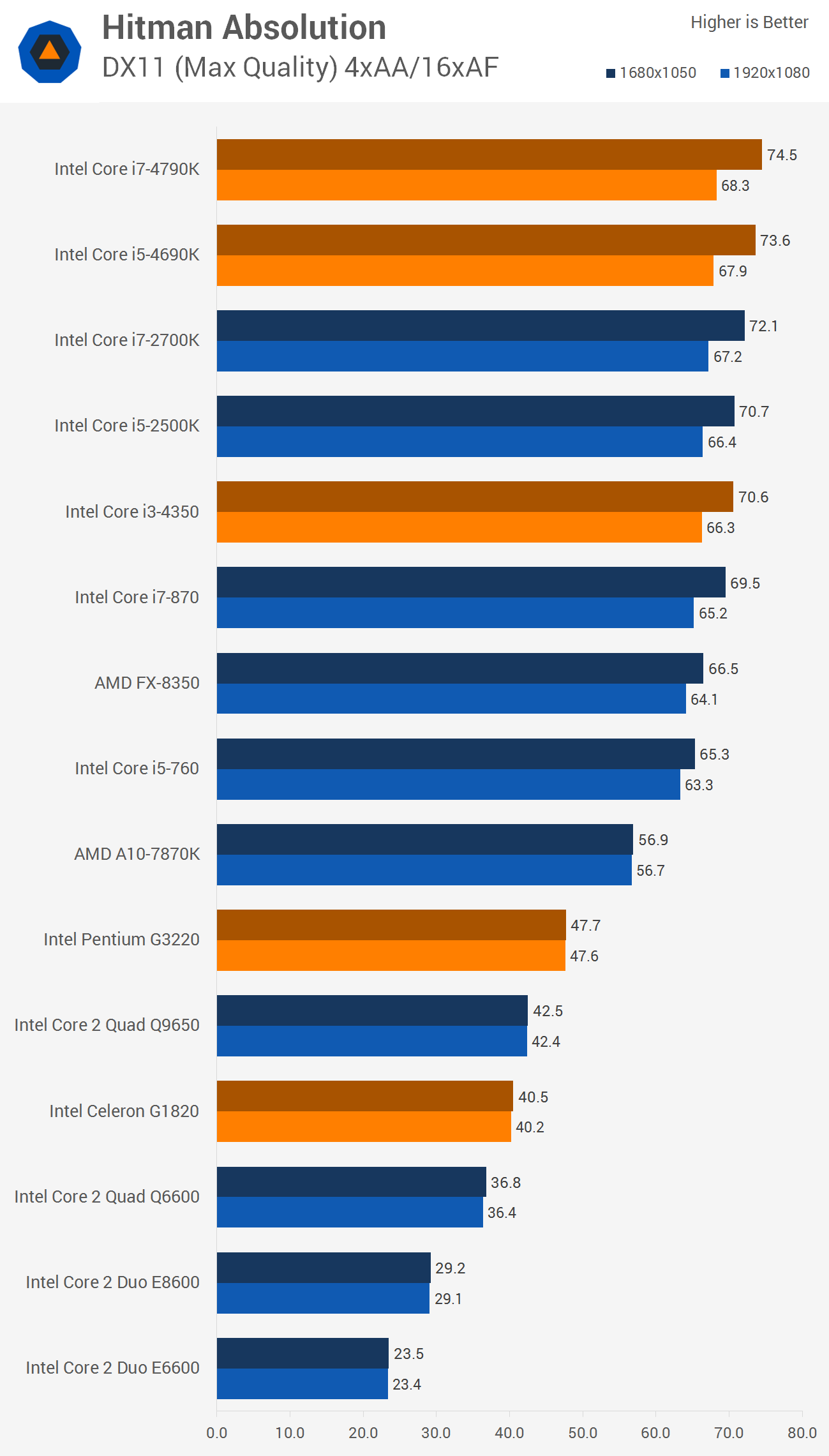
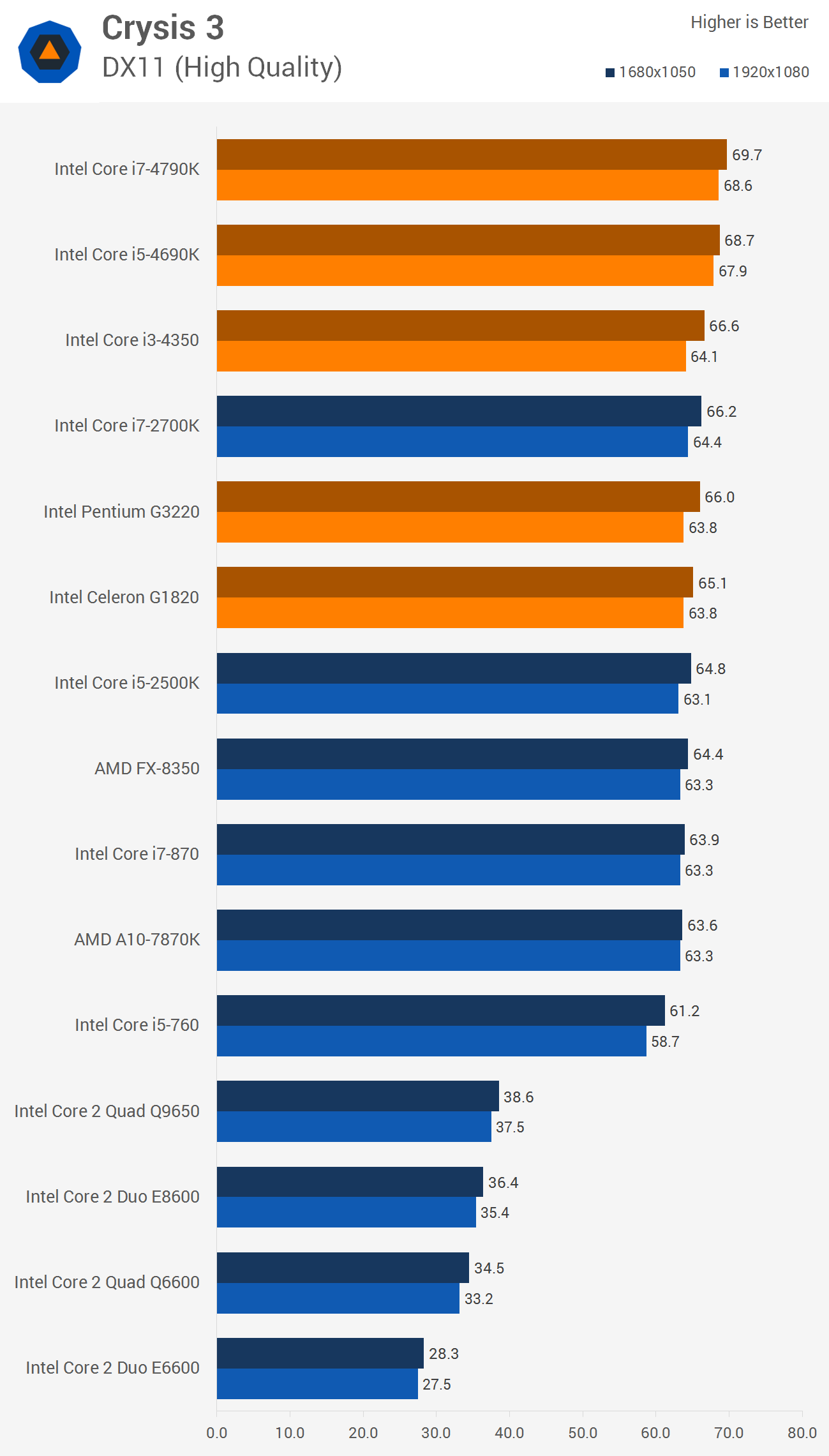
(Notice the strong drop off with Core 2 compared to Nehalem in those two games below.)

Gaming_03.png


Gaming_05.png
 
Last edited:
(Notice the strong drop off with Core 2 compared to Nehalem)

One of the most future proof CPUs to date. To think that back in 2008 it was criticized for only being 'slightly' faster than Core 2 Quad in games:

AnandTech said:
Overall in gaming tests the situations where Nehalem was faster than Penryn outnumbered those where it didn't, but upgrading to Nehalem for faster gaming performance doesn't make sense.
 
Games (which the OP is asking about) to my knowledge aren't using AVX2 (with the exception of one title I believe)

I made a thread about this a while back, and it appears that games are already using AVX2 via Microsoft's visual studio compilers..

Source

The consoles have Jaguar cores which have AVX, so I would think that one is being used though. However, Sandy Bridge also has AVX and more importantly still appears to be doing well in current game benchmarks.

Those benchmarks you posted aren't CPU bound though. Crysis 3 can be CPU bound, but only in certain areas.. If you look at a CPU bound situation, then the differences start to show up:

http--www.gamegpu.ru-images-stories-Test_GPU-Action-Dying_Light-test-new-dl_proz.jpg
 
Those benchmarks you posted aren't CPU bound though.

It is true that the faster processors (in the Techspot benchmarks) were good enough to shift the bottleneck to the GPU, but the Core 2 (and the Haswell Celeron/Pentium and A10-7870K in one of the two games) were not able to.


Crysis 3 can be CPU bound, but only in certain areas.. If you look at a CPU bound situation, then the differences start to show up:

http--www.gamegpu.ru-images-stories-Test_GPU-Action-Dying_Light-test-new-dl_proz.jpg

Sandy Bridge is doing really well in that benchmark though (this despite being 100 Mhz slower on both the Core i5 and Core i7)
 
Last edited:
Sandy Bridge is doing really well in that benchmark though (this despite being 100 Mhz slower on both the Core i5 and Core i7)

Yeah it's still doing well don't get me wrong, but as time goes by, the differences is going to get larger. Imagine if you have a 120Hz monitor. Maintaining such a high frame rate requires a very powerful CPU, and Haswell or Skylake are far better in that regard than SB/IB..

Or a seriously CPU bound game, like a strategy game with many A.I units or lots of CPU dependent systems like Star Citizen.. Here's a somewhat better example than Dying Light. Far Cry 4 is CPU bound, because it only uses a single core for rendering, one for game code, one for sound, and the other for streaming. Basically it follows the last gen programming model to the T..

Here Sandy Bridge is even notably slower than Ivy Bridge, which surprised me.

fc4-fps.gif
 
Back
Top