• We’re currently investigating an issue related to the forum theme and styling that is impacting page layout and visual formatting. The problem has been identified, and we are actively working on a resolution. There is no impact to user data or functionality, this is strictly a front-end display issue. We’ll post an update once the fix has been deployed. Thanks for your patience while we get this sorted.

Google put Moorefield in Nexus Play, Tegra K1 in Nexus 9

NTMBK

Lifer
http://arstechnica.com/gadgets/2014...the-nexus-6-nexus-9-and-android-5-0-lollipop/

Makes sense for Google to launch the first 64 bit device, they want a nice platform for developers to test on. But why are the devices this way around!? I would have put the very strong GPU of the K1 in the micro-console, not Bay Trail! I'm sure the x86 CPU will do great with all those games using ARM binary code :\

Anyway, looking forward to Denver benchmarks!
 
Last edited:
Update: The Nexus 6 will start at $649—far more expensive than previous Nexus phones.

*** **** it. I liked the old way Google was doing things, Google has the right to charge that price but I was so much happier with $300 to $400 awesome phones.

So are we going to see super high end phones in that price range anymore or are we going to see a race to the bottom with prices and specs and a hollowing out of the midrange price segment?
 
why not let tegra k1 handle the htpc? seems like a bad trade [intel tab but tegra htpc?]. I would really like to see tegra stretch its legs without formfactor limitations.
 
The Nexus 9 is definitely the successor for the Nexus 10. I really hope the dual core K1 varient called Denver is worth the hype.
 
Last edited:
I would have put the very strong GPU of the K1 in the micro-console, not Bay Trail!

It is a matter of cost, not a matter of performance. The Google Nexus Player will sell for only $99 USD, so a premium SoC such as Tegra K1 that is used in devices > $299 USD would not be very suitable. And with Intel's contra revenue program, Asus and Google can bring this product to market at such a low price while still making some money.

Google Nexus Player will be competing primarily against Amazon Fire TV (with quad-core S600 SoC) and Apple TV (with single-core A5 SoC). These devices are not dedicated gaming devices, but rather streaming media players that in some cases can play some games and in some cases have an optional game controller that is sold separately.
 
The Nexus 6 doesn't make any sense though. The Nexus line was always been recommended because it could match most flagship specs at a lower unsubsidized price. Hopefully the Nexus 6 has a killer camera and battery life....

Unlike the Nexus 5, the Nexus 6 will be sold through a wide variety of different wireless carriers, so the wireless carriers will be the ones to subsidize the cost of the phone for customers on contract.
 
pretty cool although if intel was in the 9/6 i'm sure it would have generated more positive headlines for intel. a good win nonetheless. hopefully this time next year all the nexus producs have intel inside haha
 
Last edited:

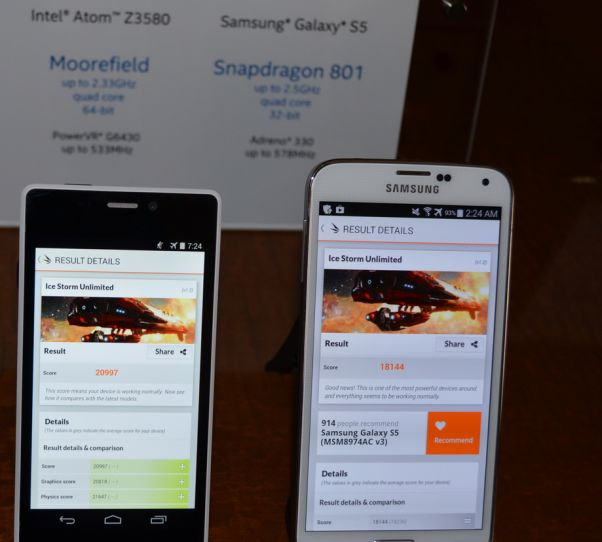
What's so funny, the fact that no one else would be able to offer comparable/better gaming performance than a Snapdragon 801 inside a $99 device? 🙂

Intel_MooreField_Snapdragon_801.jpg


Ps: Your beloved Mullins (in its fastest 500MHz iGPU incarnation, not the slower 300-350MHz iGPU parts) is only ~15% faster in 3DMark Unlimited.
 
Last edited:
What's so funny, the fact that no one else would be able to offer comparable/better gaming performance than a Snapdragon 801 inside a $99 device? 🙂

Intel_MooreField_Snapdragon_801.jpg


Ps: Your beloved Mullins (in its fastest 500MHz iGPU incarnation, not the slower 300-350MHz iGPU parts) is only ~15% faster in 3DMark Unlimited.

So in essence you believe that thoses phones with a Power VR are faster GPU wise than an Asus Transformer 100 with a Z3740.??.

You dont think that there s something fishy in your pic ? because :

3dmark.png


http://techreport.com/review/26377/a-first-look-at-amd-mullins-mobile-apu/4
 
So in essence you believe that thoses phones with a Power VR are faster GPU wise than an Asus Transformer 100 with a Z3740.??.

You dont think that there s something fishy in your pic ? because :

http://techreport.com/review/26377/a-first-look-at-amd-mullins-mobile-apu/4

Moorefield packs PowerVR G6430 graphics, same as Apple A7 but running at higher clockspeeds (@ 533MHz). Definitely faster than BT-T's Gen 7 iGPU and a better fit for a late 2014 multimedia Android device.
 
Moorefield packs PowerVR G6430 graphics, same as Apple A7 but running at higher clockspeeds (@ 533MHz). Definitely faster than BT-T's Gen 7 iGPU and a better fit for a late 2014 multimedia Android device.

The score looks genuine if we compare with the ipad air, i thought that Intel was more advanced than other brands GPU wise set apart AMD :

3DMarkIceStormUnlimited.png

http://www.tomshardware.fr/articles/samsung-galaxy-note-10.1-tablette,2-2321-8.html

Also, a usefull post about the ipad air compared to Mullins...

http://forums.anandtech.com/showpost.php?p=36317634&postcount=18
 
Last edited:
I see the K1 at 2.3GHz, wasn't it supposed to hit 2.5GHz?

Also, not exactly happy with the specs of Nexus 9, its not interesting at all. The Shield Tablet is more interesting, sadly, NV didn't put Denver in it. D:
 

Very impressive performance, esp. since it's in AArch32 mode rather than AArch64. Floating point should get a nice boost in AArch64 mode.

Memory performance is also very good, even edging out Apple A8.

Tegra K1 with Denver looks like an impressive mobile processor. Even more impressive since this is basically Core M performance on 28nm. I wonder if Geekbench 3 ultimately turns out to be representative of real-world performance in this case.
 
Last edited:
Very impressive performance, esp. since it's in AArch32 mode rather than AArch64. Floating point should get a nice boost in AArch64 mode.

Memory performance is also very good, even edging out Apple A8.

Tegra K1 with Denver looks like an impressive mobile processor. Even more impressive since this is basically Core M performance on 28nm. I wonder if Geekbench 3 ultimately turns out to be representative of real-world performance in this case.

Same ST perf as a 2.4 Core i3-3110M or a 3.5 Core 2 Duo E7500 or double the one of a Z3770, do you think that it s possible.?.
 
Same ST perf as a 2.4 Core i3-3110M or a 3.5 Core 2 Duo E7500 or double the one of a Z3770, do you think that it s possible.?.

I believe the results to be authentic, but what the benchmark is representative of is an entirely different matter.

To my understanding, Geekbench code is very simple and thus is more of a test of issue width and execution unit resources than anything else.

So it's no surprise that an in-order 7-wide machine does very well in this benchmark.
 
Back
Top