
• We’re currently investigating an issue related to the forum theme and styling that is impacting page layout and visual formatting. The problem has been identified, and we are actively working on a resolution. There is no impact to user data or functionality, this is strictly a front-end display issue. We’ll post an update once the fix has been deployed. Thanks for your patience while we get this sorted.

ESA's Integral gamma-ray observations challenges physics beyond Einstein

Status
Not open for further replies.
http://www.physorg.com/news/2011-06-physics-einstein.html


Yahoo, advancements ?

Integral’s IBIS instrument captured the gamma-ray burst (GRB) of 19 December 2004 that Philippe Laurent and colleagues have now analysed in detail. It was so bright that Integral could also measure its polarisation, allowing Laurent and colleagues to look for differences in the signal from different energies. The GRB shown here, on 25 November 2002, was the first captured using such a powerful gamma-ray camera as Integral’s. When they occur, GRBs shine as brightly as hundreds of galaxies each containing billions of stars. Credits: ESA/SPI Team/ECF

(PhysOrg.com) -- ESA's Integral gamma-ray observatory has provided results that will dramatically affect the search for physics beyond Einstein. It has shown that any underlying quantum 'graininess' of space must be at much smaller scales than previously predicted.

Einstein’s General Theory of Relativity describes the properties of gravity and assumes that space is a smooth, continuous fabric. Yet quantum theory suggests that space should be grainy at the smallest scales, like sand on a beach.

One of the great concerns of modern physics is to marry these two concepts into a single theory of quantum gravity.

Now, Integral has placed stringent new limits on the size of these quantum ‘grains’ in space, showing them to be much smaller than some quantum gravity ideas would suggest.

According to calculations, the tiny grains would affect the way that gamma rays travel through space. The grains should ‘twist’ the light rays, changing the direction in which they oscillate, a property called polarisation.

High-energy gamma rays should be twisted more than the lower energy ones, and the difference in the polarisation can be used to estimate the size of the grains.

Philippe Laurent of CEA Saclay and his collaborators used data from Integral’s IBIS instrument to search for the difference in polarisation between high- and low-energy gamma rays emitted during one of the most powerful gamma-ray bursts (GRBs) ever seen.

GRBs come from some of the most energetic explosions known in the Universe. Most are thought to occur when very massive stars collapse into neutron stars or black holes during a supernova, leading to a huge pulse of gamma rays lasting just seconds or minutes, but briefly outshining entire galaxies.

GRB 041219A took place on 19 December 2004 and was immediately recognised as being in the top 1% of GRBs for brightness. It was so bright that Integral was able to measure the polarisation of its gamma rays accurately.

ESA’s Integral gamma-ray observatory is able to detect gamma-ray bursts, the most energetic phenomena in the Universe. Credits: ESA/Medialab
Dr Laurent and colleagues searched for differences in the polarisation at different energies, but found none to the accuracy limits of the data.


Some theories suggest that the quantum nature of space should manifest itself at the ‘Planck scale’: the minuscule 10-35 of a metre, where a millimetre is 10-3 m.

However, Integral’s observations are about 10 000 times more accurate than any previous and show that any quantum graininess must be at a level of 10-48 m or smaller.

“This is a very important result in fundamental physics and will rule out some string theories and quantum loop gravity theories,” says Dr Laurent.

Integral made a similar observation in 2006, when it detected polarised emission from the Crab Nebula, the remnant of a supernova explosion just 6500 light years from Earth in our own galaxy.

This new observation is much more stringent, however, because GRB 041219A was at a distance estimated to be at least 300 million light years.

In principle, the tiny twisting effect due to the quantum grains should have accumulated over the very large distance into a detectable signal. Because nothing was seen, the grains must be even smaller than previously suspected.

“Fundamental physics is a less obvious application for the gamma-ray observatory, Integral,” notes Christoph Winkler, ESA’s Integral Project Scientist. “Nevertheless, it has allowed us to take a big step forward in investigating the nature of space itself.”

Now it’s over to the theoreticians, who must re-examine their theories in the light of this new result.
 
I will add this news as well :

http://www.physorg.com/news/2011-06-astronomers-reveal-cosmic-axis-evil.html

The Coma Cluster: A massive cluster of galaxies in the local Universe. Credit: NASA, ESA, and the Hubble Heritage Team (STScI/AURA). Acknowledgment: D. Carter (Liverpool John Moores University) and the Coma HST ACS Treasury Team

(PhysOrg.com) -- Astronomers are puzzled by the announcement that the masses of the largest objects in the Universe appear to depend on which method is used to weigh them. The new work was presented at a specialist discussion meeting on 'Scaling Relations of Galaxy Clusters' organised by the Astrophysics Research Institute (ARI) at Liverpool John Moores University and supported by the Royal Astronomical Society.

Clusters of galaxies are the largest gravitationally bound objects in the Universe containing thousands of galaxies like the Milky Way and their weight is an important probe of their dark matter content and evolution through cosmic time. Measurements used to weigh these systems carried out in three different regions of the electromagnetic spectrum: X-ray, optical and millimetre wavelengths, give rise to significantly different results.

Eduardo Rozo, from the University of Chicago, explained that any two of the measurements can be made to fit easily enough but that always leaves the estimate using the third technique out of line. Dubbed the 'Axis of Evil', it is as if the Universe is being difficult by keeping back one or two pieces of the jigsaw and so deliberately preventing us from calibrating our weighing scales properly.

More than 40 of the leading cluster astronomers from UK, Europe and the US attended the meeting to discuss the early results from the Planck satellite, currently scanning the heavens at millimetre wavelengths, looking for the smallest signals from clusters of galaxies and the cosmic background radiation in order to understand the birth of the Universe. The Planck measurements were compared with optical images of clusters from the Sloan Digitised Sky Survey and new X-ray observations from the XMM-Newton satellite.

ARI astronomers are taking a leading role in this research through participation in the X-ray cluster work and observations of the constituent galaxies using the largest ground-based optical telescopes.

One possible resolution to the 'Axis of Evil' problem discussed at the meeting is a new population of clusters which is optically bright but also X-ray faint. Dr Jim Bartlett (Univ. Paris), who is one of the astronomers who presented the Planck results, argued that the prospect of a new cluster population which responds differently was a 'frightening prospect' because it overturns age old ideas about the gravitational physics being the same from cluster to cluster.

Chris Collins, LJMU Professor of Cosmology, who organised the meeting said: 'I saw this meeting as an opportunity to bring together experts who study clusters at only one wavelength and don't always talk to their colleagues working at other wavelengths. The results presented are unexpected and all three communities (optical, X-ray and millimetre) will need to work together in the future to figure out what is going on.'
 
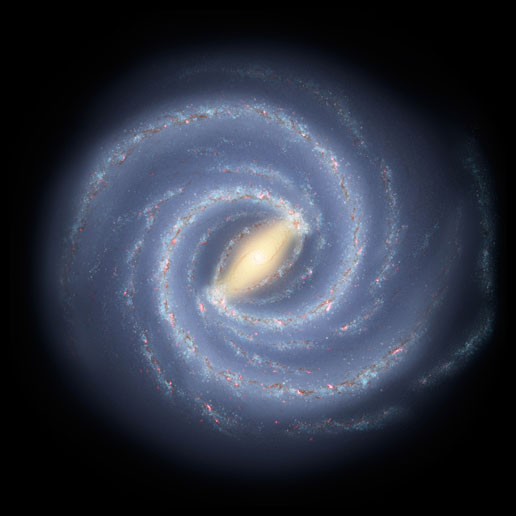
Milky_Way_Galaxy_artwork.jpg

The picture is an impression of data gathered about the milky way.

Interesting :
This made me think of the research about how the galaxies in the universe may not be uniformly distributed, in the Hannes Alfven thread.

http://forums.anandtech.com/showpost.php?p=31911924&postcount=44


http://www.physorg.com/news/2011-07-universe-born-symmetry-cosmos.html

(PhysOrg.com) -- Physicists and astronomers have long believed that the universe has mirror symmetry, like a basketball. But recent findings from the University of Michigan suggest that the shape of the Big Bang might be more complicated than previously thought, and that the early universe spun on an axis.

To test for the assumed mirror symmetry, physics professor Michael Longo and a team of five undergraduates catalogued the rotation direction of tens of thousands of spiral galaxies photographed in the Sloan Digital Sky Survey.

The mirror image of a counter-clockwise rotating galaxy would have clockwise rotation. More of one type than the other would be evidence for a breakdown of symmetry, or, in physics speak, a parity violation on cosmic scales, Longo said.

The researchers found evidence that galaxies tend to rotate in a preferred direction. They uncovered an excess of left-handed, or counter-clockwise rotating, spirals in the part of the sky toward the north pole of the Milky Way. The effect extended beyond 600 million light years away.

"The excess is small, about 7 percent, but the chance that it could be a cosmic accident is something like one in a million," Longo said. "These results are extremely important because they appear to contradict the almost universally accepted notion that on sufficiently large scales the universe is isotropic, with no special direction."

The work provides new insights about the shape of the Big Bang. A symmetric and isotropic universe would have begun with a spherically symmetric explosion shaped like a basketball. If the universe was born rotating, like a spinning basketball, Longo said, it would have a preferred axis, and galaxies would have retained that initial motion.

Is the universe still spinning?

"It could be," Longo said. "I think this result suggests that it is."

Because the Sloan telescope is in New Mexico, the data the researchers analyzed for their recent paper came mostly from the northern hemisphere of the sky. An important test of the findings will be to see if there is an excess of right-handed spiral galaxies in the southern hemisphere. This research is currently underway.

A paper on the findings, Detection of a Dipole in the Handedness of Spiral Galaxies with Redshifts z~0.04 is published in Physics Letters B.


Some information about the milky way :
http://www.daviddarling.info/encyclopedia/G/Galaxy.html
 
Last edited:
Status
Not open for further replies.
Back
Top