
-
We’re currently investigating an issue related to the forum theme and styling that is impacting page layout and visual formatting. The problem has been identified, and we are actively working on a resolution. There is no impact to user data or functionality, this is strictly a front-end display issue. We’ll post an update once the fix has been deployed. Thanks for your patience while we get this sorted.
You are using an out of date browser. It may not display this or other websites correctly.
You should upgrade or use an alternative browser.
You should upgrade or use an alternative browser.
DirectX 12Futuremark 3DMark Time Spy Benchmarks Thread
- Thread starter csbin
- Start date


http://www.pcworld.com/article/3095...geforce-in-this-major-new-dx12-benchmark.html

async compute
970/980.........

async compute
970/980.........
Last edited:

1080 gain with Async is not massively off the 480 gain
http://www.pcper.com/reviews/Graphi...Looking-DX12-Asynchronous-Compute-Performance
also Kepler not looking to bad (consider other stuff like Doom Vulkan), GCN1.0 not looking to great (280X bellow 960, way slower than Tonga)

https://www.computerbase.de/2016-07/3dmark-time-spy-dx12-benchmark/2/
Last edited:


Wound up with 5675 GTX 1070 Amp with default clocks and settings.
4790k @4.4GHz
http://www.3dmark.com/spy/8372
Guess I can try a little OC and see what happens.
On another note why don't they at least make visually pleasing benchmark apps? Seems like the overall scores just don't match the visual fidelity as one calls it.
Seems like this might be good for dialing in OC settings at least.
Left core at stock speed. Upped power limit slider to max. Upped memory clocks to 9026.
Score increased to 5869
http://www.3dmark.com/spy/9958
Going to see how high memory will be stable before I mess with the core.
Set my 4790k back to my 4.6GHz overclock. Forgot I dialed it back down during the DPC latency scare testing.
Upped the memory to 9072
Score upped to 5992
http://www.3dmark.com/spy/10795
4790k @4.4GHz
http://www.3dmark.com/spy/8372
Guess I can try a little OC and see what happens.
On another note why don't they at least make visually pleasing benchmark apps? Seems like the overall scores just don't match the visual fidelity as one calls it.
Seems like this might be good for dialing in OC settings at least.
Left core at stock speed. Upped power limit slider to max. Upped memory clocks to 9026.
Score increased to 5869
http://www.3dmark.com/spy/9958
Going to see how high memory will be stable before I mess with the core.
Set my 4790k back to my 4.6GHz overclock. Forgot I dialed it back down during the DPC latency scare testing.
Upped the memory to 9072
Score upped to 5992
http://www.3dmark.com/spy/10795
Last edited:

railven
Diamond Member
480 only having 4 ACE's hurting it? Doesn't see the Fiji gains.
Forgot where I read it, but someone said 480 has 8 ACEs, the 2 HWS have 2-ACEs each.
Wish I could remember where I read it, so I could link you a more technical explanation haha.
6861 overall, 7769 Graphics score
http://www.3dmark.com/3dm/13193388?
http://www.3dmark.com/3dm/13193388?
Forgot where I read it, but someone said 480 has 8 ACEs, the 2 HWS have 2-ACEs each.
Wish I could remember where I read it, so I could link you a more technical explanation haha.
Isn't that still 4?
2 HW * 2 ACE each = 4.

PhonakV30
Senior member
https://tpucdn.com/reviews/AMD/RX_480/images/perfrel_1600_900.png
R9 280X = 68%
GTX 960 = 59%
Now here , R9 280X is slower than GTX 960 ?
R9 280X = 68%
GTX 960 = 59%
Now here , R9 280X is slower than GTX 960 ?

William Gaatjes
Lifer
Isn't that still 4?
2 HW * 2 ACE each = 4.

4 ACE + 2 HWS (functionally 2 ACE in one HWS , sort of that is).
But the strange thing is, if i look up the fury article on anandtech, it has 8 ACE.
http://www.anandtech.com/show/9390/the-amd-radeon-r9-fury-x-review/4
But this article is from July 2015 and the extremetech article is from Februari 2016. I guess AMD did not release all information when Anandtech wrote the article. Or i am overlooking something. :hmm: .. Or we see here microcode updates in effect ? The ACE from GCN gpu's can be updated with microcode. At least, that is what i have been reading about.

And if i look up the article on extremetech, it has Fury has 4 ACE and 2 HWS.
http://www.extremetech.com/gaming/2...ashes-of-the-singularity-directx-12-benchmark
It is mentioned here (assuming the information is correct) :
A GPU that supports asynchronous compute can use multiple command queues and execute these queues simultaneously, rather than switching between graphics and compute workloads. AMD supports this functionality via its Asynchronous Compute Engines (ACE) and HWS blocks on Fiji.
Asynchronous computing is, in a very real sense, GCN’s secret weapon. While every GCN-class GPU since the original HD 7970 can use it, AMD quadrupled the number of ACEs per GPU when it built Hawaii, then modified the design again with Fiji. Where the R9 290 and 290X use eight ACEs, Fiji has four ACEs and two HWS units. Each HWS can perform the work of two ACEs and they appear to be capable of additional (but as-yet unknown) work as well.
Fiji :

Polaris :
EDIT:
Forgot to mention that the RX 480 does really well while comparing with the GTX 1070, the gpu the RX 480 was not meant to compete with.
No need to cry, the RX 480 is doing really well.
But why no tests at 1080p , the target resolution for the RX 480. 😡
Last edited:


guskline
Diamond Member
Oh Lord. If your system isn't any good; I'm in a WORLD of trouble with mine.😀😎I wonder if my system will be any good with this benchmark.
Guess I'l have to try it out when I get home.
980Ti @1450/3760 5820k@4.5GHz 16 Gb DDR4 2400 MHz
Graphics Score:5868
http://www.3dmark.com/spy/12336
Graphics Score:5868
http://www.3dmark.com/spy/12336
Last edited:

LTC8K6
Lifer
Maxwell 2 chips should be able to do some form of async compute, iirc. But not Maxwell 1.
http://wccftech.com/nvidia-amd-directx-12-graphic-card-list-features-explained/4/
http://wccftech.com/nvidia-amd-directx-12-graphic-card-list-features-explained/4/


https://tpucdn.com/reviews/AMD/RX_480/images/perfrel_1600_900.png
R9 280X = 68%
GTX 960 = 59%
Now here , R9 280X is slower than GTX 960 ?
280X is pretty bad in Tesselation and 3dMark is using a good amount of it. In games with stronger Tesselation this might happen, look at 380. Tongas Tess is way better and it's far ahead of 280X.

Krteq
Golden Member
Well... nope.Maxwell 2 chips should be able to do some form of async compute, iirc. But not Maxwell 1.
http://wccftech.com/nvidia-amd-directx-12-graphic-card-list-features-explained/4/
nVidia's Hyper-Q (32 queues) can "asynchronously" execute threads, but these threads have to be Compute type (CUDA) only. If you want to execute Graphics queue along with Compute queue, you have to wait for one queue type to finish, switch context and execute second type.
Last edited:
Silverforce11
Lifer
That first slide is nuts.
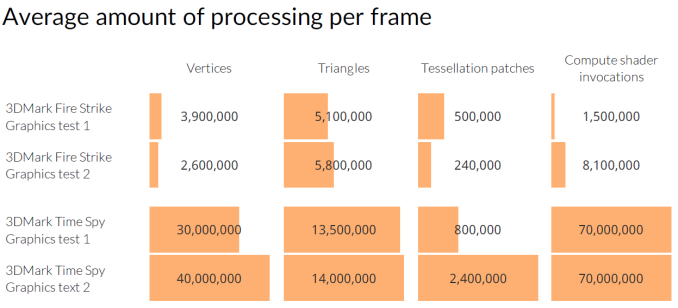
This is basically throwing more at the scene with minimal visual quality improvement. -_-
I hope games are not going to be that wasteful.
This is basically throwing more at the scene with minimal visual quality improvement. -_-
I hope games are not going to be that wasteful.
1080 gain with Async is not massively off the 480 gain
http://www.pcper.com/reviews/Graphi...Looking-DX12-Asynchronous-Compute-Performance
So now we know what to expect from neutral titles. 🙂
Silverforce11
Lifer
So now we know what to expect from neutral titles. 🙂
Doom is a neutral title btw, no GameWorks or GE. 🙂 So is Quantum Break.
It is actually interesting to note, Ashes & Warhammer, despite being AMD sponsored, runs quite well on NV GPUs. The gap is nowhere near as close as in those two neutral games above.
I wonder if there's any CPU utilization results reported by Time Spy.
If NV has finally "enabled Async" in their drivers for Pascal and not Maxwell (like they promised), could well be a CPU off-loading going on.
Fundamentally, DX12 does not specify how those separate queues (Graphics, Compute, Copy) get processed and one of the original theory when the Maxwell fake Async scandal erupted is CPU off-loading is possible for some tasks.
TRENDING THREADS
-
 Discussion Zen 5 Speculation (EPYC Turin and Strix Point/Granite Ridge - Ryzen 9000)
- Started by DisEnchantment
- Replies: 25K
-
Discussion Intel Meteor, Arrow, Lunar & Panther Lakes + WCL Discussion Threads
- Started by Tigerick
- Replies: 25K
-
 Discussion Intel current and future Lakes & Rapids thread
- Started by TheF34RChannel
- Replies: 24K
-

-
