• We’re currently investigating an issue related to the forum theme and styling that is impacting page layout and visual formatting. The problem has been identified, and we are actively working on a resolution. There is no impact to user data or functionality, this is strictly a front-end display issue. We’ll post an update once the fix has been deployed. Thanks for your patience while we get this sorted.

CFM and push-pull

martman

Member
I am considering the h100i and thinking about a push-pull config.Does the CFM rating need to be the same for top as well as the bottom fans? For instance... what happens when the top fans are rated at 65 CFM and the bottom are 32 CFM or vice versa? Are there any bad consequences?

Thank you
 
Essentially you want your fans to have the same air movement abilities (cfm) for exhaust and intake. If you have an imbalance one way or another then they won't be moving the heat off the radiator fins as efficiently as possible. I don't think anything too terrible will happen but you will probably notice an increase in case temps and your cooling loop probably won't work as well as it is able to with two equal fans.
 
Not to crap on your plans or this thread, but have your seen that the X60 spits and shitz all over the H100i?

52180.png


52182.png
 
In my unscientific opinion, pull is better than push for the same reason that pull radiator fans in automobiles consistently outperform push fans, spec for spec (which is why they are set up that way from the factory.) It follows then, that if doing push/pull, I would have the stronger fan pulling. You don't want the air slowing down and becoming turbulent through the heatsink/radiator (pressure drop) you want it accelerating through. Having equal performing fans on either side doesn't account for pressure drop/turbulence through the core. Stronger fan pushing is the worst of both worlds IMHO.
 
In my unscientific opinion, pull is better than push for the same reason that pull radiator fans in automobiles consistently outperform push fans, spec for spec (which is why they are set up that way from the factory.) It follows then, that if doing push/pull, I would have the stronger fan pulling. You don't want the air slowing down and becoming turbulent through the heatsink/radiator (pressure drop) you want it accelerating through. Having equal performing fans on either side doesn't account for pressure drop/turbulence through the core. Stronger fan pushing is the worst of both worlds IMHO.
shroudtest-17.png


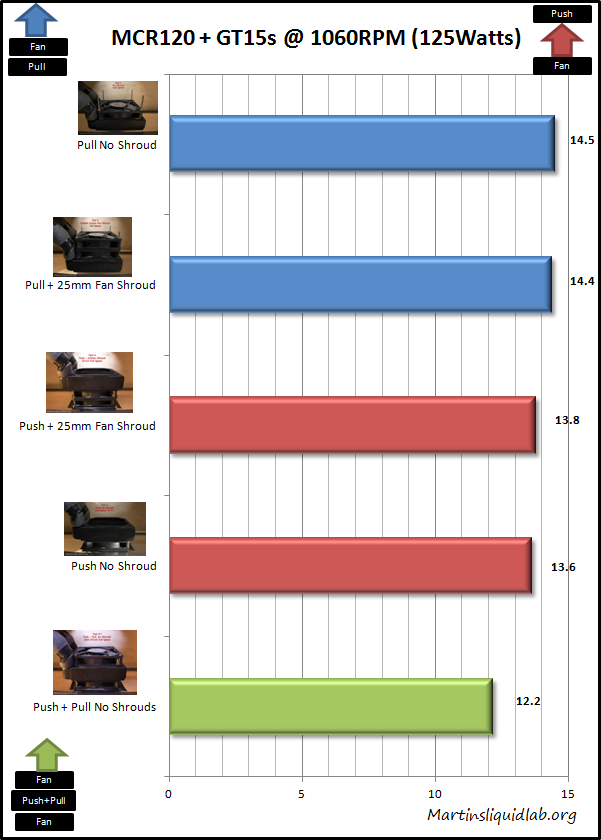
This test disagrees with your opinion. It shows a decrease in delta temps from pull => push => push + pull.

The way fans are placed in pull in automobiles is due to the fact that fans are just auxiliary coolers that provides additional cooling in extreme performance situations or idling traffic. It doesn't spin constantly and only spin when it is needed. It relies more on the air pressure that is forced into the engine space at the front of the vehicle while it is moving.
 
Interesting. We would need to know how fan specifications (CFM vs static pressure) and fin density affects those results to be able to draw a broad conclusion. That is one result from only one set of variables. I still contend that having a stronger pull fan is advantageous if doing push/pull for the reasons I stated earlier.
 
Back
Top