
• We’re currently investigating an issue related to the forum theme and styling that is impacting page layout and visual formatting. The problem has been identified, and we are actively working on a resolution. There is no impact to user data or functionality, this is strictly a front-end display issue. We’ll post an update once the fix has been deployed. Thanks for your patience while we get this sorted.

Cellular Insights: Intel modem in iPhone 7 worse than Qualcomm

witeken

Diamond Member
http://cellularinsights.com/iphone7/

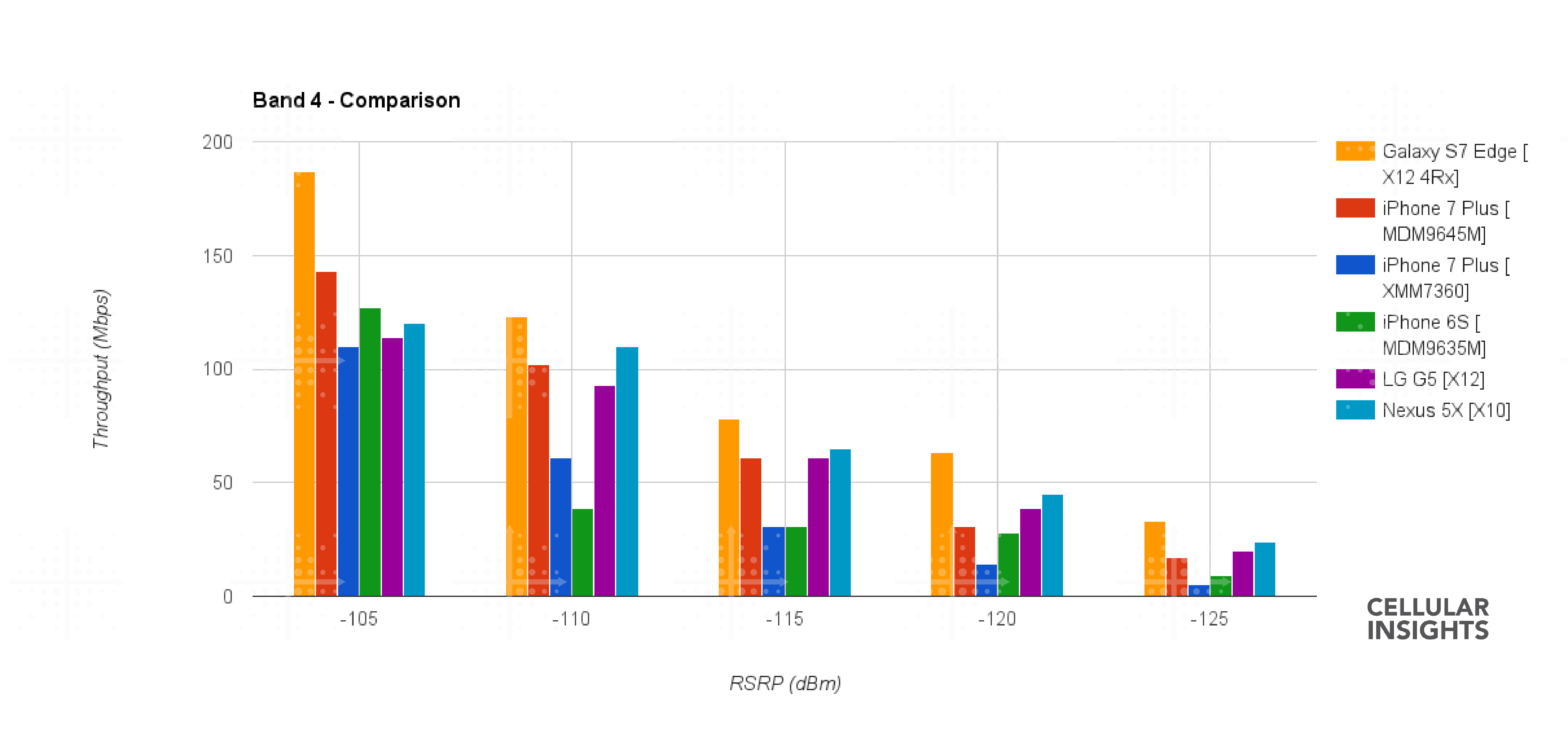
In bad circumstances, the Intel modem performs significantly worse in the metric throughput according to these tests.

Note: In the comments of some articles I have seen people make some remarks about this research like the bands that were tested (CDMA vs others) and other stuff.

Since I have no knowledge about modem technology, I can't comment on its validity and thus I post this research as-is. But note that the only difference between both phones is the modem.
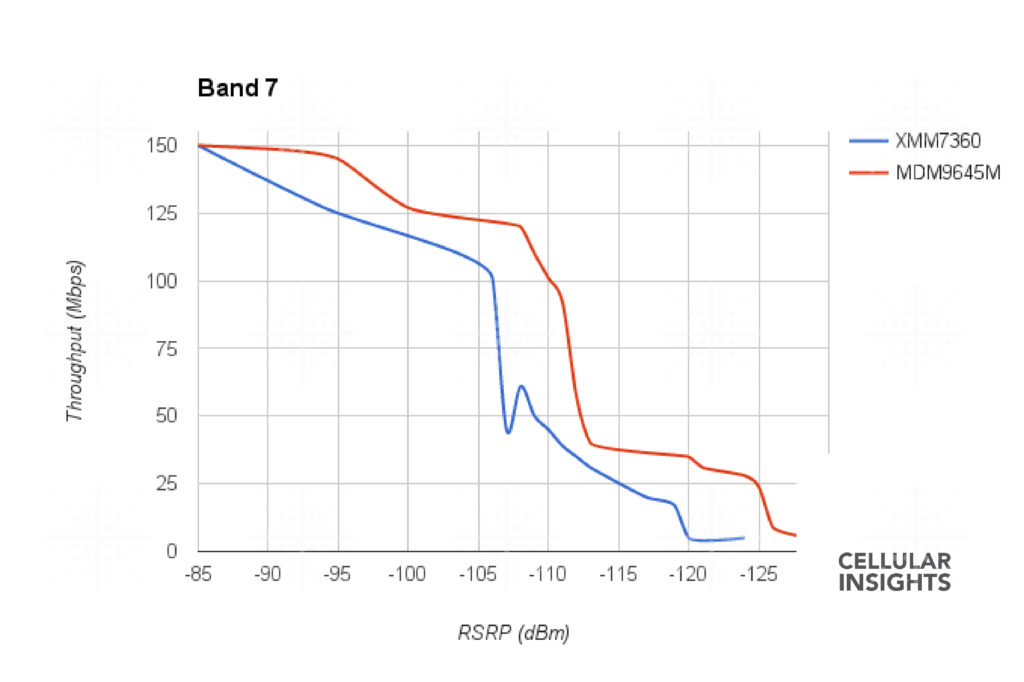
Band7-1024x682.jpg


comparison.jpg
 
Presumably Apple knew about this performance difference when they decided to go with Intel. They must have gotten a very good price.
 
Presumably Apple knew about this performance difference when they decided to go with Intel. They must have gotten a very good price.

Price indeed count, but then the difference in real usage is much less than what the curves would suggest, and nothing that couldnt get compensated by say 30% lower prices...

The Intel solution has about 4.5dB lower sensitivity as showed by the curves, but 4.5db is only 1.67x and with the compression algorithms this is reduced to 1.2x or so when it comes to throughput, this is not that much and most Apple users live in urban areas where there s enough coverage anyway..
 
I can vouch that my A1778 128GB iPhone 7 has significantly worse reception on 4G and 3G/HSPA in the same areas and at the same times as it had when I had a 6S or when I had a 5S before that. This model was shown to have the Intel XMM7360 modem. I am considering trading it in for a 6S again. Where I used to have strong LTE (4+ bars) I know barely get 3 bars of HSPA and it sometimes drops to EDGE. This intel modem and thus this Apple phone is the worst PHONE I've owned since my iPhone 5S in terms of reception. It may be worse than a 5S
 
It doesn't look that serious since even with the biggest dip at around -106dBm the throughput is still 40Mbps which is alot faster than the average wired broadband speed.
 
It doesn't look that serious since even with the biggest dip at around -106dBm the throughput is still 40Mbps which is alot faster than the average wired broadband speed.
That is theorical and with the best device available: the iPhone.... With a normal one is FAR worse...

Even Mediatek has better módem than Intel's one.
 
It doesn't look that serious since even with the biggest dip at around -106dBm the throughput is still 40Mbps which is alot faster than the average wired broadband speed.
That's just Band 4. The tests show intel's modem has significantly (75% difference in some cases) worse throughput in every single band tested. To top that off, the modem likely uses more power and I've found it drops calls significantly more often than my iPhone 6s or the iPhone 5s I had before that. It's very obvious the phone is crippled by this modem, and I would rather have a 6S that works or even an android phone than this iPhone 7 that can't receive calls in many places.


Right now intel fans are trolling macrumors saying their modem gets "better battery life" through a red herring argument about their own perception of how long the phone lasts. In reality battery life is so far removed from modem performance it's hard to say one effects the other in a significant way unless you are downloading multi-GB files all day on your phone (using the modem constantly). This argument has so far deflected attention from the multitude of articles appearing which show significant intel modem issues with reception and throughput. We'll see how long the trolls can keep this up and keep attention off intel's newest (and possibly worst) failure.


You can bet you'll never see another intel modem part in an apple product after "MODEMGATE".
 
That's just Band 4. The tests show intel's modem has significantly (75% difference in some cases) worse throughput in every single band tested. To top that off, the modem likely uses more power and I've found it drops calls significantly more often than my iPhone 6s or the iPhone 5s I had before that. It's very obvious the phone is crippled by this modem, and I would rather have a 6S that works or even an android phone than this iPhone 7 that can't receive calls in many places.


Right now intel fans are trolling macrumors saying their modem gets "better battery life" through a red herring argument about their own perception of how long the phone lasts. In reality battery life is so far removed from modem performance it's hard to say one effects the other in a significant way unless you are downloading multi-GB files all day on your phone (using the modem constantly). This argument has so far deflected attention from the multitude of articles appearing which show significant intel modem issues with reception and throughput. We'll see how long the trolls can keep this up and keep attention off intel's newest (and possibly worst) failure.


You can bet you'll never see another intel modem part in an apple product after "MODEMGATE".
I can see Apple even using the Mediatek modem before going to Intel again.
 
4.5 dB less sensitivity is a huge difference in a receiver (2.8x less sensitive). Path loss is quadratic to distance so to have 2.8x as much power, you need to be ~ 7.8x closer to the receiver for equivalent performance. There's possibly some issue with the specific phone they have or their testing methodology, IMHO it's very unlikely that Apple would put these two modems in the same device with this disparity in performance.
 
4.5 dB less sensitivity is a huge difference in a receiver (2.8x less sensitive). Path loss is quadratic to distance so to have 2.8x as much power, you need to be ~ 7.8x closer to the receiver for equivalent performance. There's possibly some issue with the specific phone they have or their testing methodology, IMHO it's very unlikely that Apple would put these two modems in the same device with this disparity in performance.
Yes, how would this get past Apple's checking?
 
They pushed out an update that has improved call quality and my phone is no longer dropping calls. It still doesn't get great reception, but it's tolerable. Still, very disappointing to know I got an inferior device... which mirrors the samsung 6s I got last year. Apple dual sourcing performance-sensitive parts is quite stupid.
 
They pushed out an update that has improved call quality and my phone is no longer dropping calls. It still doesn't get great reception, but it's tolerable. Still, very disappointing to know I got an inferior device... which mirrors the samsung 6s I got last year. Apple dual sourcing performance-sensitive parts is quite stupid.

It's very smart from Apple's POV. Building a viable second source for a critical component reduces your risk and helps drive component prices down.

It's the same reason PC OEMs use AMD APUs in some of their systems even though Intel chips are superior.
 
Allegedly, the Qualcomm modem supports EVS, but Apple disabled it to even the field with Intel. T-Mobile has already deployed EVS coverage on its network. Food for thought 🙂
 
It's very smart from Apple's POV. Building a viable second source for a critical component reduces your risk and helps drive component prices down.

It's the same reason PC OEMs use AMD APUs in some of their systems even though Intel chips are superior.

Not quite the same thing. Cost savings on AMD are directly passed onto the consumer. And there's branding all over the box on what's inside.
 
It's very smart from Apple's POV. Building a viable second source for a critical component reduces your risk and helps drive component prices down.

It's the same reason PC OEMs use AMD APUs in some of their systems even though Intel chips are superior.
Upsetting your long time customers with inferior product is not smart, no matter how you cut it. Whatever the denomination of $ bill intel wrapped their modems in, the end result is inferior products and Apple has consistently refused to produce such products. At least until now. Clearly their drive to increase their share price has clouded their original motivations in producing products people love. I do not love this phone, it's a disappointment.


Sad that in the drive for better margins Apple has opened the door to using inferior and suspect components in its devices. There was obviously a very good reason why Apple never even attempted to use Intel products in a single device before 2016, and I think they likely will avoid them in the future too.
 
Upsetting your long time customers with inferior product is not smart, no matter how you cut it. Whatever the denomination of $ bill intel wrapped their modems in, the end result is inferior products and Apple has consistently refused to produce such products. At least until now. Clearly their drive to increase their share price has clouded their original motivations in producing products people love. I do not love this phone, it's a disappointment.


Sad that in the drive for better margins Apple has opened the door to using inferior and suspect components in its devices. There was obviously a very good reason why Apple never even attempted to use Intel products in a single device before 2016, and I think they likely will avoid them in the future too.
Return your phone and go buy an unlocked version, it will have the Qualcomm modem that you should find more palatable 🙂
 
Sad that in the drive for better margins Apple has opened the door to using inferior and suspect components in its devices. There was obviously a very good reason why Apple never even attempted to use Intel products in a single device before 2016, and I think they likely will avoid them in the future too.

Actually, Apple used Intel's devices for quite a while in iPhones. IIRC, it wasn't until iPhone 3 that they stopped.
 
There is also the potential that Apple just can't get enough wafers from TSMC for both the A processors and Qualcomm modems on the 16/20nm node. The iPhone 6 had a 20nm A8 processor with a 28nm Qualcomm modem. The iPhone 6S had only 40% of the processors on the TSMC 16nm node and 100% of the Qualcomm modems on the 20nm node. With 100% of the iPhone 7 processors back at TSMC they may have only been able to get half of the Qualcomm 20nm modems and the other half of the 'advanced' Intel modems were back on the 28nm node. Qualcomm did not have a similar quality modem on the 28nm node.

TSMC increased the capacity of the 16/20nm node from 60,000 wafer starts per month to 100,000 wafer starts per month this summer to handle the iPhone 7 larger die and other customers, e.g. Nvidia, Huawei and Mediatek. However TSMC may have been reluctant to add any more capacity with Apple moving to the 10nm node next year. TSMC is already talking about moving some of the 16nm equipment to China for the new foundry and also repurposing some of the 16nm equipment for 10nm. A lot of the steps are the same just more of them.

If you annualize the production of A10 and A9X and an Qualcomm modem (assumed to be 50 mm2 since I don't have a better number) then Apple needs 57,000 wafer starts per month at 100% yield. Apple has a 4th Quarter bias and the yields aren't 100% and they don't know the initial yield for the new processor. This may even be the constraint that they have today on meeting demand. I have never been able to find the die size of any of the Qualcomm modems but I have assumed somewhere around 50 mm2.
 
There is also the potential that Apple just can't get enough wafers from TSMC for both the A processors and Qualcomm modems on the 16/20nm node.
Even though it is an intel modem, intel does not uses it foundries to make the 7360 modem the iphone uses. Instead they use TSMC 28nm process to make their modems.

This is because Intel's modem organization is actually someone they acquired.First it was Infineon Technologies wireless group in 2011 which used TSMC, but Intel also acquired VIA technologies CDMA assests in 2015. Note Intel current modems can't do CDMA for they have not integrated the tech into the modems so far, for hardware is hard and takes forever to integrate (unlike software)
 
Return your phone and go buy an unlocked version, it will have the Qualcomm modem that you should find more palatable 🙂
Fortunately or unfortunately the loss of reception after 10.3 appears to be greatly ameliorated by whatever they did with the update, to the point where the phone is now more or less usable. I already spoke with AT&T, who basically offered me a refund if I payed the restocking fee... but that is money and time I'm unwilling to spend at this point. I'm basically left with a marginally inferior phone and a bunch of wasted time, plus worse reception forever... or the option to spend more time and money acquiring a fully-functional device that I thought I bought originally.

I will never consider buying through AT&T again, and I told them that. They were unconcerned that the drop in revenue from losing me would result in much. I can't fathom why.
 
I will never consider buying through AT&T again, and I told them that. They were unconcerned that the drop in revenue from losing me would result in much. I can't fathom why.

Go Verizon. At least until Intel integrates CDMA into their modems, you'll be guaranteed Qualcomm modems...and Verizon's network is just generally better from my experience.
 
This is really a U.S. only issue. There is no choice on the modem that you get in most of the world. China, Hong Kong, and Japan get the Qualcomm modem. All the rest of the world gets the Intel modem and in the U.S. and Puerto Rico we get a choice.
 
Back
Top