• We’re currently investigating an issue related to the forum theme and styling that is impacting page layout and visual formatting. The problem has been identified, and we are actively working on a resolution. There is no impact to user data or functionality, this is strictly a front-end display issue. We’ll post an update once the fix has been deployed. Thanks for your patience while we get this sorted.

Bose Reflex Port / Waveguide Breeze

I used my cousin's Bose Sound dock portable speakers last night. It sounded good.

I was curious about the amount of wind (not breeze) coming out of the back of the reflex port on the speaker. Does the Bose Waveguide somehow create this?

Is it possible to get the same amount of air pressure on say my DIY speakers?
 
Look up speaker design on the net. This will give you some kind of understanding on how speakers work.
 
I did that. Read a lot about speaker enclosures, different types of ports and also audio transmission lines (1/4 wavelength). I was curious to know whether a long coiled up port will give air output like that, because I've got woofers at home with a simple reflex port.. can hardly feel any breeze out of it.
 
Sorry for the confusion!

Breeze = Negligible vibrations in air. Bit thumping air volume(very little)
Wind = Someone is pumping air through that port! (Fast high velocity air)
 
I did that. Read a lot about speaker enclosures, different types of ports and also audio transmission lines (1/4 wavelength). I was curious to know whether a long coiled up port will give air output like that, because I've got woofers at home with a simple reflex port.. can hardly feel any breeze out of it.


The air velocity out of the port Is a function of driver size, enclosure size, port size and length, frequency and how much power your feeding the whole thing.

High air velocity out of the port is an undesirable characteristic because it generates unwanted noise.
 
Last edited:
The tiny drivers have to move a lot to produce the sound, so there's going to be a lot of breezy wind.
Other speakers with larger drivers don't need to move as much to produce the same amount of sound, so they won't be as flatulent.
 
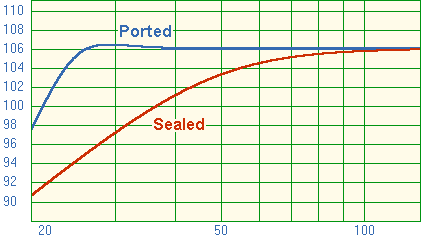
This goes a bit off the question but for general info. As far as ports in general, a good ported enclosure would look a bit like this on the low end. How much air is coming out is not what's important.

boxes.gif


In the case of Bose radio. The left speaker does the lows and right does the mid/highs with dual tapered 26" ports.

image_preview


Bose speakers are not bass reflex, rather a tuned pipe. There is no box to speak of. The resonances of the tuning frequency are absorbed by the folding like structure of the pipe.So this port or "folded pipe" is around 1/2 the driver area and the cavity behind the woofer is double the driver volume. Most of the final tuning is done by varying the thickness/density of the stuffing in the pipe.The result is a front wave reinforcing a 1/4 wavelength resonance at 130Hz back wave. Because of the added complexity, they are more expensive than reflex enclosures and typically don't have the boomy sound that is often found in typical reflex designs.
Ultimately, it's about getting the most out of the smallest possible size and Bose has had a major focus on that forever.

This one is basically Bose accoustimass basic design
2050491D2-16.jpg


Most DIY'ers just do a slot port, tuned around 32hz. It's easy and cheap and the much more complicated designs require a lot of testing and computer aid along with proper speaker specifications and box design. No small feat.
 
Thanks for the info.

I wanted to know whether it is possible to replicate the Bose Design. Like modifying an enclosure and making the folded waveguides by using a pipe or something.
 
The air velocity out of the port Is a function of driver size, enclosure size, port size and length, frequency and how much power your feeding the whole thing.

High air velocity out of the port is an undesirable characteristic because it generates unwanted noise.

Isn't this port chuffing?

Either way, like you said, it's not something you want. I actually am building a new sub because of this. It's undesirable noise although it does feel nice during movies on my sub. When an explosion happens it feels like the gust of wind is actually hitting me in the face.

But the undesirable noise aspect is not fun.
 
If you want to go the DIY route, check out the SEOS waveguide project:

http://www.diysoundgroup.com/plastic-seos-12.html
What audiophiles and DIY builders call "waveguides" aren't what Bose calls waveguide. The former is a super-refined variant of the horn, while the latter is what most audiophile/DIY folks call a "transmission line". This is generally used to improve bass response in floor-standing speakers.

OP, you can see an example of a transmission DIY design here:
http://regalianox.com/floor-standing-diy-dayton-classic-transmission-line-speakers/

Or just search for "transmission line DIY".

Btw, most knowledgable people don't rate Bose very highly. For one thing, their products aren't at all designed to maximize accurate sound reproduction...
 
Isn't this port chuffing?

Either way, like you said, it's not something you want. I actually am building a new sub because of this. It's undesirable noise although it does feel nice during movies on my sub. When an explosion happens it feels like the gust of wind is actually hitting me in the face.

But the undesirable noise aspect is not fun.
Mine don't chuff, fortunately.

One of my previous single setups used to, badly.
 
I thought chuffing was rare minus the poor DIY builds these days. It's pretty cheap for companies to use port designs that prevent chuffing. Aeroports are pretty popular.
I certainly wouldn't expect any modern company producing ported boxes that chuff these days. Box design software is cheap.
 
I thought chuffing was rare minus the poor DIY builds these days. It's pretty cheap for companies to use port designs that prevent chuffing. Aeroports are pretty popular.
I certainly wouldn't expect any modern company producing ported boxes that chuff these days. Box design software is cheap.

I think it's dependent on how hard you push your speakers/subs.
I think you'll hear about it more on DIY builds just about how you'll hear people complaining about things like TIM on the CPU section. Once you're trying to eek out the last amount of performance from your speakers/subs you're bound to be more hypercritical about things.

I complain about port chuffing but I also listen/use my speakers are extremely high listening levels. Under "normal" circumstances no, I wouldn't ever hear port chuffing, but when I'm throwing a part/after party and I'm bumping my system pretty loud then I can experience port chuffing as the sub simply just isn't capable of what I'm asking it to do (which is a lot so I'm not surprised).
 
Back
Top