• We’re currently investigating an issue related to the forum theme and styling that is impacting page layout and visual formatting. The problem has been identified, and we are actively working on a resolution. There is no impact to user data or functionality, this is strictly a front-end display issue. We’ll post an update once the fix has been deployed. Thanks for your patience while we get this sorted.

News ARM Mali "PanVK" OSS driver just reached Vulkan 1.2 compliance

As of a couple of days ago VK v1.3 and v1.4 are only 3 and 4 extensions respectively from full conformance.

Translation layers like DXVK and Zink also rely on various extensions not part of any VK standard, so even once PanVK (or anything else) reaches v1.4 don't take that as a given that it will run those TLs to the best possible performance.
 
I assume the OP is aware of this, but here's a heads-up for anyone who might not know: Google announced in March that Vulkan is now the official graphics API for Android.
Starting with the upcoming Android release, i.e. Android 16, though, Google says that “more devices will use Vulkan to process all graphics commands.” Specifically, Android 16 will require some newer devices to use ANGLE for some applications (meaning, only applications on an approved list will use ANGLE). Next year’s Android 17 release, however, will require new devices to use ANGLE for most applications (essentially, switching from an allowlist, meaning only certain apps utilize ANGLE, to a denylist, meaning all apps utilize ANGLE except for those on a specific list.) By “new devices,” Google is referring to devices that ship with chipsets built for the new Android release, as devices upgrading to the new release won’t be forced to meet these new ANGLE requirements in accordance with the Google Requirements Freeze program.
Google also worked with the Khronos Group—the industry group behind the Vulkan graphics API—to develop the latest Vulkan 1.4 release, ensuring that Android devices will broadly support its featureset. The Vulkan 1.4 specification was developed to largely be a subset of the VPA for Android 16, meaning that new devices that meet the VPA16 requirements will support most features in Vulkan 1.4. New SoCs launching with support for Android 17, though, will be required to fully support Vulkan 1.4.
By mandating support for newer versions of Vulkan, Google is essentially culling older GPUs from the market, as devices with those older GPUs won’t be allowed to update to newer Android versions. This is important because it means that robust Vulkan API support will only get better and better among Android devices as time goes on, eliminating a huge reason why mobile game developers don’t take advantage of the latest graphical features available on Android devices.
 
I assume the OP is aware of this, but here's a heads-up for anyone who might not know: Google announced in March that Vulkan is now the official graphics API for Android.
The problem with Google's pretty little pronouncement is that it's several years too late.

The Vulkan hw problem is deeply embedded at this point, because it's largely stuck on the same minimum feature set of VK 1.0 laid down in February 2016 - which is basically just OGL ES 3.1 compliance, not even 3.2 which at least would give ES level geometry and tesselation shaders.

I'm not even sure that Mali Valhall has hw geometry shaders at all, which is pretty damn poor for such a recent GPU µArch, especially if they are aiming at the WoA market in the near future.
 
@coercitiv Interesting point about Google's ANGLE translation layer, it is no longer just aiming to translate OGL ES to various APIs.

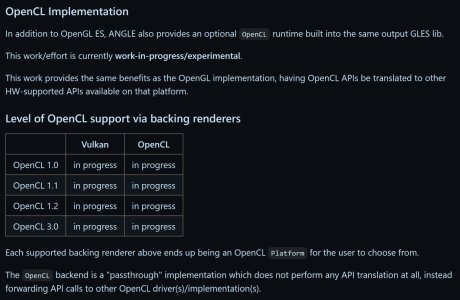
It is now also aiming to translate OpenCL too, though according to the GitHub page no implementations are finished yet, which is probably why there has been no news about it.

ANGLE-OCL.jpg
 
Back
Top