• We’re currently investigating an issue related to the forum theme and styling that is impacting page layout and visual formatting. The problem has been identified, and we are actively working on a resolution. There is no impact to user data or functionality, this is strictly a front-end display issue. We’ll post an update once the fix has been deployed. Thanks for your patience while we get this sorted.

Question Anyone using ARM CPUs/SOCs?

Page 6 - Seeking answers? Join the AnandTech community: where nearly half-a-million members share solutions and discuss the latest tech.

whm1974

Diamond Member
I've been looking at Pine64.org products, mainly the upcoming Pinebook Pro and PineTAB, also about reading the ROXK64 Pro as well. Awhile back I was considering getting Raspberry Pi 3B+ for getting into SBCs, I really not sure what I could use for it for. And yes a low cost notebook, even ARM based ones will be far more useful for.

Other then my cheap smartphone, I have no experience with non-x86 systems. So how much usability with reasonable performance I can expect out ARM SOCs such at the Rockchip RK3399 Hexa-Core such as the Pinebook Pro and ROCK64 Pro uses

While I intend to buy the Pinebook Pro, I am wondering about ARM SOCs and ARM based PCs in general using Linux.
 
The original announcement on the RK3588 was somewhat light on the details, little more than 8nm, A76, and early 2020 as the timeframe - unless someone else has further information, that may be it until closer to its mass production, which I would peg at Q4 this year.

At this point we don't even know what GPU it has, though I'm holding out hope for Mali-G77.

I'd think, that when you license Mali-G77 you would as well license Cortex-A77 to put into the same SoC.
 
Now that I think about it, 7cx may closely resemble Snapdragon 855, which is (if I remember correctly) slower than the 8cx.
 
I'd think, that when you license Mali-G77 you would as well license Cortex-A77 to put into the same SoC.

Rockchip have been sneaky before with stealth announcing better cores, at least with RK3288 anyway, it was announced as Cortex-A12, but released as Cortex-A17 - at least that what they claimed anyway.
 
Sadly, it looks like Samsung's new deal with AMD for GPU tech may leave ARM out in the cold, given that dropping Huawei had left them with only Samsung as a dependable major licensee of new high end GPU cores.

It makes me wonder, both about Samsung's confidence in the improvements of Valhall, and also what happened to the in house GPU they were developing - the AMD announcement would suggest that effort was a bust at the very least.
 
Sadly, it looks like Samsung's new deal with AMD for GPU tech may leave ARM out in the cold, given that dropping Huawei had left them with only Samsung as a dependable major licensee of new high end GPU cores.

It makes me wonder, both about Samsung's confidence in the improvements of Valhall, and also what happened to the in house GPU they were developing - the AMD announcement would suggest that effort was a bust at the very least.

From what i understood is, that the AMD licensing deal is actually for their in-house GPU. Its not like they got IP in form of RTL but rather an architectural license - where Samsung develops the microarchitecture on their own.
In addition i do not think, that ARM can afford dropping Huawei easily.
 
Rockchip have been sneaky before with stealth announcing better cores, at least with RK3288 anyway, it was announced as Cortex-A12, but released as Cortex-A17 - at least that what they claimed anyway.

Interesting. Well at least integrating Cortex A77 RTL instead of a Cortex A76 RTL is relatively simple. Of course you would have to re-do top level layout due to the increased size. Cortex A77 would be interesting, because this architecture beats the upcoming AMD Zen2 and Intel Sunnycove with respect to IPC while being smaller and more power efficient.
 
From what i understood is, that the AMD licensing deal is actually for their in-house GPU. Its not like they got IP in form of RTL but rather an architectural license - where Samsung develops the microarchitecture on their own.
In addition i do not think, that ARM can afford dropping Huawei easily.
I absolutely agree that ARM cannot easily sweep aside the license/royalty revenues from Huawei - it makes me think that threats were involved, either directly to SoftBank, or indirectly to the Japanese government (yay Japan gets more tariffs too!).
 
Interesting. Well at least integrating Cortex A77 RTL instead of a Cortex A76 RTL is relatively simple. Of course you would have to re-do top level layout due to the increased size. Cortex A77 would be interesting, because this architecture beats the upcoming AMD Zen2 and Intel Sunnycove with respect to IPC while being smaller and more power efficient.
I'm not too sure about Cortex A77 being smaller, typically ARM's designs have been smaller, but the sudden switch to 6 wide after already switching to 4 wide with Cortex A76 does make me wonder how much time was invested in making this change area efficient.

Did ARM release any numbers about ISO process core size of Cortex A77 relative to Cortex A76?
 
I absolutely agree that ARM cannot easily sweep aside the license/royalty revenues from Huawei - it makes me think that threats were involved, either directly to SoftBank, or indirectly to the Japanese government (yay Japan gets more tariffs too!).

Agreed, there certainly is going on much more behind the scenes because a normal reaction would have been "we are evaluating which of our products fall under the export embargo" - instead they stopped all communication and support etc. This was totally surprising considering Huawei is one of their prime partners.
 
No mention of the Raspberry PI 4? It ended up better that i expected... This most likely be able to run Windows 10 for every day tasks.
 
USB 3 data transfer rates is such a nice upgrade I never even realised was holding the Pi back. The foundation really has done a good job making it into the jack of all trades SoC
 
The RPi4's A72 quad core should be a huge leap for WoARM users, though still not nearly enough for pleasant x86 app dynarec uses at that clockspeed.

If native IDE apps like Visual Studio support WoARM well enough, it could turn out to be a nice devkit for those uses, but MS really should address the Vulkan/OpenGL driver situation.

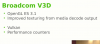
The V3D GPU OpenGL driver for Linux on the other hand was progressing very nicely when last I heard, it was nearing ability to use compute shaders in april - and a Vulkan driver is planned, so it will be able to use DXVK/D9VK/VKD3D layers eventually.
 
USB 3 data transfer rates is such a nice upgrade I never even realised was holding the Pi back. The foundation really has done a good job making it into the jack of all trades SoC
It is still limited in its codec ASIC - 4K60 HEVC is very nice, but Youtube doesn't use HEVC, it uses VP9, as do several other sources on the net.

It doesn't cripple it sure, but VP9 has been around for far too long, and is far too entrenched in the internet for such a feature to be absent.

Edit: I still can't find a source that confirms if the RPi4 SoC does 10 bit HEVC in 4K60, that's another pain point for me, 10 bit video has been around for way too long to skip such a feature.

Further edit: It's confirmed that it does 10 bit 4K60 HEVC, though the software development only covers decoding it currently - actual output over HDMI is still limited to 8 bit due to current limitations in their Linux distro from the sound of it.
Estimates seem to put it as solved (along with HDR) by the time Kodi 19 Matrix goes gold.
 
Last edited:
Back
Top