• We’re currently investigating an issue related to the forum theme and styling that is impacting page layout and visual formatting. The problem has been identified, and we are actively working on a resolution. There is no impact to user data or functionality, this is strictly a front-end display issue. We’ll post an update once the fix has been deployed. Thanks for your patience while we get this sorted.

Anyone here into autocross?

Page 2 - Seeking answers? Join the AnandTech community: where nearly half-a-million members share solutions and discuss the latest tech.
Your goal when setting the tire pressures on your car for Autocrossing should be to maximize tire grip. There is a tire PSI pressure that will give you peak grip. If you have your tires set above or below that PSI pressure you will have less than optimum grip.

If you are currently running below the optimum pressure you will increase grip as you raise tire PSI. Once you've passed the optimum point, grip will decrease as you raise PSI.

This happens because, at much less than optimum pressure, you are allowing the sidewall to come in contact with the pavement. The rubber of the sidewall is not compounded for grip, it is compounded for durability and UV resistance. Also, a sidewall that is rolling over will tend to pull the opposite side of the tread off the pavement, losing grip.

If you over inflate past the peak, you begin to balloon out the center of the tread, and it will remain ballooned out even as the sidewall rolls under cornering.

Sometimes it takes a video camera to see what your tires are doing going around a curve. For the most part overinflating your tires to the maximum inflation pressure stamped on the tire is a very good starting point.

Posting autocross questions on a mainly IT board will only get you theories from want-a-be car racers. You are best to Google Autocross Tire Recommendations and read pretty much what I pulled off their boards and posted here.

I agree with everything here except for the suggestion that the max recommended sidewall pressure is a good starting point. That is going to be way too high.

For example, my all seasons max out at 51 psi, yet anything past about 37 psi and grip is decreased.

If you seek out such things, you'll find that recommendations for "starting points" on the pressures vary depending on who you ask. I've heard people say to look at the sticker on the door jamb or the owner's manual for a good starting number, as well. I can recall having read when I first started autocrossing something similar to what you are recommending - to look at the max PSI on the sidewall. Honestly I'm not sure where that comes from as in most cases it is going to be too much.

Ideal PSI is determined by your suspension setup, the weight of the car, and the construction of the tire. If you are autocrossing a heavy Camaro then higher pressures might be advisable; Miatas rarely run above 30.

My experience has been that when I first started, I ran 40 psi for a few months before realizing that it was too much and I was sacrificing ultimate grip. Turn in was better with 40 psi and my soft, old suspension seemed to cope better, but ultimate grip was lower and times suffered as a result. Reduction to 36 psi on the recommendation of an experienced driver was a revelation.
 
I don't get why everybody wants to argue with you. You are pretty much right. I did old chalk on the side walls trick to help figure out my pressure which are higher than I normally run. Maybe the guys on all out race tires can get away with low pressure but everybody on street tires quickly learn to run higher pressures to keep off the sidewalls.


It's the internet, it's like their job to argue it seems lol.
 
I do autocross maybe once every two years, just when I about to forget the 2-3 minutes of fun is not worth standing 4+ hours in the heat for.

Go Kart is cheaper and easier on my body.

I needed more air pressure in my front tires.

FNG_2997.jpg
 
It's the internet, it's like their job to argue it seems lol.

or maybe blanket rules don't work and the answer is ultimately dependent on the tires you run.

i had bridgestone RE050A max performance summer tires in 245/40/19 and running 5psi low (30 vs 35) gave me no sidewall roll. probably could have gone lower.
 
It's a bone stock 1997 240SX. Automatic transmission. All season tires. I have lots of alibis for when I come close to last.
 
As long as you're having fun, and improving each time, that's all that matters.

Once you go down the road of trying to be competitive in any of the classes (even the stock/street ones), your wallet will get much lighter very quick.

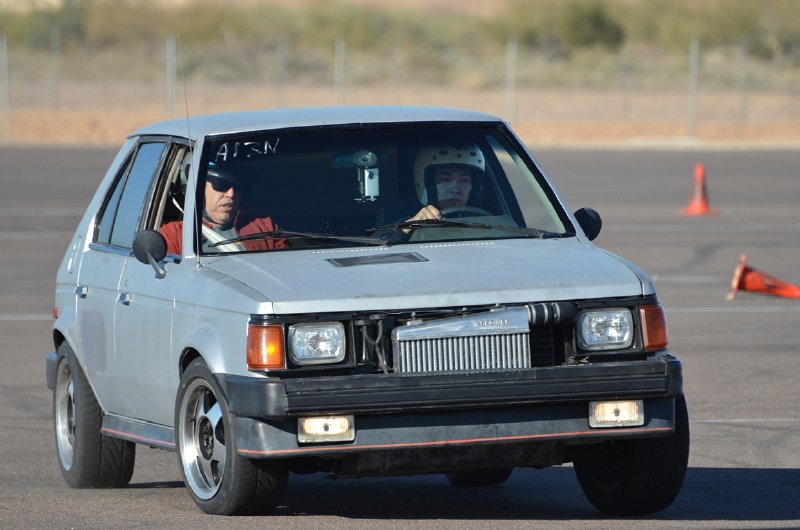
For S&Gs, here's one of my runs from last year.

https://youtu.be/Texp4k2064U
 
Last edited:
It's the internet, it's like their job to argue it seems lol.

Or some of us spent all weekend at a race track (cough) and have helpful advice.

Your goal when setting the tire pressures on your car for Autocrossing should be to maximize tire grip. There is a tire PSI pressure that will give you peak grip. If you have your tires set above or below that PSI pressure you will have less than optimum grip.

If you are currently running below the optimum pressure you will increase grip as you raise tire PSI. Once you've passed the optimum point, grip will decrease as you raise PSI.

This happens because, at much less than optimum pressure, you are allowing the sidewall to come in contact with the pavement. The rubber of the sidewall is not compounded for grip, it is compounded for durability and UV resistance. Also, a sidewall that is rolling over will tend to pull the opposite side of the tread off the pavement, losing grip.

If you over inflate past the peak, you begin to balloon out the center of the tread, and it will remain ballooned out even as the sidewall rolls under cornering.

Sometimes it takes a video camera to see what your tires are doing going around a curve. For the most part overinflating your tires to the maximum inflation pressure stamped on the tire is a very good starting point.

Posting autocross questions on a mainly IT board will only get you theories from want-a-be car racers. You are best to Google Autocross Tire Recommendations and read pretty much what I pulled off their boards and posted here.

I will never claim to be a pro, but you're a bit off base there. Some of us race. A blanket statement of "inflate to sidewall" is poor advice.

or maybe blanket rules don't work and the answer is ultimately dependent on the tires you run.

i had bridgestone RE050A max performance summer tires in 245/40/19 and running 5psi low (30 vs 35) gave me no sidewall roll. probably could have gone lower.

Bingo. My Forester XT's all seasons needed well over 40psi to keep the fronts from rolling over. Our race cars run ~34psi.
 
Back
Top