• We’re currently investigating an issue related to the forum theme and styling that is impacting page layout and visual formatting. The problem has been identified, and we are actively working on a resolution. There is no impact to user data or functionality, this is strictly a front-end display issue. We’ll post an update once the fix has been deployed. Thanks for your patience while we get this sorted.

AMD "Steamroller" - What's the deal?

So, AMD's pretty great at the whole hype machine thing. I was looking at the HotChips slides for "Steamroller" and I was thinking to myself, "gee, this looks like it could be a real improvement and it could take on Intel!"

But then I snapped out of the pretty powerpoint hype and noted the following:

- Isn't Intel already leagues ahead of AMD, and isn't Intel still feverishly spending massive amounts of $ to improve its CPUs?
- AMD is nearly out of money and just significantly cut its R&D budget/costs...
- "Steamroller" based stuff won't be out until at least 2014 (listened to Rory Read's presentation @ Credit Suisse technology conference...said that "Kabini/Temash and Trinity" would be important in 2H 2013...no mention of "Kaveri")
- Intel will be doing a ground-up design on 22nm tri-gate transistors on "Haswell"...AMD will be working with GloFo's 28nm planar transistors...

So, does it seem at all reasonable for AMD to catch up? Logically and mathematically, it seems unlikely, but could anybody outline a reasonable scenario in which AMD can actually match up with Intel? I also have to keep in mind that by the time "Kaveri" hits in 2014, Intel will be ramping freakin' Broadwell 14nm!
 
I'm sure there are people around here who will be able to see AMD pulling something amazing out of the bag but personally I doubt it will happen. As you pointed out AMD has obviously cut its R+D budget and we all know they have been laying staff off in droves.

Top that off with the fact they seem to have lost interest in competing against intel in the high end desktop market and the future doesn't look very bright.
 
SR will probably be significant upgrade to Piledriver but the problem will be it's going to compete against a significant upgrade to Core. If only AMD had an access to intel's manufacturing (alien 😀) technology the race would be somewhat closer 😉.
 
Once they discontinue all Bulldozer derivatives and start selling cpus better suited for the poor process tech they and nvidia are stuck on they might actually stand a chance in the value segment.
 
Now i'm sure, the armchair council decided the fate of AMD, another doom & gloom thread finished.

Now now dont say armchair. Many have said for years there are real tangible things that AMD could have easily done to remain competitive with intel. For example, they should have taken the 20 most common instruction combinations used by their own graphics drivers, for which they surely have a crapton of profiling data. Then they simply add logic to their core to reduce the IPC of those instructions by as much as possible. (Until they run out of transistor budget.) If they had done that one simple thing, they would have a core that blows intel away when paired with a radeon gpu. Gamers would have propelled AMD forward into heterogenous compute, GCN cores inside the cpu fpu, etc. But they never once took advantage of their vertical integration. They still have no cpu instructions which make their gpus markedly faster than say a nvidia gpu.
 
SR will probably be significant upgrade to Piledriver but the problem will be it's going to compete against a significant upgrade to Core. If only AMD had an access to intel's manufacturing (alien 😀) technology the race would be somewhat closer 😉.

I don't think AMD could afford the pricetag to develop 14nm ICs right now. Not too many companies out there can.

Look at their R&D budget now, which is already a burden too great to bare, and that is just to develop their 28nm products that have yet to be manufactured.

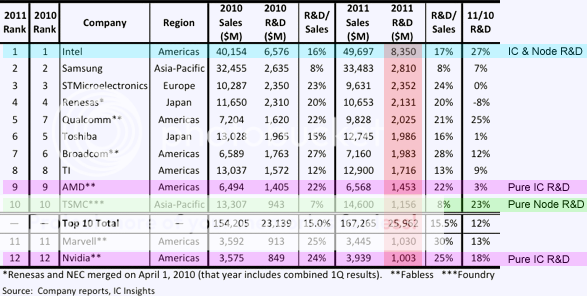
Intel's outsized R&D expenditures certainly enables them to develop better nodes and sooner, but it is really their outsized R&D for creating the IC designs themselves for those new nodes that sets them apart in the industry.

(just compare TSMC's R&D, pure node development, to Intel's and then compare NV's and AMD's R&D, pure IC development costs, to TSMC's)

RDExpenditures2011.png


Couple this with the fact AMD is saying they want to stick with nodes longer and longer going forward (as expected if IC development costs are outsizing your R&D budget) and you are not looking at an AMD that would have the wherewithal to do much with a gift like having access to Intel's fab in the first place.

AMD: We Would Like to Use Process Technologies for Longer Periods of Time.

“It is getting tougher and tougher to get to new nodes. 28nm might be with us a little longer than people [think]. [It will be a while] before they jump into 20nm node or 16nm or 14nm,” said Devinder Kumar, the corporate controller and the interim chief financial officer, at Raymond James IT supply chain conference.

^ notice that is the CFO, the accountant, not the CTO who is saying AMD wants to stick with 28nm longer than others are expecting.

If this decision were because of technological challenges then the CTO would be the one making such a comment, the fact that it is the CFO making that comment tells you why AMD won't be producing finfet-anything any time soon from any foundry (even if the foundry node is available).

Access to Intel's nodes and fabs would be like giving a homeless person a brand new home only to then watch the homeless person have no choice but to sell the home just to pay the gift taxes to the IRS (they'll want their 15-20% of the home's value).

Give AMD access to Intel's 14nm, they still wouldn't be able to afford the R&D costs to design the chips anyways (not that GloFo would let them if they could).
 
AMD's best chance of success is in their Jaguar and Trinity APUs for the time being. Personally I think the Jaguar cores are, by far, the most exciting tech they have, and I'm hoping that like Intel's did with their Core design, AMD will return to their roots and ditch the Bulldozer architecture. That would also allow them to focus their R&D into a single CPU architecture rather than splitting it into two major ones.

I also think that AMD needs to focus on integrating their latest GPU architecture into their APUs rather than being several generations behind all the time, but that's far easier said than done.

If AMD can win some contacts with their Jaguar designs, then I think they'll have a good, healthy new source of cash by providing a powerful, cheap Haswell alternative.
 
AMD's best chance of success is in their Jaguar and Trinity APUs for the time being. Personally I think the Jaguar cores are, by far, the most exciting tech they have, and I'm hoping that like Intel's did with their Core design, AMD will return to their roots and ditch the Bulldozer architecture. That would also allow them to focus their R&D into a single CPU architecture rather than splitting it into two major ones.

I also think that AMD needs to focus on integrating their latest GPU architecture into their APUs rather than being several generations behind all the time, but that's far easier said than done.

If AMD can win some contacts with their Jaguar designs, then I think they'll have a good, healthy new source of cash by providing a powerful, cheap Haswell alternative.

That bolded part is actually easy. However its an internal conflict of interests inside AMD.

AMD had great success with their Brazos platform. As we can also see in their sales. But they simply dropped the ball there again. Cancelled the 28nm version and focused on Bulldozer uarch. AMD just wont accept their proper place so to say.
 
AMD had great success with their Brazos platform. As we can also see in their sales. But they simply dropped the ball there again. Cancelled the 28nm version and focused on Bulldozer uarch. AMD just wont accept their proper place so to say.

Apparently that was more due to delays in Global Foundries' 28nm low power process- by the time that Wichita would have launched, it would have a very limited time window before they wanted to start shipping Jaguar. As such they ditched the die shrink and put resources into the next gen.
 
@IDC

That's why I said "if only.." . We all know it ain't gonna happen due to sheer money needed. And intel will probably going to see their fabs being more underutilized and less ROI as they invest more and more money into ever challenging shrinking process while market is slowly shifting away from desktop PCs and notebooks to mobile phones and tablets. That's why they are looking to become more like a foundry business model, fabbing chips for others to fill the fab capacities in the future.
 
VIA has what... 1/1000th the revenue of x86 CPUs compared to AMD?

I think you missed the point...

The claim was no different than the claim you make now (Since the revenue difference for AMD and VIA is around 1/40.). But the result is still the same.
 
Last edited:
I think amd is eventually going to give up and go in another direction. They can't compete with Intel when they are at such a disadvantage in terms of process technology. I hope they can make some money on smartphone CPUs or something so that they can make another run at Intel in a few years with a proper r&d budget.
 
Unfortunately AMD is years behind developing an ARM based smartphone platform capable of competing in the marketplace. It took Nvidia 3 architectural generations to actually get a decent foot in the door with their Tegra 3, and I'd rate Nvidia's overall management and execution to be far superior to that of AMD's.
 
VIA is a good case study for AMD;

they certainly had deep pockets behind them (formosa plastics group);

Wen Chi Chen does know the PC business having been in it for 20+ years (was co founder of Symphony Labs).

Yet, they never achieved anything serious and were not taken seriously either.

This is what will happen to AMD (and SR), IMO. Eerily similar situation.

Money doesn't buy you love; and apparently, it doesnt buy you a good x86 processor either.

ps - because there is no doubt AMD will end up being taken over by GF; they will continue to lose money/bleed cash and they won't be able to meet their $1.1B purchase commit to GF.
 
Last edited:
Meh,have been more hyped lately when my woman can make her puppies crap and piss on the designated puppy pads then anything new amd can possibly offer cpu wise to the table.

After bulldozer and the energy i spent hoping it would be a sweet alternative,yeah that's alright.

Do hope it can offer something still but personally being hyped about the puppies crapping on the puppy pads makes more sense.🙂
 
I don't think AMD could afford the pricetag to develop 14nm ICs right now. Not too many companies out there can.

Look at their R&D budget now, which is already a burden too great to bare, and that is just to develop their 28nm products that have yet to be manufactured.

Intel's outsized R&D expenditures certainly enables them to develop better nodes and sooner, but it is really their outsized R&D for creating the IC designs themselves for those new nodes that sets them apart in the industry.

(just compare TSMC's R&D, pure node development, to Intel's and then compare NV's and AMD's R&D, pure IC development costs, to TSMC's)

RDExpenditures2011.png


Couple this with the fact AMD is saying they want to stick with nodes longer and longer going forward (as expected if IC development costs are outsizing your R&D budget) and you are not looking at an AMD that would have the wherewithal to do much with a gift like having access to Intel's fab in the first place.


^ notice that is the CFO, the accountant, not the CTO who is saying AMD wants to stick with 28nm longer than others are expecting.

If this decision were because of technological challenges then the CTO would be the one making such a comment, the fact that it is the CFO making that comment tells you why AMD won't be producing finfet-anything any time soon from any foundry (even if the foundry node is available).

Access to Intel's nodes and fabs would be like giving a homeless person a brand new home only to then watch the homeless person have no choice but to sell the home just to pay the gift taxes to the IRS (they'll want their 15-20% of the home's value).

Give AMD access to Intel's 14nm, they still wouldn't be able to afford the R&D costs to design the chips anyways (not that GloFo would let them if they could).

Great post.

I would also add that Intel would do itself a favour by admitting that their bloated capex is a direct result of the increasing cost of new process nodes and that profits will be impacted during this time of double inflection points (tablet/smartphone and exponential cost of new process nodes).
 
Back
Top