
• We’re currently investigating an issue related to the forum theme and styling that is impacting page layout and visual formatting. The problem has been identified, and we are actively working on a resolution. There is no impact to user data or functionality, this is strictly a front-end display issue. We’ll post an update once the fix has been deployed. Thanks for your patience while we get this sorted.

Question AMD EPYC 7702 CPI

Prophecy1

Member
Ive been tasked with a proposal to find the CPU GIGAFLOPS of a AMD EPYC 7702 Processor. I understand that many people dont consider the gigaflops an accurate measurement of a CPU's performance, however we are required to provide the gigaflops.
Does anyone know how to find the CPI or instructions per cycle of a processor?

I have found this formula to determine the gigaflops of a CPU, however I a m missing a variable the IPC or instructs per cycle. INTEL provides this information however AMD does not.

performance in GFlops = (CPU speed in GHz) x (number of CPU cores) x (CPU instruction per cycle) x (number of CPUs per node
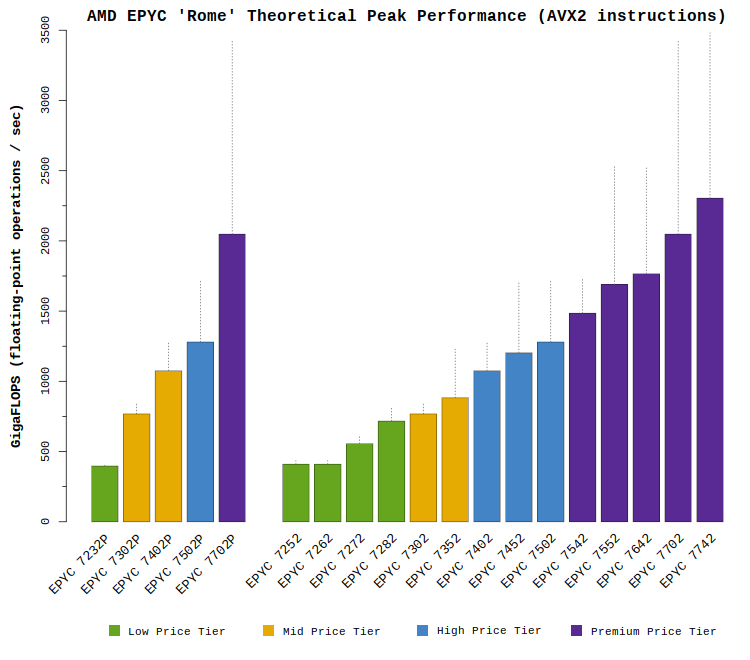
 
Here you go. Note that caveats that this is theoretical peak and what instruction they are using for their calculation, but this is what the advertised GFLOP ratings for 2nd gen Epycs are.

 
Here you go. Note that caveats that this is theoretical peak and what instruction they are using for their calculation, but this is what the advertised GFLOP ratings for 2nd gen Epycs are.


Thanks for posting that. What I was trying to figure out was the formula to be exact. However there may be a more updated Formula.

Thanks again. Was trying to get the break down of how to get the 2124
 
Thanks for posting that. What I was trying to figure out was the formula to be exact. However there may be a more updated Formula.

Thanks again. Was trying to get the break down of how to get the 2124

The formula with CPI isn't wrong, but it's a more general formula that depends on the actual instructions you are trying to execute. So, when people talk about FLOPS, they are usually referring to peak FLOPS which means we look at how many floating point operations per cycle each core can handle. Also, unless otherwise stated, usually FLOPS refers to double precision (64 bit) operations.

FLOPS = Number of cores * Frequency * peak floating point ops per cycle

For 7702 that is 64 * 2G (base frequency) * 16

How many floating point ops per cycle a core can execute will depend on how many SIMD units the core has and how it can be utilized for the preferred precision (16 bit, 32 bit, 64 bit, etc.).
 
Back
Top