Finally got around to setup the IB and testing things.
I am using 4.5ghz @ 1.265 vcore and it is hitting 105 max but stable so far with linx and some games.
Is this temperature too high?
I am using the good old Gemin II for cooling.
(had to hammer it to fit an itx board but thats another thread

)
That sounds about right for a stock CPU TIM type situation combined with that cooler.
For reference, my 3770k ran 4.5GHz @ 82°C with an NH-D14 (NT-H1 TIM) and 78°C with an H100 (NT-H1 TIM).
Because the peak temps were much lower than yours, the Vcc needed for stable operation was also lower, coming in at 1.182V.
For comparison, before delidding, if I bumped up my voltage to 1.296V (comparable to yours) then I could hit 4.7GHz LinX stable while the temperatures peaked right around 100°C.
Running at TJmax means your chip is throttling. It doesn't get any higher than 105°C. Running at 104°C means no throttle, hitting 105°C means throttling is happening.
Throttling is not bad for your chip, that is why TJMax is 105°C instead of 100°C or 80°C...your chip was designed to operate at temperature up to TJmax for its intended lifespan.
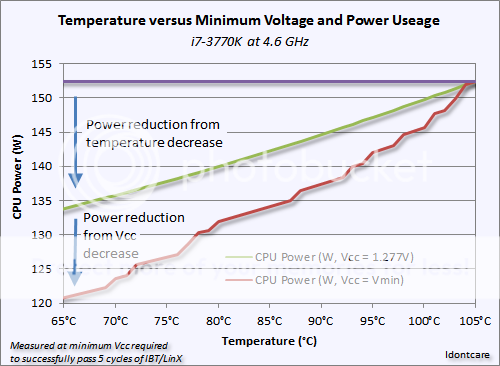
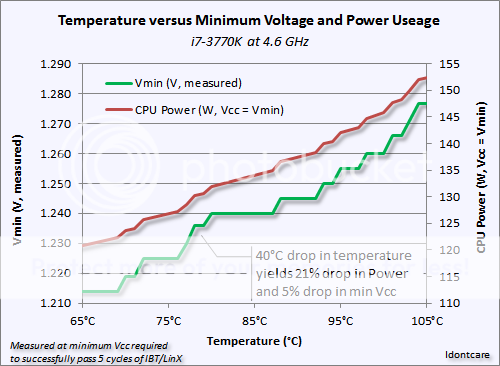
The reason we try to reduce operating temperatures is so we can reduce power-consumption (static leakage) and so we can reduce the voltage needed for stable OC'ing.
^ reducing temperature lowers the power consumption (purple to the green line) even if we leave the voltage the same.
But by lowering the temperature we also lower the required voltage for the CPU to be stable. Lowering that voltage (dark green line below) while maintaining stability results in even lower temperatures (red line in both graphs).
Lowering your power-consumption lowers your electricity bill.
If you pay 11.5 cents per KWHr, lowering your power consumption by
1W saves you $1 over the course of a year.
If you invest upfront in buying a decent HSF you can actually recoup your investment in the span of a year or two if you reduce your temperatures and optimize your voltage, saving 20W or 30W in the process (and $20 or $30 over the course of the year, depending on how loaded you keep your rig and how much you actually pay per KWHr).







 Facebook
 Twitter