• We’re currently investigating an issue related to the forum theme and styling that is impacting page layout and visual formatting. The problem has been identified, and we are actively working on a resolution. There is no impact to user data or functionality, this is strictly a front-end display issue. We’ll post an update once the fix has been deployed. Thanks for your patience while we get this sorted.

Question 1st time custom loop - Advice appreciated

Hulk

Diamond Member
I do a lot of DAW work and need a silent rig, plus I looking for a winter project. This is my first time building a custom loop.

The case will be the Corsair 2500x. CPU currently is a 9950X.

Here's what I'm thinking:

Alphacool Core 1 water block
Corsair XD6 pump reservior
2x Alphacool NexXxos XT45 radiators

Not sure if I'm going hard or soft tubing. I know soft is easier to work with and flows better but hard looks cool and I'm experienced with plumbing so not worried about bending and fitting tubes.

The plan is lots of low headloss radiator area and low speed fans to provide a lot of thermal headroom so fans don't ramp up.

Any advice appreciated.
 
need a silent rig
Getting big radiators, such that the fans can remain at low speed, is the easy part of that. The difficult part is to deal with pump noise, IMO. I haven't found a silver bullet for that myself yet. (Maybe it's just a matter of soft suspension, or maybe there is more to it...?)
 
Getting big radiators, such that the fans can remain at low speed, is the easy part of that. The difficult part is to deal with pump noise, IMO. I haven't found a silver bullet for that myself yet. (Maybe it's just a matter of soft suspension, or maybe there is more to it...?)
Waiting on the pump/reservoir and water block. From what I've read the VPP Apex pump is quieter than a D5. I'm hoping to be able to run at very low speeds. I'll let you know how it goes once I get it up and running.
 
sorry im late to the party, thanksgiving crush had me.

Your parts look solid. Can i ask why your adding such a large amount of rads just to cool your cpu?
Do you intend to add a gpu later?

Hard piping is at best, time consuming.
Dental floss will be your best friend, and no im not kidding.
That is what i used to messure the length required after each section, so i knew exactly how long of a pipe i need.

Bending requires you to get a special gun which u can control heat output otherwise u will burn though rigid piping from melting it and causing it to bubble.

I honestly think you can achieve what you want with a single 360mm UT60 if its only the cpu.
 
sorry im late to the party, thanksgiving crush had me.

Your parts look solid. Can i ask why your adding such a large amount of rads just to cool your cpu?
Do you intend to add a gpu later?

Hard piping is at best, time consuming.
Dental floss will be your best friend, and no im not kidding.
That is what i used to messure the length required after each section, so i knew exactly how long of a pipe i need.

Bending requires you to get a special gun which u can control heat output otherwise u will burn though rigid piping from melting it and causing it to bubble.

I honestly think you can achieve what you want with a single 360mm UT60 if its only the cpu.
I do a lot of audio/DAW work and am looking for a lot of radiator area to achieve really low fan speeds for a quiet rig. Just waiting on the pump/reservoir and water block, which should be arriving this week.
Going with soft tubing since this is my first try at a custom loop.
Appreciate the comments.
 
I can tell you from experience that the pumps+fans are actually typically louder than just good old air cooling if all you are doing is just cooling for the CPU. The real benefit in sound level would be GPU cooling. For just a CPU, even the 9950X, you can easily get a NH-D15 G2 and only hit 24.8 dBA for the cooling the CPU. The XD6 pump is 35.5 dBA at 50% speed and 48 dBA at 100%, and you still need to factor in the sound output of the fans on the radiators on top of that pump noise.
 
I can tell you from experience that the pumps+fans are actually typically louder than just good old air cooling if all you are doing is just cooling for the CPU. The real benefit in sound level would be GPU cooling. For just a CPU, even the 9950X, you can easily get a NH-D15 G2 and only hit 24.8 dBA for the cooling the CPU. The XD6 pump is 35.5 dBA at 50% speed and 48 dBA at 100%, and you still need to factor in the sound output of the fans on the radiators on top of that pump noise.
Thanks for the comment. I've used a D15, Assassin, various AIO's, etc.. All of the air coolers spin up like mad under load. Water at least as some good thermal capacity so you can get through the "bursty" loads without spinning up fans.
But we shall see once I get all the parts in!
It's as much curiousity as the quest for performance. I've built all kind of rigs over the years going all the way back to an overclocked Celeron 400A. Never done a custom loop.
 
I can tell you from experience that the pumps+fans are actually typically louder than just good old air cooling if all you are doing is just cooling for the CPU. The real benefit in sound level would be GPU cooling. For just a CPU, even the 9950X, you can easily get a NH-D15 G2 and only hit 24.8 dBA for the cooling the CPU. The XD6 pump is 35.5 dBA at 50% speed and 48 dBA at 100%, and you still need to factor in the sound output of the fans on the radiators on top of that pump noise.
But you need case fans even if you are using air cooling. My rad fans are my case fans.
 
Well the thing is if he has that much cooling capacity, nothing will run at 100%..
In fact he could probably almost run the radiator passively, i doubt with that much area of coverage, he wouldnt need the fans faster then 900-1100 RPMs TOPS, under full load.

Where As if he had a D15 under 15-20 min of full load, that fan would be screaming.

What CPU are you cooling?
 
Well the thing is if he has that much cooling capacity, nothing will run at 100%..
In fact he could probably almost run the radiator passively, i doubt with that much area of coverage, he wouldnt need the fans faster then 900-1100 RPMs TOPS, under full load.

Where As if he had a D15 under 15-20 min of full load, that fan would be screaming.

What CPU are you cooling?
9950X

Yes, the plan is to have so much radiator area very low fan speeds are required. Also I did some research to find rads that are designed to work optimally at 800rpm fan speed.

It's all theory at this point. I'll know soon how it all works soon.

I'm hoping to run the Alphacool Apex pump at like 50% as you mentioned, where I'm reading it is basically silent and much quieter than a D5.
 
if he had a D15 under 15-20 min of full load, that fan would be screaming.
For 200 W, a D15's fans only need to be wooshing, not screaming. :-)
Doesn't matter if 15 minutes or 15 months of full load.

I've used a D15, Assassin, various AIO's, etc.. All of the air coolers spin up like mad under load.
They wouldn't have to if we had better instrumentation, e.g. if fan speed was controlled by socket power draw, not by core hotspot temperature.

But you need case fans even if you are using air cooling. My rad fans are my case fans.
FWIW, my watercooled builds are arranged such that the radiator fans are case fans too.¹ In particular, exhaust fans, not inlet fans. I don't want pre-warmed air to "cool" the rest of the system. But because air moves only slowly through the suitably large radiator surfaces, I have one or two additional internal fans (typically 80 or 92 mm fans) which push air on to memory/ VRMs/ other stuff which would get hot otherwise. Not much air flow needed there, just avoidance of dead air pockets.

________
¹) except for one build with external radiator
 
For 200 W, a D15's fans only need to be wooshing, not screaming. :-)
Doesn't matter if 15 minutes or 15 months of full load.


They wouldn't have to if we had better instrumentation, e.g. if fan speed was controlled by socket power draw, not by core hotspot temperature.


FWIW, my watercooled builds are arranged such that the radiator fans are case fans too.¹ In particular, exhaust fans, not inlet fans. I don't want pre-warmed air to "cool" the rest of the system. But because air moves only slowly through the suitably large radiator surfaces, I have one or two additional internal fans (typically 80 or 92 mm fans) which push air on to memory/ VRMs/ other stuff which would get hot otherwise. Not much air flow needed there, just avoidance of dead air pockets.

________
¹) except for one build with external radiator
All valid points.
 
well 9950 TDP is 170, with PBO: ~ 220W.

Your radiator capacity for 2x360mm = 150W x 6 ~ 900W capacity @ 1gpm @ 1300RPM fans to hold a 3-4C Delta (Coolant temp - Ambient temp)

So just doing basic math... a d5 @ 50% is about .6gpm (rough estimate) and fans at 900RPM... at worst your heat capacity would be like 400W @ 3-4C Delta in your system.... which puts you way into over kill range still.

Meaning my estimate in you being able to run those rads in almost passive still holds.. I think you might even try running only 2 fans on each 360 for a total of 4 fans, and not run all 6 if noise is primary.

You still need fans tho, as those rads are not designed for passive.


Oh i just noticed the block you listed.

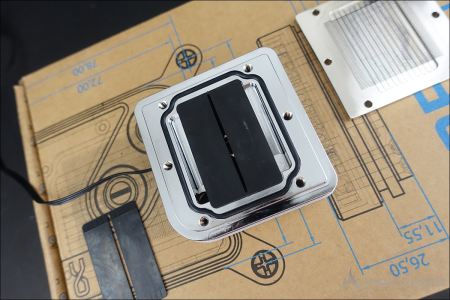
Ummm... that has a narrow injector plate, which means its designed for head pressure.
They don't perform great in a low head pressure enviorment, because you need that head pressure to cause increased turbulence to pull heat away.

This is what im talking about:
1764725348119.png

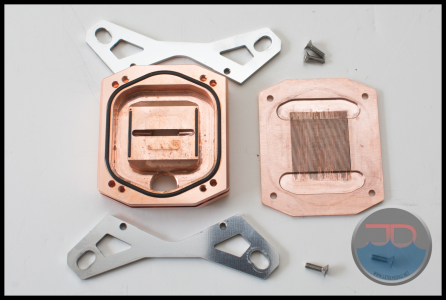
A Watercool Heatkiller IV might be a better cpu block for low headpressure because it has a wider return path.
1764725737231.png


The EK Quantium also has a injector, but its wider, to allow a lower pressure though the injector plate, that also might be a better block for lower head pressure.

But also im not too sure if those two blocks were optimized for the a 9950X with its larger die.
But just giving you some options in cpu blocks.

Ideally you want something without an injector plate, but not a lot of vendors will do that, because that injector plate is a cheat that scales better with more head pressure, so they intend you to run the pump at near 100% under PWM settings for increased head pressure and flow, and then run quiet when the cpu is near idle.
 
Last edited:
well 9950 TDP is 170, with PBO: ~ 220W.

Your radiator capacity for 2x360mm = 150W x 6 ~ 900W capacity @ 1gpm @ 1300RPM fans to hold a 3-4C Delta (Coolant temp - Ambient temp)

So just doing basic math... a d5 @ 50% is about .6gpm (rough estimate) and fans at 900RPM... at worst your heat capacity would be like 400W @ 3-4C Delta in your system.... which puts you way into over kill range still.

Meaning my estimate in you being able to run those rads in almost passive still holds.. I think you might even try running only 2 fans on each 360 for a total of 4 fans, and not run all 6 if noise is primary.

You still need fans tho, as those rads are not designed for passive.


Oh i just noticed the block you listed.

Ummm... that has a narrow injector plate, which means its designed for head pressure.
They don't perform great in a low head pressure enviorment, because you need that head pressure to cause increased turbulence to pull heat away.

This is what im talking about:
View attachment 134701

A Watercool Heatkiller IV might be a better cpu block for low headpressure because it has a wider return path.
View attachment 134702


The EK Quantium also has a injector, but its wider, to allow a lower pressure though the injector plate, that also might be a better block for lower head pressure.

But also im not too sure if those two blocks were optimized for the a 9950X with its larger die.
But just giving you some options in cpu blocks.

Ideally you want something without an injector plate, but not a lot of vendors will do that, because that injector plate is a cheat that scales better with more head pressure, so they intend you to run the pump at near 100% under PWM settings for increased head pressure and flow, and then run quiet when the cpu is near idle.
Great information. Thanks so much for taking the time to post.

I picked the Core 1 primarily based on this review. I was looking for something under 1psi with good thermal performance but had not idea about the technical aspects you mentioned.

 
9950 TDP is 170, with PBO: ~ 220W.
If sustained loads are planned, the PPT Limit is more pertinent. For Ryzen 9950X that's 200 W by default.

[...] my estimate in you being able to run those rads in almost passive still holds.. I think you might even try running only 2 fans on each 360 for a total of 4 fans, and not run all 6 if noise is primary.

You still need fans tho, as those rads are not designed for passive.
Yep, passive radiators need unusually wide fin spacing. — Several years ago, I used an external MORA 360 passively, but by accident. The cable which powered the fans had become unseated, and I noticed this only hours later. It was in August, in Germany, without air conditioning in the apartment. The MORA had to cool three GTX 1080 (correction: three 1080Ti) running SETI@Home, and a Broadwell-E or -EP which drove the GPUs. I was amazed to find that the GTXs did not even run into thermal throttling while the MORA fans were off.
 
Last edited:
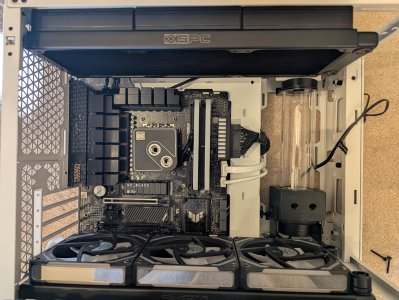
Finally got all of the parts in and I'm starting to figure this out.
What would you suggest for flow path for this set up?
I am using soft tubing and have some 45's and 90's on hand if needed.
Thanks for any advice. As you know this is my first time.

PXL_20251212_161830696.jpg
 
The reservoir should feed into the pump. The purpose is to protect the pump from air bubbles. Especially during the process of filling the loop with water before it goes into operation. (Reservoir-pump-combos such as yours should already be built exactly this way.)

Personally, I also like to have a radiator upstream of reservoir+pump. The purpose of that is to have low water temperature in the pump, for longevity of the pump. However, with proper water flow rate, water temperature deltas within a loop should be rather low, making this consideration less important. (But as one of your goals is to minimize pump speed in order to minimize noise, it's certainly a good idea to have one if not both radiators upstream of the reservoir, not the CPU cooler.)

Edit:
I built all my loops in a way that allows me to easily get to the top of the reservoir, in order to fill the loop, to add water later, as well as to empty the loop. (The last could be done at other places of the loop too, but I prefer to do it via reservoir with its lid taken off.) In loops which have a reservoir-pump combo, I arrange for the opportunity to pull the combo out of the computer. Likewise, in my loops in which the reservoir is separate from the pump, I can very easily move the reservoir out of the computer. (All my loops have flexible tubing, and I made the crucial tube segments long enough for the purpose of moving the reservoir or reservoir-pump as freely as I need to at the mentioned occasions.) — IOW, I have a habit of using the lid of the reservoir as fill port and as drain port. Other people people have dedicated ports for that; dedicated fill and drain ports are basically a must have in case of hard tubing.)
 
Last edited:
Let me preface this by saying I've never done any water-cooling. I've only watched other people do it.

I'd go out of the pump into the lower rad, out to the GPU, out to the top rad, out to the CPU, back into the reservoir.

The liquid gets cooled before going into each component.
 
The liquid gets cooled before going into each component.

lol... that is the common mistake in what people think of the laws of fluid dynamics.

So temperature tries to go equalibirum, unless you got a stupidly massive heat load (a 5090 in SLI is an example bascially greater then 350W), and little flow (less then .25gpm).
Flow is also uniform in a loop.
The only thing that isn't uniform is head pressure, as it will drop at each restriction, to keep flow uniform.

So what does that mean?

Basically you always make the loop the shortest possible. The higher flow you have, the more uniform the system will become in temperature wise, as it increase the heat capacity of water.

And res is always feeding the pump for reasons stefan stated, to protect the pump from ever running dry and burning out the impeller housing.

The purpose of that is to have low water temperature in the pump,

I was thinking you would know the answer to this.... lol.


So let me explain how heat transfer works in a LCS.
Heat Mol. is released at the radiator, but its not that significant to the point where u will get a massive temp gradient in the closed system.

Thermodynamics states, increased flow means increased heat capacity of water.
What does this mean?
It means 1.5gpm of flow, water will transport 350W of heat from one source to another, but its not like how you think of moving heat from A->B.
Its more like your stiring a pot, and trying to keep the temperature of the coolant in the system uniform as possible. This is why you want the shortest route possible. The Temp from Rad inlet to Rad outlet should not be more then 1-2C unless you have a poor radiator, or Poor flow, allowing the coolant to pool at the radiator. 1-2C at the waterblock side is not significant for you to plan around that way, hence.. ALWAYS the shortest loop possible with the exception of Res always before pump.

The only time it doesn't work this way is if you have too much heat... more then what the capacity of water is able to move, or your flow is really bad allowing the hot water to pool at that location.

So the notion of b4 radiator plays very little role if any in a well designed system, as your trying to keep the flow at or above .75-1.5gpm.


Here is some more info:


But honestly, this was when watercooling was still pioneering, and we were after the absolute performance.

I tell people now, do it how you want to do it. And dont worry too much about order. Try to make it as clean as possible, and as short as possible, as its always the most eye candy approach, along with what will most likely make you happy.
 
Last edited:
Appreciate all of the advice. As advised I went for the shortest possible tubing configuration while not needing any small tube radius bends for fear or kinking. I used a couple 45's. 90's can be quite restrictive.

So far so good. Fans at 800rpm and pump at about 2800rpm, pretty much dead silent and temps very good after 10 minutes of CB R23.

It was fun putting it together actually. I've done a lot of plumbing in the various houses I've owned over the years, from copper, to cpvc, and pex so it was pretty straightforward. Now for some cable management, get all the LED's set up.
 
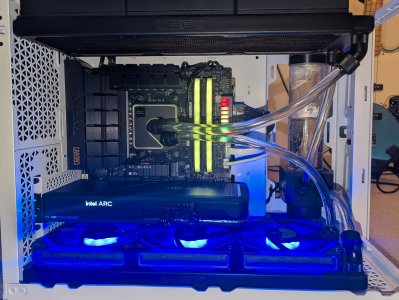
Okay, pretty much finished. Can't seem to get the reservoir led's working but I'm almost positive it's an RMA fix. Great, drain the loop already...

Anyway, rad fans at 550rpm (top), 800rpm (bot) and pump at 2600rpm is pretty much silent. 10 minute CB R23 MT shows a max tctl/tdie temp of 80.1C.

I'm happy with that result and scratched the custom loop itch.

Thanks for the help.

PXL_20251213_024404281.jpg
 
[maintain a decent flow rate = maintain a decent heat transfer]
This is why you want the shortest route possible.
Not exactly. For this, you want to avoid too much *resistance*. (It is not about reaching an absolute minimum of resistance though. It still is about reaching a compromise, as resistance can't be very well minimized in cooler designs.) *Length* of the loop per se does not add much resistance. People have placed external radiators in a separate room, or even at a different storey of their house.

Try to make it as clean as possible,
I concur in the sense of avoiding any dirt within the loop.
Edit: Also in the sense of cleanly laid out in order to not obstruct anything that should be kept in reach for maintenance or upgrades, e.g. any important connectors on the mainboard.

its always the most eye candy approach,
I for one have never built an LCS for looks, always only for utility = in systems in which air cooling was not practical. (Two classes of systems: Either ones in which there was just not enough space to strap large enough air coolers onto each relevant heat source = multi GPU without PCIe cables, or one for which a suitably large air cooler just does not exist = socket SP5, if put into a living room instead of a datacenter.)

What's there to LOL? The opening post says that low noise is at the very top of consideration. This means to make a compromise WRT flow rate. (Although with just one cooler as main source of flow resistance in this particular loop, it is not hard to maintain good flow rate even at reduced pump noise.)

Edit 2: I do admit that my view on LCSs is rather narrow. Those which I built had/have the purpose to transfer 400...1200 W (depending on the system) sustained, and unsupervised. I never thought deeply about requirements of LCSs for different purposes than these.
 
Last edited:
I had some time today to investigate the performance of the loop a bit more today.

While the custom loop was pricey, this is a hobby or sorts for me and the performance is everything I expected. It is basically silent all the way to max power of 200W and temps are generally maxing out at 80C.

Also, longer term high load testing, Handbrake x265 really heats things up, shows that increasing fan speed has little to no effect on temps, while pump speed does. This makes sense because I have quite a bit of radiator area, meaning coolant temps aren't really rising. But, increasing the flowrate over the CPU has the effect of increasing the temperature difference between the coolant and the cpu (coolant has less time to heat up) ,the result is increases heat transfer.

Anyway, was it worth it? Would I do it again? Absolutely! That Handbrake test I mentioned above would smash my AIO and push the CPU into thermal throttling in like 10 seconds. Now temps stay low and there is no fan or pump noise. It's great.

I have so much thermal headroom I'm tempted to push the power up a bit...
 
Looks like I have to RMA the Alphacool 200 Reservoir. Draining the loop a lot sooner than I planned.

I'm doing some video work right now that generally smashes the CPU. I'm using Magix Vegas Pro 21 and rendering out a video using x264 (for compatibility purposes) using the CPU heavy Vokouder. Normall this would push the fans to max and get the CPU to 100C.

Encode just finished and max Tdie/Tctl show 86.6C. The average temp was quite a bit lower because as you know this is the hottest sensor on the die and it jumps around quite a bit. The fact that the loop was able to control it with fans running 600/800rpm is quite amazing. It's kind of erie. I press render and I'm so used to the fans spinning up and seeing the red "thermal throttling" font in HWinfo. But now it just remains silent and the temps are managed.

While this was expensive and definitely a luxury the performance and control is really great. I finally figured out how much I spent in total and it was about $600 for the two rads, waterblock, pump/reservoir, fittings, tubing and coolant. Based on what I was reading online I was expecting it to go higher. I mean is the "value" there compared to my old Arctic 280 that was $90? Absolutely not. I could have simply dialed the max power back to 125W and had the same acoustic performance I have now and probably would have only lost 20% or so performance.

But we're enthusiasts right?
 
Back
Top